Design of CT with ferrite core for reverse operation of CT

Click For Summary
The discussion centers on coupling noise into a CAT5 data cable using a ferrite core current transformer (CT) for reverse operation. The user achieved a maximum induced voltage of 380mV but needs at least 1V. Suggestions include increasing the number of turns on the ferrite core, with the voltage being influenced by the turns ratio and the absence of a common ground affecting the transformer’s operation mode. The transformer behaves as a voltage transformer without an external return path, leading to a reduced induced voltage proportional to the signal generator's output. Clarification on the complete circuit and termination points is necessary for accurate assessment and recommendations.
Nikhil N
Messages
80
Reaction score
2
I have to couple noise into data cable(cat5) in common mode. I have done this with a CT of 50A/1A, ferrite core. What I have done is, I connected the S1 and S2 of CT to probe of my signal generator and inserted the cable through the whole of CT(ring type). I got maximum of 380mV in the cable ends when only the signal from signal generator fed no data is transferring. But I have to couple atleast 1V to the cable. I want to know how can increase this, whether should I increase the turns on the ferrite core or any other method ? If I should increase the no of turns, how to calculate the no of turns and the wire specifications? (I used 200KHz, 10Vpp AC signal)
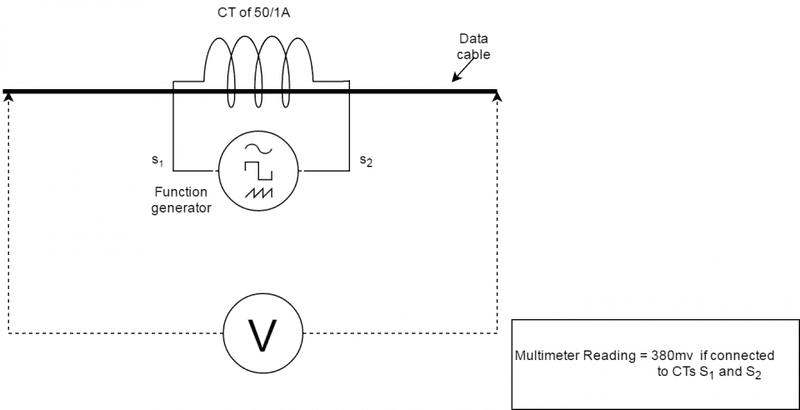
ct_testing_0.png
 
Engineering news on Phys.org
The transformer will behave like a voltage transformer if there is no return path external to the transformer. The signal generator voltage will be reduced by the turns ratio of the transformer.

If there is a separate conduction path, (such as a common ground), between the ends of the cable, the transformer will behave like a current transformer. As a CT, the voltage on the cable will be equal to the product of the induced current and the external return resistance. V = I * R

You have not identified the complete circuit of the cable terminations so we cannot identify the transformer mode of operation.
 
Baluncore said:
The transformer will behave like a voltage transformer if there is no return path external to the transformer. The signal generator voltage will be reduced by the turns ratio of the transformer.

If there is a separate conduction path, (such as a common ground), between the ends of the cable, the transformer will behave like a current transformer. As a CT, the voltage on the cable will be equal to the product of the induced current and the external return resistance. V = I * R

You have not identified the complete circuit of the cable terminations so we cannot identify the transformer mode of operation.
For my device to which I am connecting the wires, doesn't have a common ground line...
 
Nikhil N said:
For my device to which I am connecting the wires, doesn't have a common ground line...
Then, as there is no alternative current path, the transformer is operating as a voltage transformer.
The induced voltage in the cable will be 1/10 of the loaded signal generator voltage. 380 mV induced on the cable suggests signal generator voltage when driving the 10 turn winding will be about 3.8 V. You can check that with a multimeter.

Without an external conduction path, what do you think you are testing ?
 
I am trying to understand how transferring electric from the powerplant to my house is more effective using high voltage. The suggested explanation that the current is equal to the power supply divided by the voltage, and hence higher voltage leads to lower current and as a result to a lower power loss on the conductives is very confusing me. I know that the current is determined by the voltage and the resistance, and not by a power capability - which defines a limit to the allowable...

Similar threads

  • · Replies 9 ·
Replies
9
Views
2K
  • · Replies 2 ·
Replies
2
Views
2K
  • · Replies 36 ·
2
Replies
36
Views
12K
Replies
10
Views
9K
  • · Replies 1 ·
Replies
1
Views
3K
  • · Replies 6 ·
Replies
6
Views
2K
Replies
11
Views
2K
  • · Replies 3 ·
Replies
3
Views
35K
  • · Replies 21 ·
Replies
21
Views
2K
  • · Replies 7 ·
Replies
7
Views
3K