Designing a Reclining Binocular Chair: Ideas and Techniques

  • Thread starter Thread starter Saladsamurai
  • Start date Start date
  • Tags Tags
    Building Ideas
Click For Summary
SUMMARY

The forum discussion centers around designing a reclining binocular chair with a focus on mechanisms for controlled reclining and rotation. Users propose various solutions, including a hand-crank spiral jack for slow height adjustment and the use of a screw jack for smooth reclining motion. Electric motors from car seats are suggested for ease of use, while others recommend using bicycle cranks for hands-free operation. The conversation emphasizes the importance of portability and simplicity in the design, with multiple users sharing ideas and potential components.

PREREQUISITES
  • Understanding of mechanical design principles
  • Familiarity with screw jack mechanisms
  • Basic knowledge of electric motor systems
  • Experience with DIY furniture construction
NEXT STEPS
  • Research screw jack mechanisms for controlled motion
  • Explore electric motor options from automotive seats
  • Investigate bicycle crank systems for mechanical operation
  • Look into portable chair designs and materials for lightweight construction
USEFUL FOR

DIY enthusiasts, furniture designers, and hobbyists interested in mechanical engineering and custom furniture projects.

Saladsamurai
Messages
3,009
Reaction score
7
Okay so completed a similar project the other day,but I am addicted now.

I built a parallelogram binocular mount similar to this.
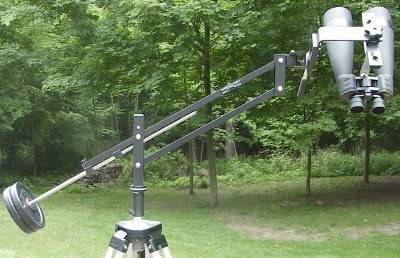
bino.jpg


Now I am trying to come up with ideas for a binocular chair...like this
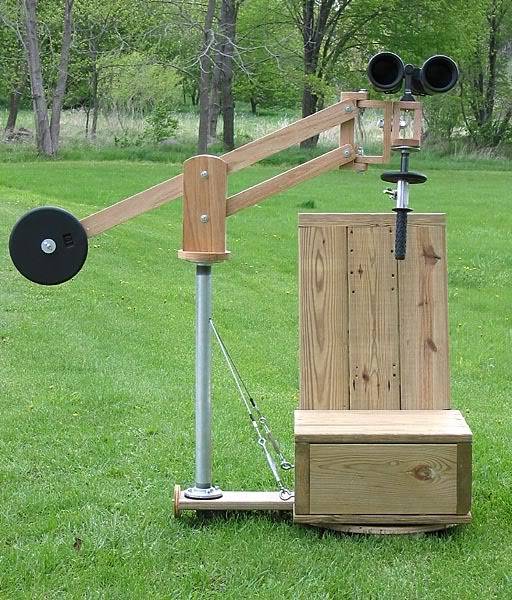
BinoChairPortrait.jpg
I would like to make the chair recline though. This is where I need help. I need to make it so goes up and down slowly (since in my design, the binos will be attached directly to the chair) , perhaps by use of a hand crank.

I was thinking of using some kind of spiral jack or something...

It needs to be cheap and the premise should be something along the lines of, I turn a crank and it raises or lowers a cylinder or something to that effect.

Any ideas are appreciated and images of those ideas too if possible.

I am also going to use a similar method to make the chair rotate about the vertical axis too.
 
Last edited:
Engineering news on Phys.org
You will notice that most chairs do their reclining feature through the use of pulling a handle and allowing you to freely recline the chair while you hold that handle, and it relocks when you release it.

So what you do is you use a hinge, and you attach a ridged circle at the end, and then you attach another ridged circle that locks with the hinge, and connect it to a handle that has a pivot just before the second ridged circle, and a spring to keep it in place until moved. Then pivoting the handle will allow you to recline.

NOTE: I'll draw you a diagram and attach it in a few minutes.
 
Math Jeans said:
You will notice that most chairs do their reclining feature through the use of pulling a handle and allowing you to freely recline the chair while you hold that handle, and it relocks when you release it.

So what you do is you use a hinge, and you attach a ridged circle at the end, and then you attach another ridged circle that locks with the hinge, and connect it to a handle that has a pivot just before the second ridged circle, and a spring to keep it in place until moved. Then pivoting the handle will allow you to recline.

NOTE: I'll draw you a diagram and attach it in a few minutes.

Though the simplicity of the idea is attractive, the motion needs to be very slow and controlled. The motions cuased by this kind of mechanism, I believe, would be too jagged.

Thanks though!
 
Actually, it would not be jagged at all, as in pulling the handle, it would release the two ridged circles, and if you add a small amount of friction between the chair and the area that reclines, the movement will actually be very smooth.

(The drawing is terrible btw, so interpret the best you can)
 

Attachments

  • Chair.jpg
    Chair.jpg
    8.9 KB · Views: 623
Last edited:
You can buy one of those reclining chairs (or get a broken chair from somewhere) .. remove the base (those wheels) and just hammer it into your system
 
Math Jeans said:
Actually, it would not be jagged at all, as in pulling the handle, it would release the two ridged circles, and if you add a small amount of friction between the chair and the area that reclines, the movement will actually be very smooth.

(The drawing is terrible btw, so interpret the best you can)

Is that something that PF does automatically...or did you really just link me to a definition of friction?:smile:
 
Any ideas on the hand crank mechanism?
 
No. PF did that automatically.
 
I'm a really lazy bastard, so I'd go electric. There's nothing like good old scrap-yard power seat packs for strong, fluid movement. Of course, you need a 12VDC power supply, but that's never been a problem for me.
 
  • #10
Danger said:
I'm a really lazy bastard, so I'd go electric. There's nothing like good old scrap-yard power seat packs for strong, fluid movement. Of course, you need a 12VDC power supply, but that's never been a problem for me.

I had this idea too, I think. You mean getting pulling a motor out of a car seat? What do these look like after you remove one from the actual seat? Is it easy to convert for my purpose?
 
  • #11
I don't know whether or not they're all the same. The jaw-drive mechanism for my 'Alien' Hallowe'en costume was the 6-way pack from a '65 Mustang. It's essentially 3 motors in one case, with cable drives off of both ends of all 3 rotors. For my purposes, I removed 2 of the rotors, which still left it weighing at least a kilo. (That left me truckin' around with about 15 kg of steel on my head, but I had it suspended on springs from a welding helmet harness, so it was painless. :biggrin:)
The pack itself was about 50% larger than a package of Smokies. (Maybe twice as big as a pack of wieners.)
 
  • #12
The pack itself was about 50% larger than a package of Smokies. (Maybe twice as big as a pack of wieners.)

these above mentioned measurements are standards from National Bureau of standard weights and measures. (Danger, your my hero)


instead of getting the electric motors from a car seat, why not use the whole car seat? everything is already there, just need power. pretty comfortable too
 
  • #13
frogman said:
why not use the whole car seat? everything is already there, just need power. pretty comfortable too

That's pretty much the way that I was thinking, although not all functions are necessary for the purpose. One advantage is that you can snipe the control buttons from the driver's door panel while on site. That can save a couple of bucks down the road.
 
  • #14
frogman said:
The pack itself was about 50% larger than a package of Smokies. (Maybe twice as big as a pack of wieners.)


instead of getting the electric motors from a car seat, why not use the whole car seat? everything is already there, just need power. pretty comfortable too

Needs to be portable. I think I have ruled out the seat pack.

I am thinking of using some sort of combination of springs and dampeners...like a screen door or something...

I open to more suggestions...
 
  • #15
If you want super simple, how about a car jack, i.e. screw jack, directly attached to the back of the chair? If you wanted, you could increase complexity by putting a right angled drive in the back, then run one end up to the back of the chair and then the other out the front between the legs of the person sitting in the chair. Then you could even look into providing a drive to attach a cordless drill to power it.

http://img.directindustry.com/images_di/photo-p/214004.jpg
 
  • #16
Good idea, Fred. A screwjack is probably my favourite actuator mechanism for just about any purpose that doesn't require high speed. Awesome torque and controllability, and just about bullet-proof.
 
  • #17
FredGarvin said:
If you want super simple, how about a car jack, i.e. screw jack, directly attached to the back of the chair? If you wanted, you could increase complexity by putting a right angled drive in the back, then run one end up to the back of the chair and then the other out the front between the legs of the person sitting in the chair. Then you could even look into providing a drive to attach a cordless drill to power it.

http://img.directindustry.com/images_di/photo-p/214004.jpg

I like this idea...hopefully I can find a decent jack at the scrapyard for short money.

Thanks
 
  • #18
I found one online. It goes from min height of 6.4" to max height of 13.5"

I am wondering if this what the best range of inclination I can get out of this will be.

Taking the horizontal as a reference axis and sitting upright to be 90 degrees.
Sitting at 90 and laying at 0 degrees are unnecessary.

Hmmm. Time to get out some paper here to see what the compromise will be.
 
  • #19
No need to compromise, pal. You can always add secondary leverage or gearing to your primary unit to obtain the results that you want.
 
  • #20
Danger said:
No need to compromise, pal. You can always add secondary leverage or gearing to your primary unit to obtain the results that you want.

Could you elaborate on what you mean? I know there is a way around this...

I am thinking something like this
Picture1-11.png


Where the circle is a hinge and where the length of the overhanging portion d is part of the back rest (all one piece). By changing the length of d and having the actuator act at the end of d i can vary the range of the angle of inclination.

I think this is a simple but effective idea. I like simple...less can go wrong...supposedly.

(remember when images actually showed up in threads? not just links to them...what gives?)
 
Last edited:
  • #21
Can anyone tell me about http://www.homedepot.com/webapp/wcs/stores/servlet/ProductDisplay?storeId=10051&productId=100595199&langId=-1&catalogId=10053&ci_src=14110944&ci_sku=100595199&cm_mmc=1hd.com2froogle-_-product_feed-_-D25X-_-100595199"?

What does it mean 2 stages?
 
Last edited by a moderator:
  • #22
W insisted upon hosting a BBQ for the the whole neighbourhood tonight, so I'm afraid that I'm far too drunk to address this right now. I'll take a crack at it tomorrow.
 
Last edited:
  • #23
How about a set of bicycle cranks to operate the mechanism hands-free?
 
  • #24
pantaz said:
How about a set of bicycle cranks to operate the mechanism hands-free?

I planned on using the sprockets from a bike to operate the rotational aspect of the chair.

However, using the actual pedals with my feet was not something I had thought of. This is a great idea that I may use! thanks!
 
  • #25
Saladsamurai said:
Can anyone tell me about http://www.homedepot.com/webapp/wcs/stores/servlet/ProductDisplay?storeId=10051&productId=100595199&langId=-1&catalogId=10053&ci_src=14110944&ci_sku=100595199&cm_mmc=1hd.com2froogle-_-product_feed-_-D25X-_-100595199"?

What does it mean 2 stages?

That's actually kind of cool! I've never seen a screw-jack in that configuration before; it looks like a hydraulic bottle jack. It appears obvious from the rotary input that 2-stage refers to a secondary gearing system incorporated before the screw mechanism. The 2-ton capacity would tend to support that. I can't be sure about this without seeing a cut-away of the unit, though.
 
Last edited by a moderator:
  • #26
I got that two stage screw jack. We'll see...
 
  • #27
How about http://yhst-1469288697390.stores.yahoo.net/smsmch.html"
 
Last edited by a moderator:
  • #28
chemisttree said:
How about http://yhst-1469288697390.stores.yahoo.net/smsmch.html"

My chair will recline, which will eliminate the need to physically look up and thus eliminate neck and back discomfort.
 
Last edited by a moderator:
  • #29
So I am thinking of doing something like this now. The seat will be a box and the actuator will go inside of it here is a crappy drawing

Picture1-12.png


the back rest looks like this from the front (before installation)
Picture2-8.png


I just need to decide how large (diameter) a wooden dowel I should use (or can find) for the cylindrical part.

I need it to be sufficiently strong. I need to cut out a groove where I will set the backrest into and I also need to make a slot into which part B (the thing the actuator pushes on) will slide and be set.

Open to comments and ideas/opinions.

Thanks
 
  • #30
I just thought of something. If you can find a scrapped recliner/rocker chair (such as a La-Z-Boy) at a scrapyard, you could just replace the lever assembly with a gear drive and reupholster it.
 

Similar threads

  • · Replies 4 ·
Replies
4
Views
2K
  • · Replies 9 ·
Replies
9
Views
2K
  • · Replies 5 ·
Replies
5
Views
3K
  • · Replies 3 ·
Replies
3
Views
2K
Replies
6
Views
2K
Replies
2
Views
2K
  • · Replies 18 ·
Replies
18
Views
3K
  • · Replies 15 ·
Replies
15
Views
4K
Replies
11
Views
4K
  • · Replies 86 ·
3
Replies
86
Views
10K