Designing Bolts for 500kg Machine Component in Trains

Click For Summary
SUMMARY

The forum discussion centers on designing bolts for a 1000 kg machine component fixed to the roof of a train, requiring careful consideration of both static and dynamic loads due to acceleration and deceleration. The acceleration of the train is specified as 0.3g, which affects the forces acting on the bolts. Participants emphasize the importance of creating a free body diagram to visualize the load distribution and the necessity of accounting for additional factors such as vibration and shock during operation. The discussion highlights the need for precise calculations to ensure the structural integrity of the bolted connection under worst-case scenarios.

PREREQUISITES
  • Understanding of static and dynamic load calculations
  • Familiarity with free body diagrams in mechanical engineering
  • Knowledge of bolt tensioning and material strength
  • Awareness of vibration and shock specifications in mechanical design
NEXT STEPS
  • Study the principles of static and dynamic load analysis in mechanical systems
  • Learn how to create and interpret free body diagrams for complex structures
  • Research bolt sizing and material selection for high-load applications
  • Investigate vibration and shock absorption techniques in train components
USEFUL FOR

Mechanical engineers, structural designers, and anyone involved in the design and analysis of bolted connections in heavy machinery, particularly in the transportation sector.
lingesh
Messages
28
Reaction score
2
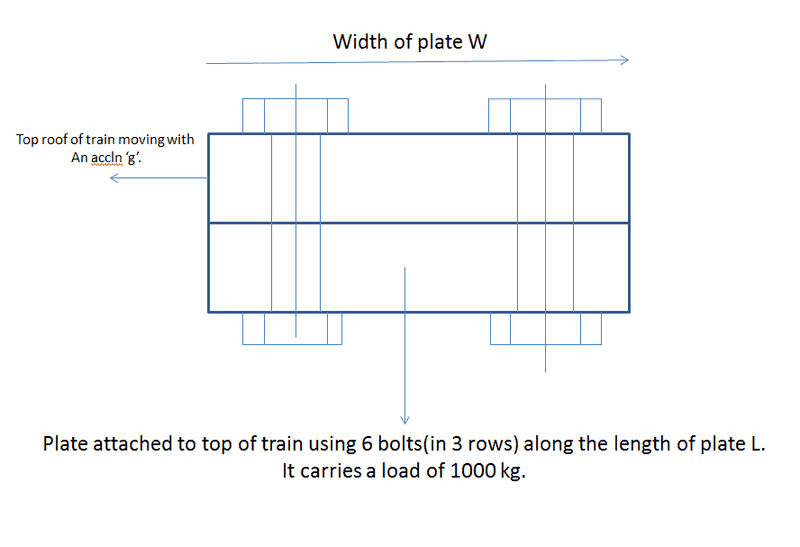
We are working on a machine component structure that weighs around 500 kg.This component is fixed inside the train on top roof using 6 bolts..Now the part is we need to design bolt size and no of bolts under worst condition..The acceleration of train may be taken as 0.3g,where g-accn due to gravity..

what kind of forces act on this bolt and how to design?
BOLT PLATE.PNG
BOLT PLATE.PNG
 
Engineering news on Phys.org
You description says the load is 500 kg, but your diagram says the load is 1000 kg. Which is it?

Since the train is accelerating, and presumably the c.g. of the load is located somewhere below the mounting plate attached to the roof, you'll need to expand your diagram and draw a free body diagram which includes the load and the mounting plate and then determine the static + dynamic loads when the train is accelerating.
 
You may want to find deceleration during emergency breaking, I'd guess it's more than acceleration under power.
 
  • Like
Likes   Reactions: lingesh
lingesh said:
We are working on a machine component structure that weighs around 500 kg.This component is fixed inside the train on top roof using 6 bolts..Now the part is we need to design bolt size and no of bolts under worst condition..The acceleration of train may be taken as 0.3g,where g-accn due to gravity..

what kind of forces act on this bolt and how to design?View attachment 85744 View attachment 85744

You don't have any professional Mechanical Engineers working on this project who can figure this out? That's kind of scary, IMO. You don't even mention issues like vibration and shock (I presume this location qualifies for the "sprung truck" shock/vibe spec?)
 
  • Like
Likes   Reactions: billy_joule
billy_joule said:
You may want to find deceleration during emergency breaking, I'd guess it's more than acceleration under power.
Hi,
very valid point..The value of deceleration is 0.3g.i mentioned it wrongly..And load consider it as 1000 kg...
 
SteamKing said:
You description says the load is 500 kg, but your diagram says the load is 1000 kg. Which is it?

Since the train is accelerating, and presumably the c.g. of the load is located somewhere below the mounting plate attached to the roof, you'll need to expand your diagram and draw a free body diagram which includes the load and the mounting plate and then determine the static + dynamic loads when the train is accelerating.
Hi SteamKing,
I regret that mistake...Load is 1000 kg..If possible can you elaborate the method...

Thanks
 
lingesh said:
Hi SteamKing,
I regret that mistake...Load is 1000 kg..If possible can you elaborate the method...

Thanks
By using the acceleration of the train and the mass of the load, you can create a "fictitious" force acting on the load, F = ma. Apply this load at the center of gravity of the object, and then use statics to figure out what tensions the bolts must hold.
 

Similar threads

  • · Replies 3 ·
Replies
3
Views
2K
Replies
3
Views
2K
  • · Replies 12 ·
Replies
12
Views
5K
  • · Replies 1 ·
Replies
1
Views
2K
  • · Replies 17 ·
Replies
17
Views
3K
Replies
3
Views
3K
  • · Replies 6 ·
Replies
6
Views
4K
  • · Replies 30 ·
2
Replies
30
Views
3K
  • · Replies 52 ·
2
Replies
52
Views
7K
Replies
2
Views
2K