Determinant of 3x3 matrices: Is a matrix with all odd entries a multiple of 4?

Click For Summary
SUMMARY

A 3x3 matrix with all odd entries has a determinant that is a multiple of 4. The matrix can be represented as A = { {a, b, c}, {d, e, f}, {g, h, i} }, where each entry is an odd integer. By applying row operations, specifically adding multiples of the first row to the second and third rows, the resulting matrix B will have even entries in the second and third rows. The determinant of B remains unchanged, and since the determinants of the resulting 2x2 matrices consist of even numbers, the overall determinant of the 3x3 matrix is confirmed to be a multiple of 4.

PREREQUISITES
  • Understanding of 3x3 matrix determinants
  • Familiarity with row operations in linear algebra
  • Knowledge of the Rule of Sarrus for determinant calculation
  • Basic concepts of odd and even integers
NEXT STEPS
  • Study the Rule of Sarrus for calculating determinants of 3x3 matrices
  • Explore properties of determinants involving odd and even integers
  • Learn about the implications of row operations on matrix determinants
  • Investigate the relationship between determinants of 2x2 matrices and their entries
USEFUL FOR

Mathematicians, students studying linear algebra, and anyone interested in matrix theory and determinants.

fox1
Messages
3
Reaction score
0
I need to prove that a 3x3 matrix with all odd entries will have a determinant that is a multiple of 4.

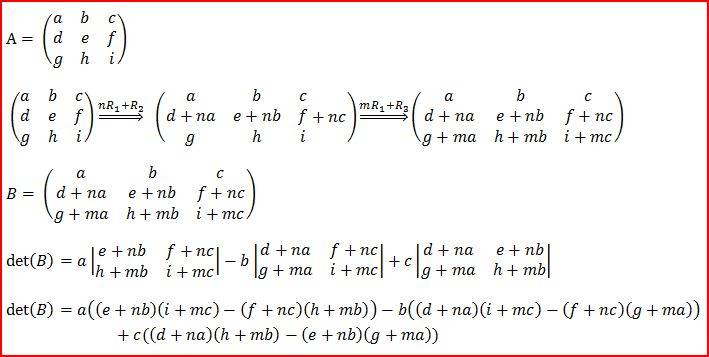
This is how I set it up:
20fuqo9.jpg

I let A = { {a, b, c}, {d, e, f}, {g, h, i} } with all odd entries

then I define B = { {a, b, c}, {d + na, e + nb, f + nc}, {g + ma, h + bm, i + cm} }
where I add the multiple of first row to second and third row. So only the first row will have odd integers entries while the second and third row will be even entries.

det(A) = det(B) since adding multiple of one row to another doesn't change the determinant

After this I was going to show that the each of three 2x2 matrix will have a even determinants. This is where I'm kind of stuck. I can show that the determinant of 3x3 will be even, but how can I show that it will be a multiple of 4?
 
Last edited:
Physics news on Phys.org
IDK why you are using row operations and minors to calculate a 3x3 determinant. Certainly, the row operations complicate the calculation.

The Rule of Sarrus is a more straightforward method for calculating the determinant.

http://en.wikipedia.org/wiki/Rule_of_Sarrus
 
Maybe think about what happens when most of the entries are even and what you can say about the product of two even numbers.
 
fox1 said:
then I define B = { {a, b, c}, {d + na, e + nb, f + nc}, {g + ma, h + bm, i + cm} }
where I add the multiple of first row to second and third row. So only the first row will have odd integers entries while the second and third row will be even entries.
You're overcomplicating things. Why the arbitrary n and m? What's wrong with n=m=1?

Your main problem with this problem is that you aren't representing that matrix as consisting of odd numbers only. Instead of a use 2a+1; for b use 2b+1, etc.

What can you say about the determinant of a 2x2 matrix that consists of only even numbers? (What is it a multiple of?)
 

Similar threads

Replies
1
Views
2K
  • · Replies 32 ·
2
Replies
32
Views
3K
  • · Replies 5 ·
Replies
5
Views
5K
Replies
13
Views
4K
  • · Replies 2 ·
Replies
2
Views
2K
  • · Replies 7 ·
Replies
7
Views
2K
  • · Replies 3 ·
Replies
3
Views
2K
Replies
2
Views
2K
  • · Replies 21 ·
Replies
21
Views
3K
  • · Replies 1 ·
Replies
1
Views
1K