Determinant of 3x3 matrices: Is a matrix with all odd entries a multiple of 4?

Click For Summary

Homework Help Overview

The discussion revolves around proving that the determinant of a 3x3 matrix with all odd entries is a multiple of 4. The original poster presents a matrix setup and attempts to manipulate it to explore properties of determinants.

Discussion Character

  • Exploratory, Assumption checking, Mathematical reasoning

Approaches and Questions Raised

  • The original poster describes a method involving row operations and the definition of a new matrix to analyze the determinant. Some participants question the complexity of this approach and suggest alternative methods, such as the Rule of Sarrus. Others propose considering the implications of even and odd entries on the determinant.

Discussion Status

The discussion is ongoing, with participants providing different perspectives on the approach to take. Some guidance has been offered regarding simplifying the representation of odd numbers and considering the properties of determinants of matrices with even entries.

Contextual Notes

There is a focus on the nature of the entries in the matrix, specifically the implications of having all odd entries and how that relates to the determinant being a multiple of 4. The original poster's setup and reasoning are under scrutiny, with suggestions to clarify assumptions.

fox1
Messages
3
Reaction score
0
I need to prove that a 3x3 matrix with all odd entries will have a determinant that is a multiple of 4.

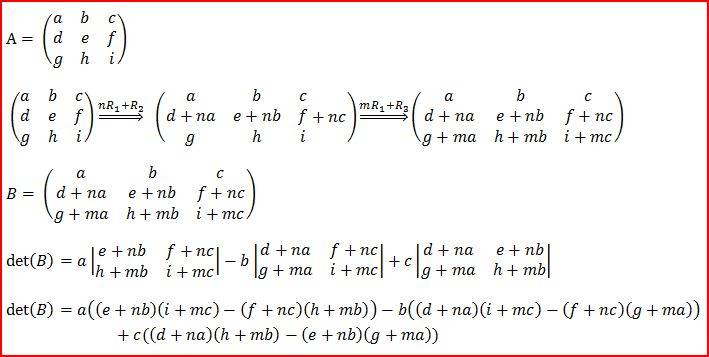
This is how I set it up:
20fuqo9.jpg

I let A = { {a, b, c}, {d, e, f}, {g, h, i} } with all odd entries

then I define B = { {a, b, c}, {d + na, e + nb, f + nc}, {g + ma, h + bm, i + cm} }
where I add the multiple of first row to second and third row. So only the first row will have odd integers entries while the second and third row will be even entries.

det(A) = det(B) since adding multiple of one row to another doesn't change the determinant

After this I was going to show that the each of three 2x2 matrix will have a even determinants. This is where I'm kind of stuck. I can show that the determinant of 3x3 will be even, but how can I show that it will be a multiple of 4?
 
Last edited:
Physics news on Phys.org
IDK why you are using row operations and minors to calculate a 3x3 determinant. Certainly, the row operations complicate the calculation.

The Rule of Sarrus is a more straightforward method for calculating the determinant.

http://en.wikipedia.org/wiki/Rule_of_Sarrus
 
Maybe think about what happens when most of the entries are even and what you can say about the product of two even numbers.
 
fox1 said:
then I define B = { {a, b, c}, {d + na, e + nb, f + nc}, {g + ma, h + bm, i + cm} }
where I add the multiple of first row to second and third row. So only the first row will have odd integers entries while the second and third row will be even entries.
You're overcomplicating things. Why the arbitrary n and m? What's wrong with n=m=1?

Your main problem with this problem is that you aren't representing that matrix as consisting of odd numbers only. Instead of a use 2a+1; for b use 2b+1, etc.

What can you say about the determinant of a 2x2 matrix that consists of only even numbers? (What is it a multiple of?)
 

Similar threads

Replies
1
Views
2K
  • · Replies 32 ·
2
Replies
32
Views
3K
  • · Replies 5 ·
Replies
5
Views
6K
Replies
13
Views
4K
  • · Replies 2 ·
Replies
2
Views
2K
  • · Replies 7 ·
Replies
7
Views
2K
  • · Replies 3 ·
Replies
3
Views
3K
Replies
2
Views
2K
  • · Replies 21 ·
Replies
21
Views
3K
  • · Replies 1 ·
Replies
1
Views
1K