Determine Floor Load on Columns: Hi Everyone!

  • Thread starter Thread starter Peter10
  • Start date Start date
  • Tags Tags
    Columns Load
Click For Summary

Discussion Overview

The discussion revolves around determining the floor load on columns, specifically focusing on the tributary area and load distribution from a beam with unevenly distributed loads. Participants explore the calculations and reasoning behind the load allocation to each column based on the given beam and load parameters.

Discussion Character

  • Technical explanation
  • Mathematical reasoning
  • Debate/contested

Main Points Raised

  • One participant describes a scenario involving an 8 m beam with varying uniformly distributed loads (UDL) and seeks clarification on how to determine the load area on each column.
  • Several participants express confusion regarding the term "distance of load" and question the relevance of the 7 m spacing between columns in the X direction.
  • Another participant suggests that the load distribution should be halved for each column if the load were uniformly distributed, but acknowledges that the uneven load complicates this assumption.
  • There is a discussion about the need to find the center of gravity or resultant force to determine how the load is carried by each column.
  • Some participants propose using moments to analyze the load distribution and suggest taking moments about one of the columns to find the loads.
  • Concerns are raised about the reaction forces quoted in the initial post, with participants questioning their validity and suggesting that they may be too high for the given loads.
  • A participant emphasizes focusing on tributary area rather than tributary distance, explaining how to calculate loads based on slab load and tributary areas.

Areas of Agreement / Disagreement

Participants express differing views on the interpretation of tributary area versus tributary distance, and there is no consensus on the correct approach to calculating the load distribution on the columns. The discussion remains unresolved with multiple competing perspectives on how to proceed with the calculations.

Contextual Notes

Limitations include potential misunderstandings regarding the definitions of tributary area and distance, as well as the validity of the reaction forces provided. The discussion also highlights the complexity introduced by uneven load distributions.

Peter10
Messages
10
Reaction score
0
Hi everyone.I would really appreciate if someone would help me with determination of floor load on columns (column tributary area).

Normally uniformly distributed load acting on a beam is halved and each half-load is allocated to one column supporting the beam. In this case however, there is an 8 m beam spanning between a column 1 and 2, uniformly distributed load of magnitude of 80kN/m runs from column 1 up to 5m along the beam. Then another UDL 10kN/m runs from that point for 3 m up the column 2. On the grid distance between columns 1 and 2 and adjacent columns is 7 m.
What distance of load along that beam do column 1 and 2 take respectively? Reaction Force at column 1 is 281 kN and column 2 is 149 kN.

M I look for explanation (calcs would be welcome however). The beam is simply supported. Below is a simple diagram.
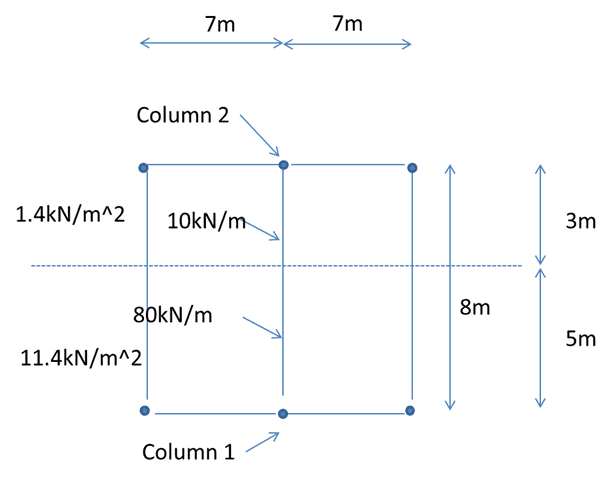
upload_2016-3-15_16-39-38.png

Thanks a lot !
 
Physics news on Phys.org
Not sure I understand the question. What do you mean by "distance of load"? You seem to have found the loads on the columns ("reaction force" in your post), so I don't understand what else you are after.
Also, is the 7m spacing in the X direction relevant? I couldn't see how.
 
haruspex said:
Not sure I understand the question. What do you mean by "distance of load"? You seem to have found the loads on the columns ("reaction force" in your post), so I don't understand what else you are after.
Also, is the 7m spacing in the X direction relevant? I couldn't see how.
Thank you for your reply.

Yes the 7m is in X direction ( not really relevant), the 8 m beam is in Y direction. I was given a task to determine load area on each column. In X direction the distance of the imposed load that each column carries is 3.5 m(half the distance because the load is the same and uniform for all the beams along the X direction ). If the load was uniformly distributed and of the same magnitude along the beam in Y direction ( 8m) the load distribution would be halved for each column and each column would carry 4 m of that load in Y direction ( the same as in X direction). But the load in Y direction is uneven so the column 1 will not carry 4m of that load, neither will the column 2. So I need to get ' centre' or 'centre of gravity' or 'resultant force of all the forces' and then I could say that to the right of this point all the load will be carried by the column 1 and all the load to the left of that point will be carried by the column 2.
 
Peter10 said:
Thank you for your reply.

Yes the 7m is in X direction ( not really relevant), the 8 m beam is in Y direction. I was given a task to determine load area on each column. In X direction the distance of the imposed load that each column carries is 3.5 m(half the distance because the load is the same and uniform for all the beams along the X direction ). If the load was uniformly distributed and of the same magnitude along the beam in Y direction ( 8m) the load distribution would be halved for each column and each column would carry 4 m of that load in Y direction ( the same as in X direction). But the load in Y direction is uneven so the column 1 will not carry 4m of that load, neither will the column 2. So I need to get ' centre' or 'centre of gravity' or 'resultant force of all the forces' and then I could say that to the right of this point all the load will be carried by the column 1 and all the load to the left of that point will be carried by the column 2.
Ok, but in post #1 you quoted 'reaction forces' for those two columns which confused me. So I thought you must mean something else.
But checking those numbers now, I see they are much too high for the loads you are trying to calculate, so I'm mystified as to what those two forces represent.
Anyhow, you need to take moments to find how the load is distributed. Pick one of the columns to take moments about - either will do.
 
haruspex said:
Ok, but in post #1 you quoted 'reaction forces' for those two columns which confused me. So I thought you must mean something else.
But checking those numbers now, I see they are much too high for the loads you are trying to calculate, so I'm mystified as to what those two forces represent.
Anyhow, you need to take moments to find how the load is distributed. Pick one of the columns to take moments about - either will do.
Sorry, I rounded the numbers up a bit. So you are saying that I should take it from bending moment? From the elevation it looks like this
upload_2016-3-16_11-23-24.png

haruspex said:
Ok, but in post #1 you quoted 'reaction forces' for those two columns which confused me. So I thought you must mean something else.
But checking those numbers now, I see they are much too high for the loads you are trying to calculate, so I'm mystified as to what those two forces represent.
Anyhow, you need to take moments to find how the load is distributed. Pick one of the columns to take moments about - either will do.
Should I take the point from the bending moment? Elevation view looks like this
upload_2016-3-16_11-25-49.png
 
Originally you wrote 80kN/m etc., now you have kN/m2. I assume it's kN/m.
You still have not explained how you got 281 and 149, so I shall assume you have been told these are the answers and you are trying to prove it.
To find the loads on those columns you need two equations. Any two of the following will do it:
- sum of vertical forces
- sum of moments of vertical forces about the top of one column
- ditto, moments about the other column
- ditto, moments about the point where the load changes.

To get the moment of a spread load, you could write an integral, but it should not be necessary. For this purpose, you can take each uniform load as acting at its midpoint.
 
Peter

You seem to have double posted but you are mixing up your definition of tributary area versus tributary distance. Forget about tributary distance and focus on tributary area. The center beam between columns 1 and 2 takes the floor slab load from 3.5 m either side of it. So for example where the slab load is 1.4 kN/m^2, the distributed load on that beam is 1.4 times 7 or 9.8 kN/m which you have rounded off to 10 kN/m. Same procedure for other part of the beam and you get about 80 kN/m. Did you get these by yourself or what? That is how you calculate those loads to the beam using the tributary areas. Then solve for the column reactions as haruspex has noted. Done. Don't try to come up with some tributary 'distance 'along the beam.
 
Thank you every one for you answers. they were very helpful
 

Similar threads

  • · Replies 1 ·
Replies
1
Views
2K
  • · Replies 8 ·
Replies
8
Views
2K
  • · Replies 3 ·
Replies
3
Views
2K
  • · Replies 1 ·
Replies
1
Views
2K
  • · Replies 6 ·
Replies
6
Views
2K
  • · Replies 2 ·
Replies
2
Views
3K
Replies
1
Views
2K
  • · Replies 8 ·
Replies
8
Views
10K
  • · Replies 8 ·
Replies
8
Views
7K
  • · Replies 1 ·
Replies
1
Views
2K