Determine the electric field that yields the desired result

Click For Summary

Homework Help Overview

The discussion revolves around determining the electric field necessary to ensure that only protons with a specific speed pass through a region influenced by both electric and magnetic fields. The context involves a beam of protons entering a magnetic field and the requirement to select protons based on their speed.

Discussion Character

  • Exploratory, Conceptual clarification, Assumption checking

Approaches and Questions Raised

  • Participants discuss the relationship between electric and magnetic forces acting on protons and question the conditions under which protons can pass through the fields without deflection. There is an exploration of relevant formulas and concepts, including the Lorentz force and the role of electric fields.

Discussion Status

Some participants are attempting to clarify the forces acting on the protons and how these forces interact. Guidance has been offered regarding the nature of the forces involved, though there is no explicit consensus on the correct approach to finding the potential difference or the electric field.

Contextual Notes

Participants are working under the constraints of a parallel-plate capacitor setup and are discussing the implications of the plate separation on the potential difference required. There is uncertainty regarding the application of certain formulas in this context.

whoknows12345
Messages
9
Reaction score
0
A beam of protons with various speeds is directed in the positive x direction. The beam enters a region with a uniform magnetic field of magnitude 0.45 T pointing into the page, as indicated in Figure 22-45. It is desired to use a uniform electric field (in addition to the magnetic field) to select from this beam only those protons with a speed of 1.60 105 m/s; that is, only these protons should be undeflected by the two fields.
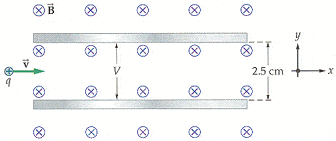
22-45.gif


(a) Determine the electric field that yields the desired result.
size: ____72000___ N/C
dir: -y dir

(b) Suppose the electric field is to be produced by a parallel-plate capacitor with a plate separation of 2.5 cm. What potential difference is required between the plates?
________ V

for part B, I understand that C=EA/d and V=IR

also, I can find I, by that I can use I=2pieRB/(4pie x 10^-7)
but I am really not sure how to find this potential difference correctly, can anyone help?
 
Physics news on Phys.org
whoknows12345 said:
for part B, I understand that C=EA/d and V=IR

also, I can find I, by that I can use I=2pieRB/(4pie x 10^-7)
but I am really not sure how to find this potential difference correctly, can anyone help?
You seem to be just guessing at formulas. None of the three you have identified are used here, in either part.

What is it that determines whether the protons get through the plates? What are the forces acting on the protons? How do you determine what those forces are?

AM
 
force acting on the proton is upwards and that should be force of the magnetic field, and I am not sure what determines whether the protons get through the plates.
 
whoknows12345 said:
force acting on the proton is upwards and that should be force of the magnetic field, and I am not sure what determines whether the protons get through the plates.
There are two kinds of forces: motion through the magnetic field produces a Lorentz force. The electric field produces an electric force. They are in opposite directions. If they are not balanced, what happens to the proton? does it make it through?

AM
 

Similar threads

  • · Replies 26 ·
Replies
26
Views
3K
  • · Replies 16 ·
Replies
16
Views
1K
  • · Replies 58 ·
2
Replies
58
Views
6K
  • · Replies 7 ·
Replies
7
Views
955
  • · Replies 9 ·
Replies
9
Views
8K
Replies
1
Views
2K
Replies
1
Views
2K
  • · Replies 2 ·
Replies
2
Views
2K
  • · Replies 11 ·
Replies
11
Views
2K