Determine values of K>0 such that the poles are in left-hand plane?

  • Thread starter Thread starter annas425
  • Start date Start date
  • Tags Tags
    Plane Poles
Click For Summary
SUMMARY

The discussion focuses on determining the values of K>0 for the transfer function G(s) = 1 / (s(s+1)(s^2 + 4s + 13) to ensure closed-loop poles remain in the left-hand plane, indicating stability. It is established that while K>0 is necessary for stability, it is not sufficient, as excessively large values of K lead to instability. The phase shift of G(s) as a function of ω must be analyzed, and Excel can be utilized to compute the phase shift across a range of ω values to identify the corresponding stable range of K.

PREREQUISITES
  • Understanding of transfer functions in control systems
  • Familiarity with stability criteria in control theory
  • Knowledge of phase shift analysis
  • Proficiency in using Excel for data analysis
NEXT STEPS
  • Analyze the phase shift of G(s) as a function of ω
  • Utilize Excel to compute phase shifts for varying ω values
  • Investigate the Routh-Hurwitz stability criterion
  • Learn about Root-Locus techniques for stability analysis
USEFUL FOR

Control engineers, systems analysts, and students studying control theory who are interested in stability analysis of dynamic systems.

annas425
Messages
16
Reaction score
0
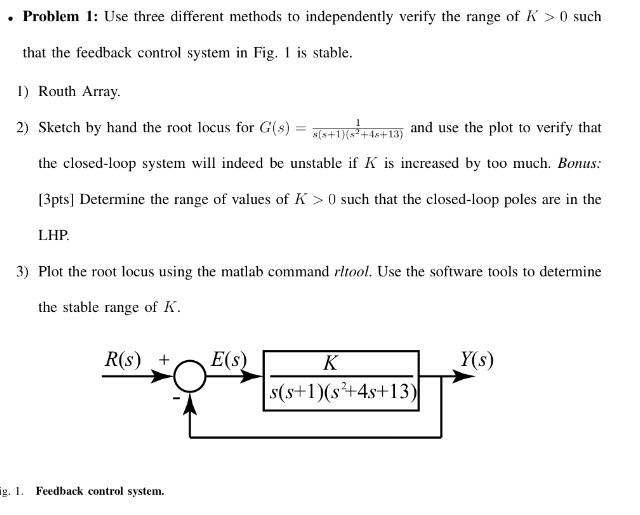
Given the transfer function G(s) = 1 / (s(s+1)(s^2 + 4s + 13)), how would I determine the range of the values of K>0 such that the closed-loop poles are in the left-hand plane?

Picture of block diagram with transfer function:
swbypj.jpg


Not sure if this is right at all, but I know that a system is stable when K>0, so if the poles were to be in the left-hand plane (i.e., be stable), would it just be for all K>0? I am assuming it's more involved than just that, so I would really appreciate some help please! :)

Thank you in advance!
 
Physics news on Phys.org
Start by solving question 3).

Note also that in question 2 you are given the information that for too large K, the system become unstable.
Therefore you hypothesis that K>0 for stability must be wrong. (there was no reason for that)
 
maajdl said:
Start by solving question 3).

Note also that in question 2 you are given the information that for too large K, the system become unstable.
Therefore you hypothesis that K>0 for stability must be wrong. (there was no reason for that)

Well, doesn't the prompt just say that K must be greater than 0?? I am confused...
 
To give you a feel for how k has to range as a function of ω, form an expression for the phase shift of G(s) as a function of ω. This is not hard. The phase shift will be a transcendental equation in ω. The phase shift is independent of k. Then use Excel to run ω over a range of values starting at zero with constant small increments, and ask it to compute the phase shift for each ω. When the phase shift gets to π, put that value of ω into G(s) and solve for the range of k for which |G(s)| < 1. That range of k gives a stable closed loop.

There may be more than one value of ω for which the phase shift is π, so don't quit when you hit pay dirt the first time.

Routh-Hurwitz is seldom used in 'real life' because usually the transfer function is known as gain and phase plots but not in closed form.

I never learned how to do Root-Locus, don't regret it, so can't help you there either. Sorry about both.
 

Similar threads

  • · Replies 2 ·
Replies
2
Views
2K
  • · Replies 8 ·
Replies
8
Views
3K
  • · Replies 1 ·
Replies
1
Views
3K
Replies
4
Views
2K
Replies
2
Views
1K
  • · Replies 3 ·
Replies
3
Views
2K
Replies
1
Views
3K
Replies
3
Views
2K
Replies
3
Views
3K
  • · Replies 1 ·
Replies
1
Views
1K