Magnitude versus Frequency Response Drawing from Pole-Zero Plot

Click For Summary

Discussion Overview

The discussion revolves around understanding the frequency response of discrete systems using pole-zero plots. Participants explore methods for analyzing the magnitude and phase response, as well as the implications for impulse response based on these plots.

Discussion Character

  • Exploratory
  • Technical explanation
  • Debate/contested
  • Mathematical reasoning

Main Points Raised

  • One participant expresses uncertainty about how to approach a problem related to discrete systems and seeks general methods for analysis.
  • Another participant suggests that the frequency response should be evaluated by substituting z with jω and visualizing the distance between z and the poles/zeros.
  • A later reply clarifies that resonance does not occur for every pole or zero and emphasizes the importance of their proximity to jω.
  • There is a discussion about the correct interpretation of ω=0 in the z-plane, with one participant confirming that it corresponds to the point 1+0j on the unit circle.
  • Participants discuss the implications of a potential typo in the problem statement regarding the system being discrete versus analogue, raising questions about the nature of the poles described.
  • One participant mentions a lack of teaching on the topic and relies on external resources for understanding.
  • Another participant notes the importance of pole locations relative to the unit circle in the z-plane and questions the clarity of the problem statement regarding its context.

Areas of Agreement / Disagreement

Participants express differing views on the correctness of initial interpretations and methods for analyzing the frequency response. There is no consensus on the implications of the problem statement's context, particularly regarding discrete versus analogue systems.

Contextual Notes

Participants highlight limitations in their understanding due to insufficient teaching on the topic and the ambiguity of the problem statement. The discussion also reflects uncertainty about the transformation between continuous and discrete time representations.

Master1022
Messages
590
Reaction score
116
Homework Statement
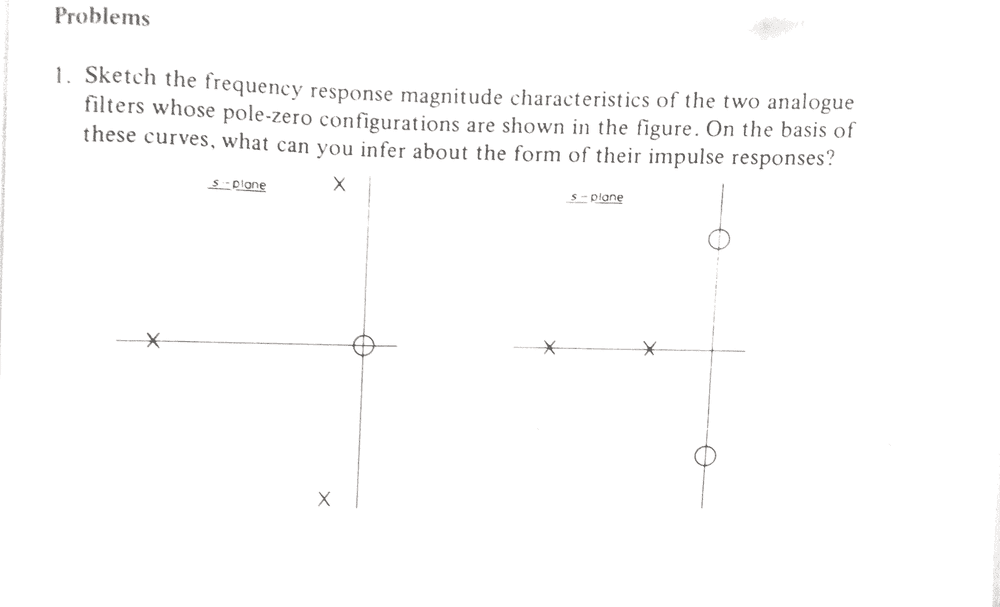
Sketch the frequency magnitude characteristics of the two analogue filters whose pole-zero configurations are shown in the figure. On the basis of these curves, what can you infer about the form of their impulse responses
Relevant Equations
Transfer functions
Hi,

EDIT: apologies for any ambiguity, but this is for DISCRETE systems, not analogue like the problem states.

I was attempting a problem which is shown below
.
Scannable Document on Dec 28, 2020 at 12_15_40 PM.png


I am not really sure how to attempt this problem, but here is my attempt. Are there general methods for tackling these types of questions?

Attempt:
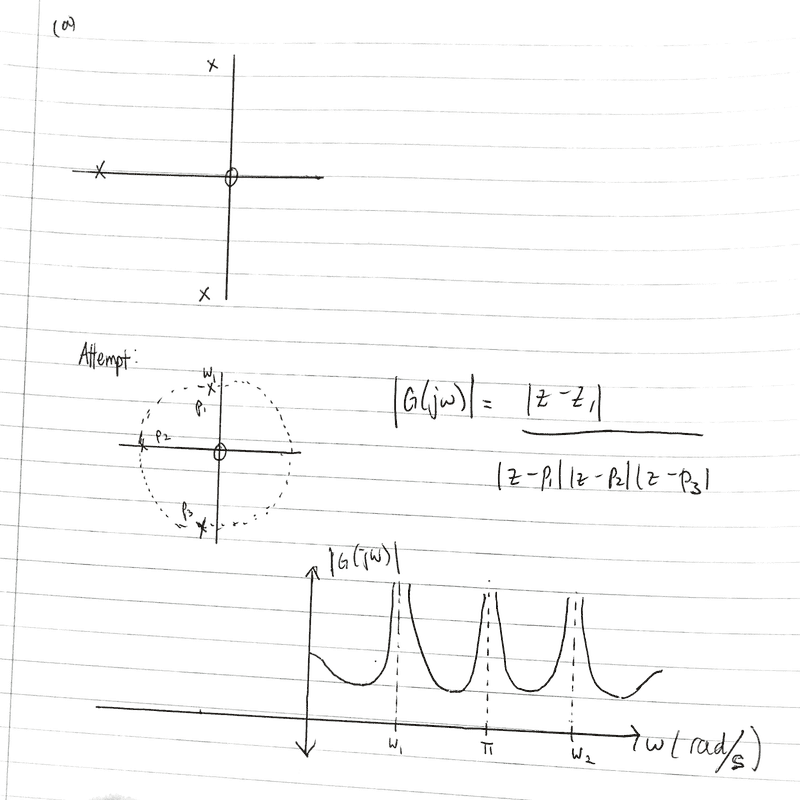
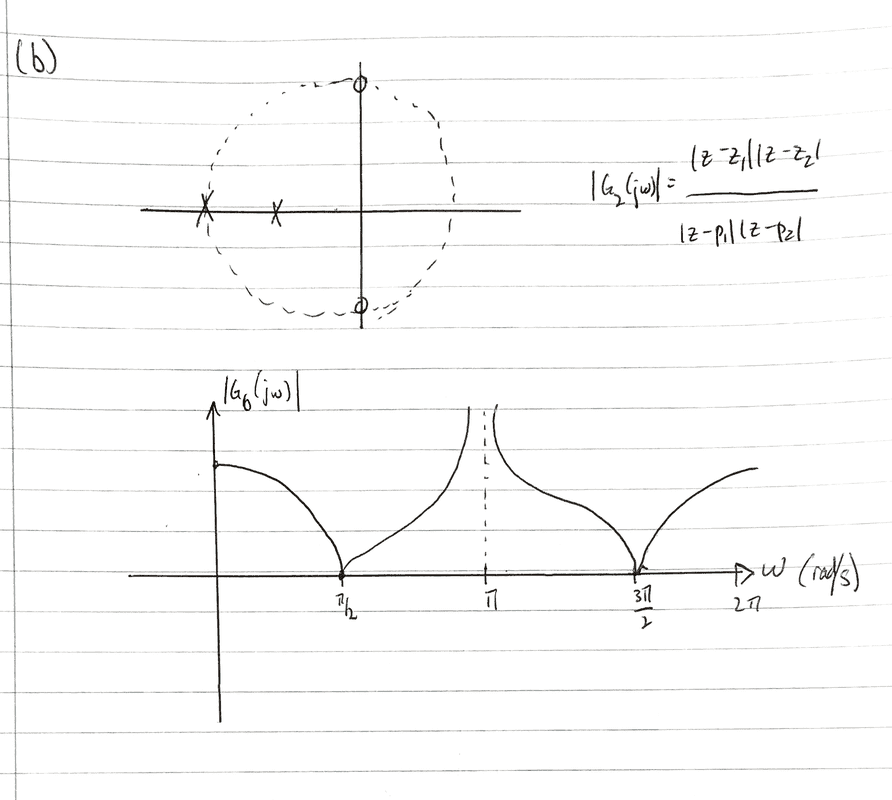
I have assumed that the outer most poles/zeros are on the unit circle such that the system is stable.

A zero on the unit circle will create a gain of zero at that frequency, whereas a pole will create resonance at its frequency. I think this because we can write the transfer function as:
$$ G(w) = \frac{\prod_{i = 1}^{n} |z-z_i|}{\prod_{j=1}^{m} |z-p_j|} $$

Part (a)
Thus, for the first (left) diagram, I think there should be resonance at the frequencies of the three poles. The effect of the zero is the same for all frequencies.
Scannable Document on 28 Dec 2020 at 12_51_20.png


Part (b)
For the second (right hand) diagram, I think there should be resonance at the frequency of the outermost pole (the inner one is within the unit circle) and points of zero gain at the frequencies of the two zeros.
Scannable Document 2 on 28 Dec 2020 at 12_51_20.png


Are these attempts correct? If so, how I do make inferences about the impulse response from these?

I know that the impulse response is the transfer function, but am not sure how to qualitatively use these plots to describe it.

Thanks in advance for any help.
 
Last edited:
Physics news on Phys.org
No, not really correct. I think you need to go back and study your course materials a bit more to get this. It's hard to know how to provide guidance without knowing what the material that you've covered in your course is so far. But, I will start with some ideas:

Since you are being asked for the frequency response, then the terms in your magnitude equation like |(z-zi)| can be written as |(jω-zi)|. For frequency response, which is steady state, you will substitute z=jω. This can be visualized as the positive imaginary axis in the complex plane that you drew. At ω=0 you are at the origin. As ω increases (increasing frequency on your plot) you move up on the imaginary axis.

Now let's look at the term |(z-zi)|. This can be visualized as the distance between z and zi. So, for each frequency in your plot, you can measure the magnitude of jω-zi for each pole or zero. You then multiply or divide these according to your magnitude formula.

You will do the same for the phase response, except you aren't multiplying the distance to the poles (or zeros), you are adding up the phase angles. So, for example, the angle from p2 to jω starts at 0 at ω=0 and increases as ω increases, approaching π/2 as ω→∞.

You do not necessarily get a resonance for each pole or zero. Resonance is a description of a rapid change in magnitude (and phase) as ω changes. This doesn't happen if the poles (or zeros) are always far from jω in the plane.

In the real world, roots with a non-zero imaginary part always come in complex conjugate pairs. Which are usually expressed as a quadratic term with real coefficients, like [1 + jω/(Qωo) + (jω/ωo)2]; but this may not be the style that applies to your course methods.
 
  • Informative
Likes   Reactions: berkeman
Thanks for your reply!

DaveE said:
No, not really correct. I think you need to go back and study your course materials a bit more to get this. It's hard to know how to provide guidance without knowing what the material that you've covered in your course is so far. But, I will start with some ideas:
Unfortunately we have had little to no teaching for this topic, so have just been trying to read on the internet. My knowledge is more or less restricted to the information (albeit incorrect) in the post.

DaveE said:
Since you are being asked for the frequency response, then the terms in your magnitude equation like |(z-zi)| can be written as |(jω-zi)|. For frequency response, which is steady state, you will substitute z=jω. This can be visualized as the positive imaginary axis in the complex plane that you drew. At ω=0 you are at the origin. As ω increases (increasing frequency on your plot) you move up on the imaginary axis.

Apologies, but in the z-plane, doesn't \omega = 0 correspond to the point 1 + 0 j on the unit circle as z = e^{sT} = e^{(\sigma + j\omega)T} and we are only concerned with s = j \omega as you have written so z = e^{j \omega T}.

DaveE said:
Now let's look at the term |(z-zi)|. This can be visualized as the distance between z and zi.
Agreed

DaveE said:
So, for each frequency in your plot, you can measure the magnitude of jω-zi for each pole or zero. You then multiply or divide these according to your magnitude formula.
I think my ambiguity in the post was not clear. Should this instead be | e^{j \omega T} - z_i |?

Does the fact that it is the z-plane change anything about the correctness (or lack thereof) about my method?

Thanks.
 
Master1022 said:
in the z-plane, doesn't ω=0 correspond to the point 1+0j on the unit circle as z=esT=e(σ+jω)T and we are only concerned with s=jω as you have written so z=ejωT.
Yes, absolutely correct in discrete time z-plane. I missed that part of the problem, I thought it was continuous time, the s-plane in common usage.
 
DaveE said:
Yes, absolutely correct in discrete time z-plane. I missed that part of the problem, I thought it was continuous time, the s-plane in common usage.
Okay thank you very much. Do you know where I might be able to read about using the magnitude frequency plot to infer the behaviour of the impulse response?
 
DaveE said:
Yes, absolutely correct in discrete time z-plane. I missed that part of the problem, I thought it was continuous time, the s-plane in common usage.
Apologies, yes the problem statement had a typo and should have said discrete not analogue (quite the typo!)
 
I'm not that "up to speed" with discrete filter design. It's been a few decades since I actually did any of that. I do think the concepts are similar though.

This guy has some nice videos though:
 
  • Like
Likes   Reactions: Master1022
Interesting that the problem statement doesn't have any scale associated with the pole locations. It's not such a big deal in the s-plane since it's the axes that matter. But, in the z-plane inside or outside the unit circle is a really important difference. Are you sure those poles are z-plane poles? The text says "analogue filter" and is labeled "s-plane". Sometimes the system is analog and the poles are described in continuous time, but the filter/controller is discrete time and you have to make the transformation at some point. I'm unclear on when/if discrete time matters here.
 
DaveE said:
Interesting that the problem statement doesn't have any scale associated with the pole locations. It's not such a big deal in the s-plane since it's the axes that matter. But, in the z-plane inside or outside the unit circle is a really important difference. Are you sure those poles are z-plane poles? The text says "analogue filter" and is labeled "s-plane". Sometimes the system is analog and the poles are described in continuous time, but the filter/controller is discrete time and you have to make the transformation at some point. I'm unclear on when/if discrete time matters here.
Hmm, that is true. We were told that it was a typo, but I will definitely check. I presume the problem was taken from somewhere and quickly repurposed to discrete time (perhaps without fully considering the nuances of the problem originally being set as an analogue)
 

Similar threads

  • · Replies 3 ·
Replies
3
Views
3K
  • · Replies 3 ·
Replies
3
Views
2K
  • · Replies 10 ·
Replies
10
Views
2K
  • · Replies 1 ·
Replies
1
Views
6K
  • · Replies 2 ·
Replies
2
Views
2K
  • · Replies 3 ·
Replies
3
Views
3K
  • · Replies 1 ·
Replies
1
Views
2K
  • · Replies 20 ·
Replies
20
Views
4K
  • · Replies 2 ·
Replies
2
Views
2K
  • · Replies 17 ·
Replies
17
Views
4K