Understanding BJT Voltages and Operating Point Analysis

  • Context: Undergrad 
  • Thread starter Thread starter JasonHathaway
  • Start date Start date
Click For Summary
SUMMARY

This discussion focuses on analyzing BJT (Bipolar Junction Transistor) voltages and determining the operating point. The participants clarify that VBE is approximately 0.7 V when the BE junction is forward biased, and they derive the voltage across the base resistor as 11.3 V. The operating point is defined in terms of four regions: Active, Cut-off, Saturation, and Inverted, with emphasis on the biasing of the BE and CE junctions. The voltage values and relationships among VBE, VCE, and VCB are crucial for understanding transistor operation.

PREREQUISITES
  • Understanding of BJT operation and biasing
  • Familiarity with voltage calculations in transistor circuits
  • Knowledge of electrical circuit analysis
  • Basic concepts of forward and reverse biasing in diodes
NEXT STEPS
  • Study BJT operating point analysis in detail
  • Learn about the characteristics of NPN and PNP transistors
  • Explore the concept of transistor saturation and cut-off regions
  • Investigate the impact of resistor values on BJT performance
USEFUL FOR

Electronics students, circuit designers, and engineers interested in understanding transistor behavior and voltage analysis in BJT circuits.

JasonHathaway
Messages
113
Reaction score
0
Hi everyone,


I'm new to transistors analyzing, and I need a way to correctly identify the voltages.

Let's take this circuit for example:
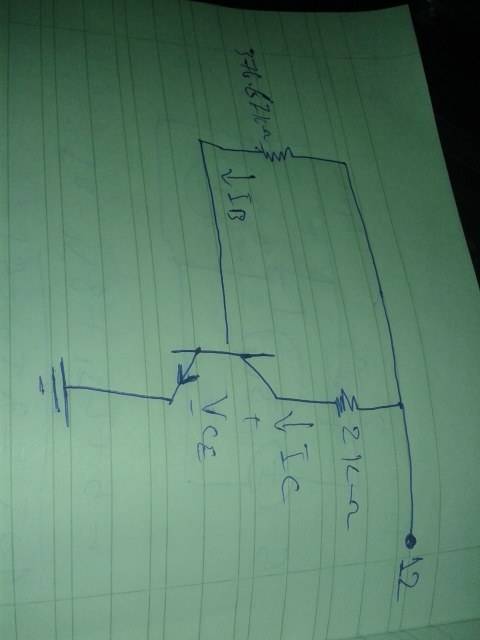
20140618_112601.jpg


Assuming that the Emitter is the common element (The one with arrow which is connected to the ground), then VBE would be:
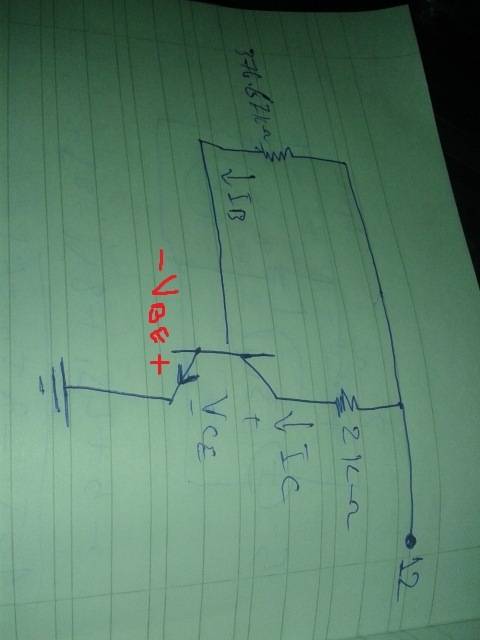
22222.jpg


My questions are:

1- If I want to know the common element of the transistor, shall I look for the element that is directly connected to the ground?
2- For this circuit, I've VBE - VCE + VCB =0, On which basis I can get the these voltages?
 
Physics news on Phys.org
Is the "12" at the top right the voltage applied to the circuit? Or is that something else?
 
You analyze it like this:

(1) The BE junction is forward biased, so Vbe is about 0.7 V.
(2) The voltage across the base resistor is then 12.0 - 0.7 = 11.3 V.
(3) The current through the base resistor Ib = 11.3 / 376 K = .03 mA = 30 uA.
(4) The colector current Ic is beta times this. Assuming beta = 100, Ic = 3 mA.
(5) Vc = 12 - (3mA * 2 k) = 6.0 V.

Does this make sense?
 
Drakkith:
Yes, it's applied on the circuit.

phyzguy:
That makes sense. Now I want to determine Vcb, which is Vc - Vb. Now I've Vc, is Vb the same as Vbe (0.7)? And what's the operating point of the transistor?
 
JasonHathaway said:
That makes sense. Now I want to determine Vcb, which is Vc - Vb. Now I've Vc, is Vb the same as Vbe (0.7)? And what's the operating point of the transistor?

Since you now know the voltages on all three terminals (Ve, Vb, and Vc) calculating the differences is easy. Vbe = Vb - Ve, Vce = Vc-Ve, etc. What do you think the operating point is? What's the definition of operating point? Are the BE and CE junctions forward biased or reverse biased?
 
Actually, that what I'm asking for, the definition of the operating point. As far as I know, the operating point should be one of four regions: 1- Active (forward biased diode and reversed biased one) 2- Cut off (two reversed biased diodes) - 3- Saturation (two forward biased diodes) 4- Inverted (inverse of active).

I know that BE resamples forward biased diode, but I'm not sure about CE
 
In your second pic, those red + and ─ signs are wrong way 'round.
 
NascentOxygen

Thanks :)
 
JasonHathaway said:
Actually, that what I'm asking for, the definition of the operating point. As far as I know, the operating point should be one of four regions: 1- Active (forward biased diode and reversed biased one) 2- Cut off (two reversed biased diodes) - 3- Saturation (two forward biased diodes) 4- Inverted (inverse of active).

I know that BE resamples forward biased diode, but I'm not sure about CE

Well, what is Vc? What is Vb? Is the CB junction therefore forward biased or reverse biased? Given that it is an NPN transistor, you should be able to figure this out.
 

Similar threads

Replies
10
Views
2K
Replies
2
Views
2K
  • · Replies 4 ·
Replies
4
Views
3K
  • · Replies 7 ·
Replies
7
Views
2K
  • · Replies 19 ·
Replies
19
Views
2K
  • · Replies 17 ·
Replies
17
Views
3K
Replies
16
Views
10K
  • · Replies 3 ·
Replies
3
Views
3K
  • · Replies 8 ·
Replies
8
Views
4K
Replies
68
Views
7K