Determining coefficient of kinetic friction help

Click For Summary

Homework Help Overview

The discussion revolves around determining the coefficient of kinetic friction for a block being pushed along a ceiling with a specified applied force and angle, while it accelerates. Participants are analyzing the forces involved, including the applied force, friction, and the effects of acceleration.

Discussion Character

  • Mixed

Approaches and Questions Raised

  • Participants are attempting to set up equations based on the forces acting in both the x and y directions. Some are questioning the assumptions regarding net forces and the role of the applied force in relation to friction and acceleration.

Discussion Status

There are multiple interpretations of the problem, with some participants providing different calculations for the coefficient of kinetic friction. Guidance has been offered regarding the setup of equations, but there is no explicit consensus on the correct approach or answer.

Contextual Notes

Some participants express frustration over differing results and interpretations of the net force, indicating a lack of clarity in the problem setup. The original question is reiterated multiple times, suggesting a focus on ensuring all participants are aligned on the problem statement.

riseofphoenix
Messages
294
Reaction score
2
A 3.40 kg block is pushed along the ceiling with a constant applied force of 85.0 N that acts at an angle of 55.0° with the horizontal, as in the figure below. The block accelerates to the right at 6.00 m/s2. Determine the coefficient of kinetic friction between block and ceiling.
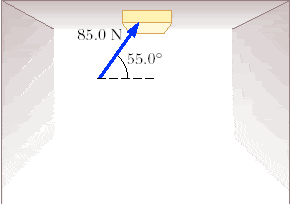
p4-60.gif
Ugghhh so... this is what I did...

F = 85.0 N
m = 3.40 kg
a = 6.00 m/s2
fk = μkn

1) Forces in the x-direction:
F cos θ
fk (kinetic friction)

Forces in the y-direction:
F sin θ
n (normal force)

2) Sum of forces

ƩFx = F cos θ + fk = 0
ƩFy = F sin θ + n = 0
ƩFy = n = -F sin θ

3) ƩFx = F cos θ + μkn = 0
3) ƩFx = F cos θ + μk(-F sin θ) = 0
3) ƩFx = 85 cos 55 - μk(85 sin 55) = 0
3) ƩFx = 85 cos 55 = μk(85 sin 55)
3) ƩFx = (85 cos 55)/(85 sin 55) = μk
3) ƩFx = 0.700 = μk

So I got this wrong, the answer is actually 0.781 (?)

I don't know what to do!
 
Physics news on Phys.org
A 3.40 kg block is pushed along the ceiling with a constant applied force of 85.0 N that acts at an angle of 55.0° with the horizontal, as in the figure below. The block accelerates to the right at 6.00 m/s2. Determine the coefficient of kinetic friction between block and ceiling
-----------------------
It is accelerating, net Fx not zero.
The force applied is pressing the block to the ceiling. The weight is pulling it away.
I got this value - 0.78093138
 
Last edited:
azizlwl said:
A 3.40 kg block is pushed along the ceiling with a constant applied force of 85.0 N that acts at an angle of 55.0° with the horizontal, as in the figure below. The block accelerates to the right at 6.00 m/s2. Determine the coefficient of kinetic friction between block and ceiling
-----------------------
It is accelerating, net Fx not zero.
The force applied is pressing the block to the ceiling. The weight is pulling it away.
I got this value - 0.78093138
So is it supposed to be this?

ƩFx = F cos θ + μkn = 6

85 cos 55 + μk(-85 sin 55) = 6
85 cos 55 - μk(85 sin 55) = 6
85 cos 55 = 6 + μk(85 sin 55)
48.75 - 6 = 69.62μk
42.75/69.62 = μk
0.614 = μk

-____-

I didn't get that answer!
Can you please show me what you did?
 
Last edited:
Force of kinetic friction:
fk = μkn

Horizontal force of acceleration in the x-direction/Value of the bottom leg of the triangle:
Facceleration-x = Fa(cos θ)
Facceleration-x = 85(cos 55)
Facceleration-x = 48.75 N

Normal force n (value of the upright, vertical leg of the triangle):
n = Facceleration-y(sin θ) + mg
n = 85(sin 55) + (3.40 kg)(6.00 m/s2)
n = 69.62 + 20.4
n = 90.02 N

fk = μkn
48.75 = μk(90.02)
48.75/90.02 = μk
0.541 = μk

aksjflkjadsfjds -____-
Help?
 
azizlwl said:
A 3.40 kg block is pushed along the ceiling with a constant applied force of 85.0 N that acts at an angle of 55.0° with the horizontal, as in the figure below. The block accelerates to the right at 6.00 m/s2. Determine the coefficient of kinetic friction between block and ceiling
-----------------------
It is accelerating, net Fx not zero.
The force applied is pressing the block to the ceiling. The weight is pulling it away.
I got this value - 0.78093138

You were completely wrong.
Net force doesn't equal 6.
Thanks for nothing.
 
riseofphoenix said:
You were completely wrong.
Net force doesn't equal 6.
Thanks for nothing.

I not sure whether you read the question.
I just copy and paste the original question you posted and just underlined it.
 
riseofphoenix said:
A 3.40 kg block is pushed along the ceiling with a constant applied force of 85.0 N that acts at an angle of 55.0° with the horizontal, as in the figure below. The block accelerates to the right at 6.00 m/s2. Determine the coefficient of kinetic friction between block and ceiling.

Here your original question and i underlined it.
 

Similar threads

  • · Replies 2 ·
Replies
2
Views
3K
Replies
2
Views
2K
  • · Replies 5 ·
Replies
5
Views
2K
  • · Replies 4 ·
Replies
4
Views
3K
  • · Replies 6 ·
Replies
6
Views
2K
  • · Replies 3 ·
Replies
3
Views
4K
  • · Replies 4 ·
Replies
4
Views
6K
Replies
18
Views
3K
  • · Replies 3 ·
Replies
3
Views
2K
Replies
48
Views
8K