riseofphoenix
- 294
- 2
A 3.40 kg block is pushed along the ceiling with a constant applied force of 85.0 N that acts at an angle of 55.0° with the horizontal, as in the figure below. The block accelerates to the right at 6.00 m/s2. Determine the coefficient of kinetic friction between block and ceiling.
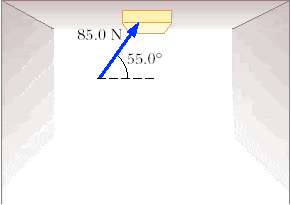
Ugghhh so... this is what I did...
F = 85.0 N
m = 3.40 kg
a = 6.00 m/s2
fk = μkn
1) Forces in the x-direction:
F cos θ
fk (kinetic friction)
Forces in the y-direction:
F sin θ
n (normal force)
2) Sum of forces
ƩFx = F cos θ + fk = 0
ƩFy = F sin θ + n = 0
ƩFy = F sin θ + n = 0
ƩFy = n = -F sin θ
3) ƩFx = F cos θ + μkn = 0
3) ƩFx = F cos θ + μk(-F sin θ) = 0
3) ƩFx = F cos θ + μk(-F sin θ) = 0
3) ƩFx = 85 cos 55 - μk(85 sin 55) = 0
3) ƩFx = 85 cos 55 = μk(85 sin 55)
3) ƩFx = (85 cos 55)/(85 sin 55) = μk
3) ƩFx = 0.700 = μk
So I got this wrong, the answer is actually 0.781 (?)
I don't know what to do!
Ugghhh so... this is what I did...
F = 85.0 N
m = 3.40 kg
a = 6.00 m/s2
fk = μkn
1) Forces in the x-direction:
F cos θ
fk (kinetic friction)
Forces in the y-direction:
F sin θ
n (normal force)
2) Sum of forces
ƩFx = F cos θ + fk = 0
ƩFy = F sin θ + n = 0
ƩFy = F sin θ + n = 0
ƩFy = n = -F sin θ
3) ƩFx = F cos θ + μkn = 0
3) ƩFx = F cos θ + μk(-F sin θ) = 0
3) ƩFx = F cos θ + μk(-F sin θ) = 0
3) ƩFx = 85 cos 55 - μk(85 sin 55) = 0
3) ƩFx = 85 cos 55 = μk(85 sin 55)
3) ƩFx = (85 cos 55)/(85 sin 55) = μk
3) ƩFx = 0.700 = μk
So I got this wrong, the answer is actually 0.781 (?)
I don't know what to do!