Determining the period of a pendulum with an accelerometer

Click For Summary
SUMMARY

The discussion focuses on using an accelerometer to determine the period of a pendulum-like robotic swing, referred to as "swingman." The user is facing challenges with data accuracy due to the accelerometer's tolerance, which complicates the identification of equilibrium points. Suggestions include employing a Fourier transform to analyze the data more effectively. The goal is to enhance the swingman's timing for improved motion dynamics, particularly as the amplitude of the swing increases.

PREREQUISITES
  • Understanding of accelerometer data collection techniques
  • Familiarity with Fourier transform analysis
  • Basic knowledge of pendulum physics and motion dynamics
  • Experience with Arduino programming for robotics
NEXT STEPS
  • Research how to implement Fourier transform in Python or MATLAB
  • Explore advanced filtering techniques for noisy accelerometer data
  • Learn about the effects of amplitude on pendulum period
  • Investigate Arduino libraries for real-time data processing from accelerometers
USEFUL FOR

Physics educators, robotics enthusiasts, and anyone interested in enhancing motion control in robotic systems using accelerometer data.

tony873004
Science Advisor
Gold Member
Messages
1,753
Reaction score
143
I've got an accelerometer swinging back and forth on a string collecting data. But because of the tolerance of the accelerometer, the data is not quite clean enough to simply determine when positive turns to negative, or passes through equilibrium.

Here's the data. (arbitrary reading vs. time in milliseconds). It's easy to eyeball and see that the period is roughly 1.2 seconds. What kind of logic can I give my code so it doesn't get confused by the outliers?
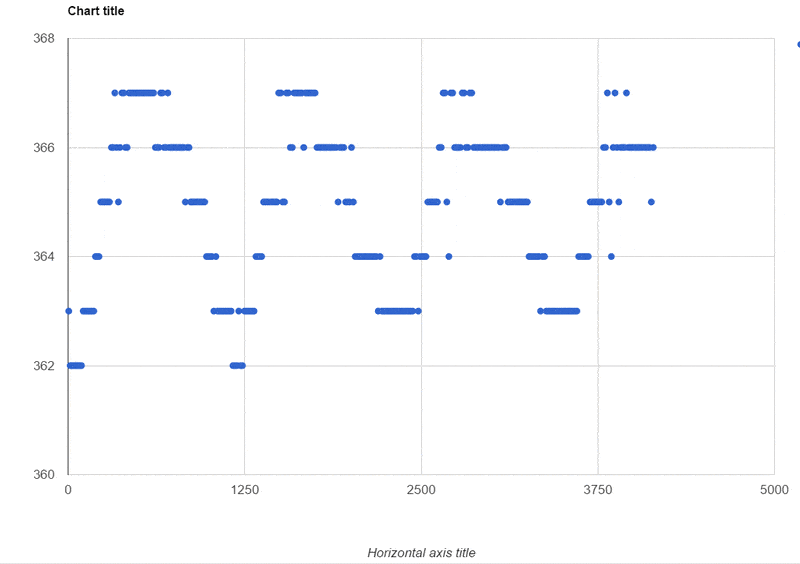
pendulumdata.GIF
 
Physics news on Phys.org
Have you tried just doing a Fourier transform?
 
Thanks, I think that's a step in the right direction. I haven't done one since college so I'm rusty at it.

A little background...
I teach high school Physics.

Earlier this year our school got a few 3d printers. My students and I are together learning how to design things. I thought it would be fun to build a robotic person on a playground swing. Our "swingman" can lean his torso and kick his lower legs. We time his period unpowered with a stopwatch and then code that into an Arduino which tells him how often to pump.

It would be nicer if "swingman" could figure that out on his own. We're guessing that we could get more amplitude if the timing were better. The forward motion and backwards motion should have slightly different periods, as his center of mass changes. And as the amplitude gets larger, it becomes a factor in the period. So I'm trying to use the accelerometer to get better timing of his motions.

Here's a Youtube of the setup:
 
  • Like
Likes   Reactions: 256bits

Similar threads

  • · Replies 1 ·
Replies
1
Views
4K
  • · Replies 3 ·
Replies
3
Views
8K
Replies
3
Views
6K
  • · Replies 30 ·
2
Replies
30
Views
9K
Replies
29
Views
6K
  • · Replies 1 ·
Replies
1
Views
3K