Determining whether grid coordinates lie within a circle

Click For Summary
To determine if a grid cell lies within a circle, the distance from the cell's coordinates to the circle's center must be compared to the circle's radius. The discussion highlights the challenge of calculating this distance without using a square root, as it can be computationally expensive. It suggests leveraging the monotonic nature of the square root function to simplify the calculation. The conversation also touches on the ambiguity of defining "within" a circle, especially regarding grid cells that may partially intersect the circle's boundary. Overall, the focus is on finding an efficient method to assess the relationship between grid coordinates and a defined circular area.
STENDEC
Messages
21
Reaction score
0
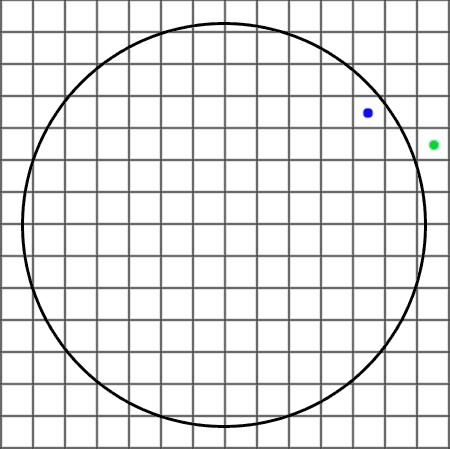
I have a grid and want to determine whether a point lies within (our outside of) a circle.
asXctUw.png


The grid cells simply have integer coordinates, e.g. x = 5, y = 7. The circle's radius is known, and also an integer value.

I wrote a program that can place points in a (quantized) circle using sin/cos, but I can't seem to wrap my head around how to check whether a grid cell lies within a circle of a given radius. Maybe someone can guide me into the right direction. Thanks.
 
Mathematics news on Phys.org
What is your definition of "within"? Surely that blue square in your picture has a part outside the circle.
 
If you think of the border being derived from the sin/cos values describing the circle, rounded to the nearest integer; A blocky ring if you will.

It doesn't have to be accurate to the single cell if there's some ambiguity about that. X and Y coordinates and 2 states per cell (on/off) is all that's being processed.
 
Do you know the x and y coordinates of the center of the circle, the x and y coordinates of your point and the radius of the circle? If so, compute the distance from the point to the center of the circle and compare that to the radius.

Naively, that computation requires evaluating a square root. Can you think of a way to avoid that?

Hint: The square root function is strictly monotone increasing.
 
That's the help I needed. I'll think about your hint on whether/how sqrt can be avoided in this scenario. I'm not solid in math as is evident I think :shy:
 
Here is a little puzzle from the book 100 Geometric Games by Pierre Berloquin. The side of a small square is one meter long and the side of a larger square one and a half meters long. One vertex of the large square is at the center of the small square. The side of the large square cuts two sides of the small square into one- third parts and two-thirds parts. What is the area where the squares overlap?

Similar threads

  • · Replies 5 ·
Replies
5
Views
4K
Replies
2
Views
2K
  • · Replies 20 ·
Replies
20
Views
4K
  • · Replies 3 ·
Replies
3
Views
9K
  • · Replies 8 ·
Replies
8
Views
4K
Replies
7
Views
2K
  • · Replies 40 ·
2
Replies
40
Views
5K
  • · Replies 3 ·
Replies
3
Views
5K
  • · Replies 51 ·
2
Replies
51
Views
5K
  • · Replies 6 ·
Replies
6
Views
2K