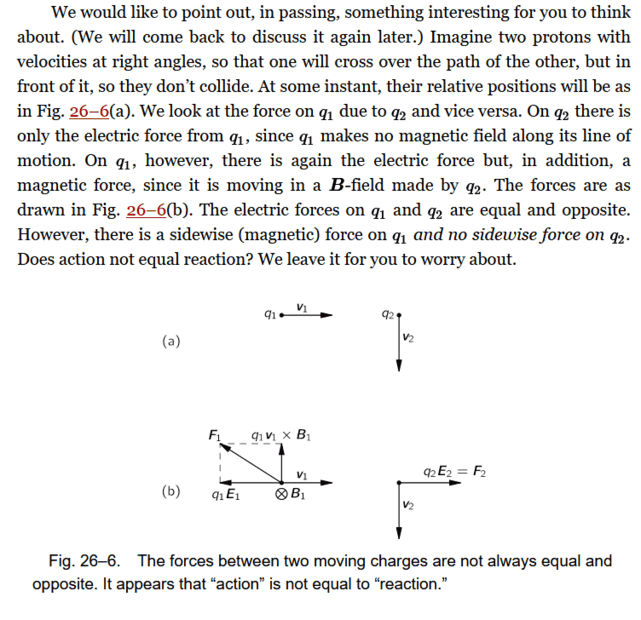
Did Feynman make a mistake in the drawing of moving charges?

Click For Summary
SUMMARY

The discussion centers on the interpretation of Feynman's diagrams depicting the forces on moving charges, specifically addressing the labeling of electric fields and forces. Participants clarify that the fields at each charge, denoted as ##\mathbf{E}_1## and ##\mathbf{B}_1##, are correctly labeled according to the conventions of electromagnetic theory. It is established that the diagram, drawn by Matthew Sands, accurately represents the forces acting on the charges, and any confusion arises from subjective interpretations rather than factual inaccuracies. The linearity of Maxwell's equations allows for the decomposition of fields, affirming that the diagram's labeling is valid.

PREREQUISITES
  • Understanding of Maxwell's equations and their linearity
  • Familiarity with electromagnetic field theory
  • Knowledge of vector notation in physics
  • Basic principles of charge interactions and forces
NEXT STEPS
  • Study the implications of Maxwell's equations on electromagnetic fields
  • Explore the differences between electric fields and forces in particle interactions
  • Investigate the role of diagrammatic representations in physics
  • Learn about the historical context of Feynman's lectures and their impact on modern physics
USEFUL FOR

Physics students, educators, and anyone interested in the nuances of electromagnetic theory and the interpretation of Feynman's work in the context of charge interactions.

Jaaanosik
Messages
27
Reaction score
0
TL;DR
Did Feynman make a mistake in the drawing of moving charges?
This is from Feynman's lectures: https://www.feynmanlectures.caltech.edu/II_26.html

1715867530007.png


Should the (b) say F1=q1E2 and F2=q2E1?
 
Physics news on Phys.org
It is an arbitrary choice. I take it that ##\mathbf{E}_1## and ##\mathbf{B}_1## are the electric and magnetic field at the position of particle 1.
 
  • Like
Likes   Reactions: mattt and Dale
DrClaude said:
It is an arbitrary choice. I take it that ##\mathbf{E}_1## and ##\mathbf{B}_1## are the electric and magnetic field at the position of particle 1.
That does not make sense.
If there is a charge ##q_3## and the field from ##q_2## would be named ##\mathbf{E}_3##?

This is more intuitive: source...

1715872622713.png
 
Jaaanosik said:
That does not make sense.
If there is a charge ##q_3## and the field from ##q_2## would be named ##\mathbf{E}_3##?

This is more intuitive: source...

View attachment 345367
That’s completely subjective. There is nothing wrong with naming the fields at 1 ##\vec E_1## and ##\vec B_1##, respectively. In the end, there is only a single electromagnetic field so in some sense it is more natural to use that naming convention. The only reason you can split the field into contributions from different sources is that Maxwell’s equations are linear. This is not the case for all field theories.
 
  • Like
Likes   Reactions: mattt and Dale
As long as the diagrams match the text and the equations then it is not a mistake. But it certainly could be confusing even without being a mistake
 
First of all, I would like to mention that Feynman did not draw this figure. Matthew Sands drew it. Feynman's figure we much simpler; You can see him standing by it in photo #9 of the blackboard photos that are posted with this lecture in the online edition of FLP. Secondly, it seems obvious that in this figure E_n and B_n are the electric and magnetic field at charge q_n. I see nothing confusing about this whatsoever.
 
  • Like
Likes   Reactions: DrClaude, Lord Jestocost, Nugatory and 2 others
Jaaanosik said:
Should the (b) say F1=q1E2 and F2=q2E1?
No, the diagram is clearly labeled, showing that E1 points left from q1 (the left arrow labeled q1E1), while the right arrow from q2 is labeled q2E2.
Jaaanosik said:
That does not make sense.
If there is a charge ##q_3## and the field from ##q_2## would be named ##\mathbf{E}_3##?
That is certainly a valid option for labeling diagrams. But note that it's not "the field from q2", it's "the field at q3".
Jaaanosik said:
This is more intuitive: source...
Not really. That source is talking about placing a test charge in a field produced by 2+ charges (for a total of 3+ charges), whereas your post is about the force of a single charge acting on a single other charge. Note that you are NOT drawing field lines from each charge in your first post (or decomposing the composite lines into their individual charge contributions), which is what they do in the diagram you linked in post #3.

The line labeled q1E1 in the first post isn't a field line, it's the electric force on the particle. Same for the q2E2 line.
 
  • Like
Likes   Reactions: Orodruin

Similar threads

  • · Replies 4 ·
Replies
4
Views
2K
  • · Replies 15 ·
Replies
15
Views
2K
  • · Replies 1 ·
Replies
1
Views
968
  • · Replies 3 ·
Replies
3
Views
2K
  • · Replies 2 ·
Replies
2
Views
2K
  • · Replies 8 ·
Replies
8
Views
3K
  • · Replies 9 ·
Replies
9
Views
3K
Replies
3
Views
784
  • · Replies 3 ·
Replies
3
Views
3K
  • · Replies 28 ·
Replies
28
Views
4K