Dielectric half-filled parallel plate capacitor

Join the discussion
Ask a follow-up here, or get your own question answered by working scientists, mathematicians and engineers — people, not an autocomplete.
Real named experts · corrections over time · the nuance an AI answer skips
3 replies · 23K views
unscientific
Messages
1,728
Reaction score
13
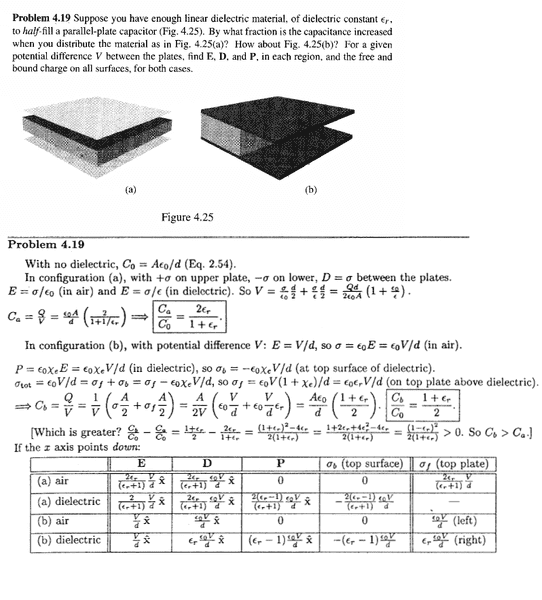
Question taken from Griffiths Pg 185, Problem 4.19:

For part (b):

-Why are the electric fields the same whether in dielectric or in air? In part (a), they are clearly different!

-Why is [tex]σ_{tot} = ε_{0}E = ε_{0}\frac{V}{d}[/tex]

-In calculation of capacitance, why is the total charge [tex](\frac {A}{2})(σ_{tot} + σ<br /> _f)[/tex]?part (a) makes perfect sense, but in part (b) it is confusing..
4p6hi.png
 
Physics news on Phys.org
The fields are the same for the same PD if you change the dielectric throughout because Field is PD/spacing (volts per metre).
When you have two different sections, you can treat it as two capacitors in series, each with the same value of Q. The potential across each bit is no longer fixed by the power supply PD but the PD is shared between the two series capacitors according to 1/C. (Remember V=Q/C). Then each field is given by PD/width. (It's just another version of the potential divider thing only with Cs instead of Rs.

If you just apply the right formula at the right time, the right answer pops out.
 
You can use circuit theory for that one.
(a) can be seen as two capacitors in series.
one with a capacity of A * e0 / (0.5 * d) and the other A * er * e0 / (0.5 * d).
And part (b) can be seen as two capacitors in parallel.
One with 0.5 * A * e0 / d and the other 0.5 * A * er * e0 / d.