Difference between Elastic Limit & Yield Point

Click For Summary
The discussion clarifies the difference between the Elastic Limit and Yield Point on a stress/strain curve for ductile materials. The Elastic Limit is where the material can return to its original shape, while the Yield Point marks the transition from elastic to plastic behavior. Participants note that there can be multiple yield points (Y1 and Y2) in some ductile materials, indicating upper and lower yield points, with the region between the Elastic Limit and the first yield point exhibiting both elastic and plastic properties. It is also mentioned that some materials may not have a defined yield point, which can be approximated by a 0.2% plastic strain. The conversation emphasizes that while plastic and permanent deformation are often used interchangeably, they can describe different aspects of material behavior.
tomtomtom1
Messages
160
Reaction score
8
Hi All

I am trying to understand a stress / strain curve for a ductile material.

But I am struggling with understanding the difference between the Elastic Limit and the Yield Point. I define these terms as:-

Elastic Limit - Is the point on the stress/strain curve where the material will behave elastically i.e. will return to its original shape without leaving any permanent deformations.

Yield Point - The yield point is the point on a stress–strain curve that indicates the limit of elastic behaviour and the beginning of plastic behaviour.

Assuming that you agree with these definitions then the Elastic limit and Yield Point should be the same point on the stress strain curve - But they are NOT?

To help me better understand I created a stress strain curve for a ductile material and labelled them.
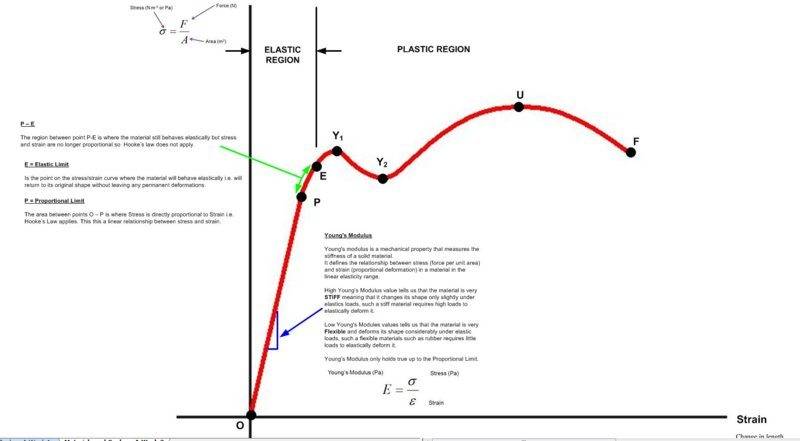
ffffffffffffffffffffffff.JPG


I understand everything up to point E which is the elastic limit.

I have been told that Y1 and Y2 are yield points but why are there two of them and why is E and Y1 on different points on the curve?

What is happening between E and Y1?

Can anyone help explain?

Thank you.
 

Attachments

  • ffffffffffffffffffffffff.JPG
    ffffffffffffffffffffffff.JPG
    23.5 KB · Views: 5,346
Engineering news on Phys.org
I might be wrong but I thought the yield point was the point at which strain started to increase without much or any extra stress being added. So ductile materials have wider region between the two points than brittle materials.
 
Some materials do not have a well defined yield point, so the yield point is defined as 0.2% plastic strain. That could be point E on your curve. Points Y1 and Y2 apply to some (not all) ductile materials, where the stress decreases immediately after yielding. They are the upper and lower yield points. So "the" yield point could be point E, point Y1, or somewhere between those two points.

Wikipedia has a good article: https://en.wikipedia.org/wiki/Yield_(engineering)
 
Yes, it is possible for a material to have a higher elastic limit than yield point. This means that the material can withstand greater stress without permanently deforming, but once it reaches the yield point, it will begin to deform plastically.

but don't plastic deformation and permanent deformation mean the same thing?
 
I think until the elastic limit, the material has only elastic properties, and in the region between the elastic limit and the yield point, the material has both elastic and plastic properties, but after the yield point, the material has only plastic properties
 
What mathematics software should engineering students use? Is it correct that much of the engineering industry relies on MATLAB, making it the tool many graduates will encounter in professional settings? How does SageMath compare? It is a free package that supports both numerical and symbolic computation and can be installed on various platforms. Could it become more widely used because it is freely available? I am an academic who has taught engineering mathematics, and taught the...

Similar threads

  • · Replies 2 ·
Replies
2
Views
3K
  • · Replies 2 ·
Replies
2
Views
6K
  • · Replies 2 ·
Replies
2
Views
5K
  • · Replies 3 ·
Replies
3
Views
2K
Replies
2
Views
9K
  • · Replies 9 ·
Replies
9
Views
7K
  • · Replies 3 ·
Replies
3
Views
3K
  • · Replies 1 ·
Replies
1
Views
4K
  • · Replies 5 ·
Replies
5
Views
19K
  • · Replies 1 ·
Replies
1
Views
1K