Difference between scalar and cross product

Join the discussion
Ask a follow-up here, or get your own question answered by working scientists, mathematicians and engineers — people, not an autocomplete.
Real named experts · corrections over time · the nuance an AI answer skips
5 replies · 2K views
member 731016
Homework Statement
I am interested to understand how to tell when to use the scalar or cross product when solving physics problems.
Relevant Equations
Instantaneous angular momentum = cross product of the instantaneous position vector and instantaneous momentum
Hi!

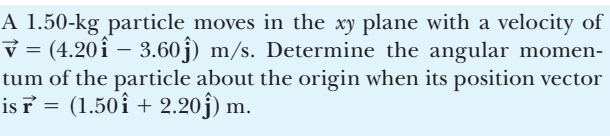
For example, how do you tell whether to use the scalar or cross product for an problem such as,
1669785436146.png

However, I do know that instantaneous angular momentum = cross product of the instantaneous position vector and instantaneous momentum. However, what about if I didn't know whether I'm meant to take the cross product or scalar product of the quanties given. For example, for this work problem,

1669785598405.png

How would I tell whether to use the scalar or dot product just by looking at the work equation,
1669785624702.png


Many thanks!
 
Last edited by a moderator:
Physics news on Phys.org
Callumnc1 said:
How would I tell whether to use the scalar or dot product just by looking at the work equation,
View attachment 317934
The equation you posted shows ##\cdot##, the dot (or 'scalar') product operator. If it were the cross (or 'vector') product it would show ##\times## as the operator.
 
Reply
  • Like
Likes   Reactions: member 731016 and Orodruin
Given two 3D vectors, ##\mathbf{A}## and ##\mathbf{B}##, in component form, and you were asked to find the angle between them, you could use either the dot product or the cross product. First you find the magnitudes, ##A## and ##B##, using the Pythagorean theorem in 3D. Then,
$$\cos\theta=\frac{\mathbf{A}\cdot\mathbf{B}}{AB}\implies \theta=\arccos\left[\frac{\mathbf{A}\cdot\mathbf{B}}{AB}\right].$$ Note that if the dot product is negative, the angle is greater than 90°, because ##\cos(\pi-\theta)=-\cos\theta.##

You could also use, $$\sin\theta=\frac{\|\mathbf{A}\times\mathbf{B}\|}{AB}\implies \theta=\arcsin\left[\frac{\|\mathbf{A}\times\mathbf{B}\|}{AB}\right].$$ However, I do not recommend this method for two reasons: (a) an additional calculation is needed to find the magnitude of the cross product vector ##\|\mathbf{A}\times\mathbf{B}\|##; (b) one has to draw the vectors tail-to-tail to figure out whether the angle is less or greater than 90° because ##\sin(\pi-\theta)=+\sin\theta##. More work means increased likelihood for mistakes.
 
Reply
  • Like
Likes   Reactions: member 731016
kuruman said:
Given two 3D vectors, ##\mathbf{A}## and ##\mathbf{B}##, in component form, and you were asked to find the angle between them, you could use either the dot product or the cross product. First you find the magnitudes, ##A## and ##B##, using the Pythagorean theorem in 3D. Then,
$$\cos\theta=\frac{\mathbf{A}\cdot\mathbf{B}}{AB}\implies \theta=\arccos\left[\frac{\mathbf{A}\cdot\mathbf{B}}{AB}\right].$$ Note that if the dot product is negative, the angle is greater than 90°, because ##\cos(\pi-\theta)=-\cos\theta.##

You could also use, $$\sin\theta=\frac{\|\mathbf{A}\times\mathbf{B}\|}{AB}\implies \theta=\arcsin\left[\frac{\|\mathbf{A}\times\mathbf{B}\|}{AB}\right].$$ However, I do not recommend this method for two reasons: (a) an additional calculation is needed to find the magnitude of the cross product vector ##\|\mathbf{A}\times\mathbf{B}\|##; (b) one has to draw the vectors tail-to-tail to figure out whether the angle is less or greater than 90° because ##\sin(\pi-\theta)=+\sin\theta##. More work means increased likelihood for mistakes.
Thank you kuruman for your answer! It is Interesting to know how to find the angle between vectors using the cross and scalar product.
 
Reply
  • Like
Likes   Reactions: kuruman