Differential Forms.... Another question.... Browder, Sec 13.1

Click For Summary
SUMMARY

The discussion centers on Section 13.1 of Andrew Browder's book "Mathematical Analysis: An Introduction," specifically regarding the nature of the mapping ##\text{dx}_P^j## and its evaluation of the components ##h^i##. Participants clarify that ##\text{dx}_P^j## is a linear functional, or 'one-form', which evaluates to a real number when applied to a vector in the tangent space. The distinction between the manifold M and the tangent bundle TM is emphasized, as well as the implications of Browder's 1996 text on modern interpretations of differential forms.

PREREQUISITES
  • Understanding of differential forms and tensor fields
  • Familiarity with manifolds and tangent bundles
  • Knowledge of linear functionals and their properties
  • Basic concepts of real analysis and vector spaces
NEXT STEPS
  • Study the properties of linear functionals in differential geometry
  • Explore modern texts on differential forms for updated perspectives
  • Learn about the relationship between manifolds and tangent bundles
  • Investigate the implications of Browder's work in contemporary mathematical analysis
USEFUL FOR

Mathematicians, students of differential geometry, and anyone interested in the application of differential forms in analysis will benefit from this discussion.

Math Amateur
Gold Member
MHB
Messages
3,920
Reaction score
48
I am reading Andrew Browder's book: "Mathematical Analysis: An Introduction" ... ...

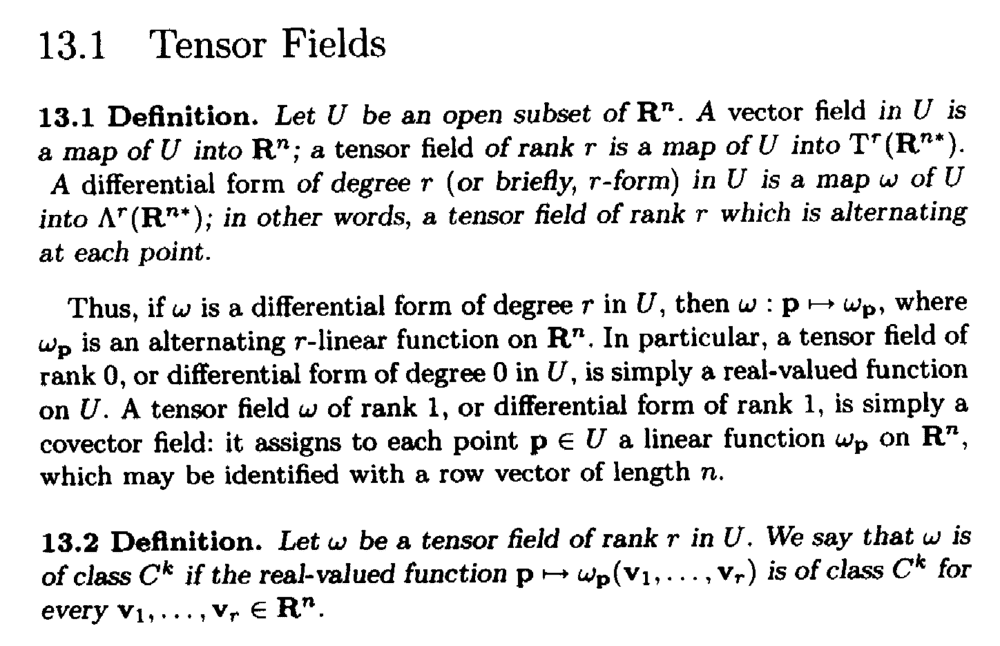
I am reading Chapter 13: Differential Forms ... ... and am currently focused on Section 13.1 Tensor Fields ...

I need some help in order to fully understand some statements by Browder in Section 13.1 ... ...


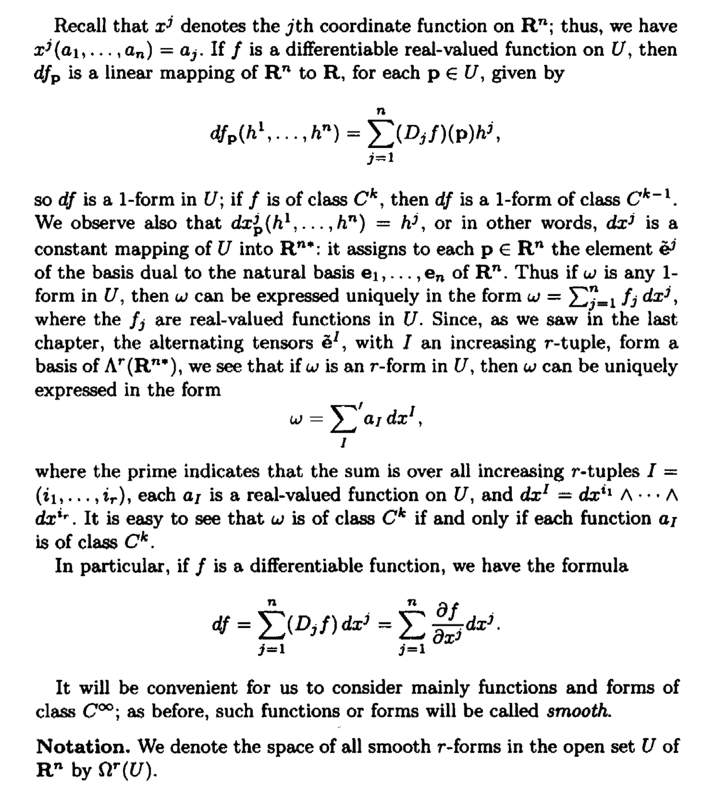
Section 13.1 reads as follows:
?temp_hash=b63a36a349d9b9bbedf37aea4772fe69.png

?temp_hash=b63a36a349d9b9bbedf37aea4772fe69.png


In the above text we read the following:

" ... ... We observe also that ##\text{dx}_P^j (h^1, \cdot \cdot \cdot , h^n) = h^j## ... ... "My question is what is the nature of the ##h^i## ... given that ##\text{dx}_P^j## is a constant mapping from an open subset ##U## of ##\mathbb{R}^n## it seems that the ##h^i## are real numbers ...

... BUT ... then it seems strange that ##\text{dx}_p^j (h^1, \cdot \cdot \cdot , h^n) = h^j## ... that is ... how can the function evaluate to a real number when it is a constant mapping into ##\mathbb{R}^{ n \ast }## ... it should evaluate to a linear functional, surely ...

... indeed ... should Browder have written ...

##\text{dx}_P^j (h^1, \cdot \cdot \cdot , h^n) = \tilde{e}^j##
Can someone please clarify the above ...

Peter
 

Attachments

  • Browder - Defn of a differential form .png
    Browder - Defn of a differential form .png
    59.4 KB · Views: 408
  • Browder - 2 - Start of Section 13.1 ... ... PART 2  ... .png
    Browder - 2 - Start of Section 13.1 ... ... PART 2 ... .png
    60.3 KB · Views: 382
  • Browder - 2 - Start of Section 13.1 ... ... PART 2  ... .png
    Browder - 2 - Start of Section 13.1 ... ... PART 2 ... .png
    60.3 KB · Views: 387
  • ?temp_hash=b63a36a349d9b9bbedf37aea4772fe69.png
    ?temp_hash=b63a36a349d9b9bbedf37aea4772fe69.png
    59.4 KB · Views: 494
  • ?temp_hash=b63a36a349d9b9bbedf37aea4772fe69.png
    ?temp_hash=b63a36a349d9b9bbedf37aea4772fe69.png
    60.3 KB · Views: 471
Physics news on Phys.org
I think it really helps to distinguish between the manifold, often denoted by M, and the tangent bundle, usually denoted by TM, which is the union of all tangent spaces to points on the manifold. TM consists of vectors, whereas M consists of points that may or may not be vectors. Unfortunately, that distinction is obscured here by the author specifying that U, which is a part of the manifold, is a subset of ##\mathbb R^n##, which is a vector space as well as a manifold. Is it an old text? Newer texts tend to avoid assuming the manifold is embedded in ##\mathbb R^n##, partly to give greater generality, but also to avoid this sort of confusion.
Math Amateur said:
My question is what is the nature of the ##h^i## ... given that ##\text{dx}_P^j## is a constant mapping from an open subset ##U## of ##\mathbb{R}^n## it seems that the ##h^i## are real numbers ...
Not quite. If you look carefully, you will see that it is ##dx^j## that is a map whose domain is ##U##. That domain is part of the manifold. The function ##dx^i_{\mathbf p}## has a domain that is the tangent space ##T_{\mathbf p}M##, which is a vector space. That domain has no intersection with ##U##. That's why the argument to the function ##x^j## is given as a ##n##-tuple of numbers with lower subscripts ##(a_1,...,a_n)##, being coordinates of a manifold point, and the same applies to the argument to the function ##dx^j##. But the argument to the function ##dx^j_{\mathbf p}## has components with superscripts - ##(h^1,...,h^n)## - because they are components of a vector in the tangent space at ##\mathbf p##.
it seems strange that ##\text{dx}_p^j (h^1, \cdot \cdot \cdot , h^n) = h^j## ... that is ... how can the function evaluate to a real number when it is a constant mapping into ##\mathbb{R}^{ n \ast }## ... it should evaluate to a linear functional, surely ...

... indeed ... should Browder have written ...

##\text{dx}_P^j (h^1, \cdot \cdot \cdot , h^n) = \tilde{e}^j##
The correct expression is

##\text{dx}_P^j= \tilde{e}^j##, which is a linear functional, aka a 'one-form'.

Then when we apply it to the vector ##\vec h##, which the author writes in component form as ##(h^1,...,h^n)##, we get a real number.
 
  • Like
Likes   Reactions: Math Amateur
Thanks Andrew ...

Really appreciate your help ...

Still reflecting on what you have written ...

Your distinction between M and TM was most illuminating...

Thanks again...

Peter

NOTE: Browder's text was published in 1996
 

Similar threads

  • · Replies 3 ·
Replies
3
Views
3K
  • · Replies 2 ·
Replies
2
Views
2K
Replies
2
Views
2K
  • · Replies 4 ·
Replies
4
Views
2K
  • · Replies 2 ·
Replies
2
Views
2K
Replies
2
Views
2K
  • · Replies 2 ·
Replies
2
Views
2K
  • · Replies 6 ·
Replies
6
Views
3K
Replies
7
Views
2K
Replies
2
Views
2K