Undergrad Differential Forms in General Relativity: Definition & Use

Click For Summary
The discussion centers on the definition of differential forms in General Relativity and the inconsistency between definitions found online and in personal textbooks. Participants emphasize the importance of citing specific sources to validate claims about definitions. There is a call for the original poster to compare the definitions from their book with the one they found online. The conversation highlights the need for clarity and reference in academic discussions. Overall, the thread underscores the significance of precise definitions in understanding complex mathematical concepts in General Relativity.
kent davidge
Messages
931
Reaction score
56
Some time ago I was looking around the web for the use of differential equations in General Relativity. Then I found a definition (below) of differential forms, but I noted that the definition on my book is different from this one. Could someone tell me if it is right?
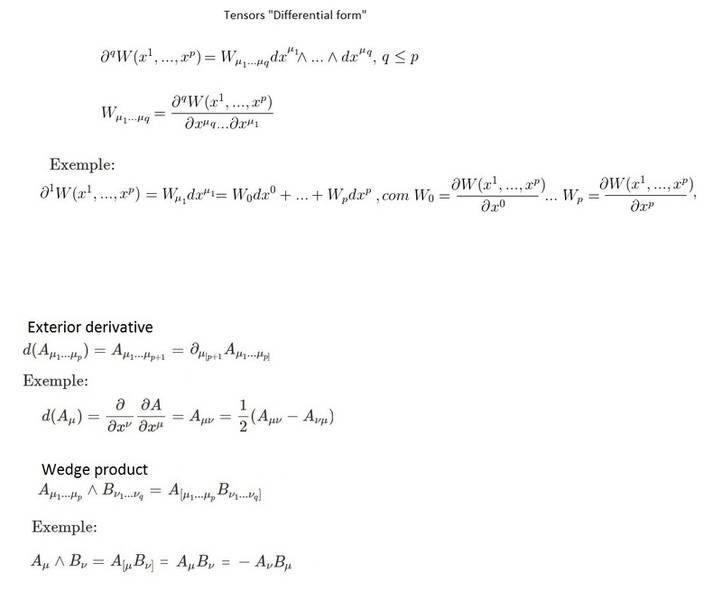
vyl6if.jpg
 
Physics news on Phys.org
kent davidge said:
Then I found a definition (below) of differential forms

Where? You should not post something like this without giving a specific reference for where you got it.

kent davidge said:
the definition on my book

Which book? Same point as above.
 
PeterDonis said:
Where? You should not post something like this without giving a specific reference for where you got it.

Which book? Same point as above.
I forgot where I found it. I just wish to know if this definition is consistent with definitions commonly given in books.
 
kent davidge said:
I just wish to know if this definition is consistent with definitions commonly given in books.

You referred to "the definition in my book". That implies that you have a specific book already, so you should be able to look at the definition in it and compare it to what you posted in the OP. Have you done that? Are they the same? If not, what differences did you see? Can you post them?
 
In an inertial frame of reference (IFR), there are two fixed points, A and B, which share an entangled state $$ \frac{1}{\sqrt{2}}(|0>_A|1>_B+|1>_A|0>_B) $$ At point A, a measurement is made. The state then collapses to $$ |a>_A|b>_B, \{a,b\}=\{0,1\} $$ We assume that A has the state ##|a>_A## and B has ##|b>_B## simultaneously, i.e., when their synchronized clocks both read time T However, in other inertial frames, due to the relativity of simultaneity, the moment when B has ##|b>_B##...

Similar threads

  • · Replies 10 ·
Replies
10
Views
2K
  • · Replies 38 ·
2
Replies
38
Views
7K
  • · Replies 12 ·
Replies
12
Views
2K
  • · Replies 5 ·
Replies
5
Views
2K
  • · Replies 21 ·
Replies
21
Views
2K
  • · Replies 10 ·
Replies
10
Views
2K
  • · Replies 10 ·
Replies
10
Views
3K
  • · Replies 16 ·
Replies
16
Views
1K
  • · Replies 19 ·
Replies
19
Views
3K
  • · Replies 38 ·
2
Replies
38
Views
1K