Differential Pressure measurement problem

Click For Summary
SUMMARY

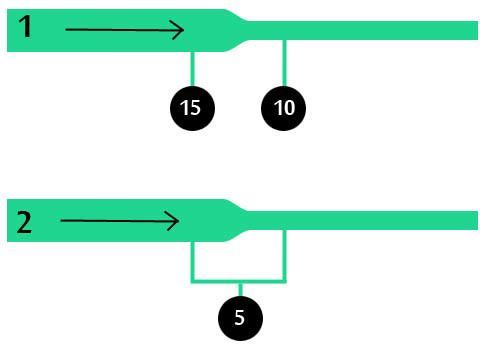
The discussion focuses on measuring differential pressure in a fluid system using two setups. In setup 1, a pressure gauge measures 15psi before and 10psi after a pipe diameter reduction, resulting in a 5psi differential. In setup 2, a thin tube connects both diameters to a single gauge, which will not read the differential pressure directly but rather the static pressure influenced by flow conditions. A U-tube manometer is recommended for accurate differential pressure measurement without flow interference.

PREREQUISITES
  • Understanding of fluid dynamics principles
  • Knowledge of pressure measurement techniques
  • Familiarity with U-tube manometers
  • Basic concepts of pipe flow and pressure differentials
NEXT STEPS
  • Research the operation and applications of U-tube manometers
  • Study fluid dynamics related to pipe flow and pressure changes
  • Explore the effects of pipe geometry on pressure readings
  • Learn about different types of pressure gauges and their uses
USEFUL FOR

Engineers, fluid mechanics students, and technicians involved in pressure measurement and fluid system design will benefit from this discussion.

vega7
Messages
1
Reaction score
0
Here is a relatively simple problem. I'm wondering if someone can give me their opinion on it or actually know experimentally if it is true.

Here is the diagram:
pipe.jpg


A flow of liquid (say water) is pumped through a pipe that has a reduction in diameter. You place a pressure gauge before and after the reduction to measure the pressure.
In setup 1, you have 15psi before and 10psi after. The pressure differential is 5psi.

Now, here is the part I am not sure about. In setup 2, If you connected a thin tube (as not to disturb system) between both diameters and then placed one gauge. What would that gauge read? Would this setup work?
Would the pressure read the differential pressure of 5psi (as above)? Or, would it just be the average of the pressures 12.5psi? Or, would it read something else?

Has anyone tried this?
 
Engineering news on Phys.org
Think about the limiting case where there was no flow through the system and the pressure was the same everywhere (say 10psi). Why do you think the gauge in setup 2 would read zero?

If there is some flow through the large pipe, there will also be flow through the small pipe. The gauge will read the static pressure in the small pipe, which will be some value between 15psi and 10psi depending on the exact geometry of the system.

You could connect a single gauge to measure the pressure difference across the change in area, but you would need a gauge with NO flow through it, e.g. a U-tube manometer with the one arm of the U connected to the upstream side and the other to the downstream side.
 

Similar threads

  • · Replies 1 ·
Replies
1
Views
8K
  • · Replies 10 ·
Replies
10
Views
6K
  • · Replies 13 ·
Replies
13
Views
3K
Replies
1
Views
2K
  • · Replies 2 ·
Replies
2
Views
3K
  • · Replies 2 ·
Replies
2
Views
3K
  • · Replies 6 ·
Replies
6
Views
2K
  • · Replies 7 ·
Replies
7
Views
6K
  • · Replies 3 ·
Replies
3
Views
1K
  • · Replies 15 ·
Replies
15
Views
3K