Difficult Introductory Electricity Circuit Problem - Capacitors

Click For Summary
SUMMARY

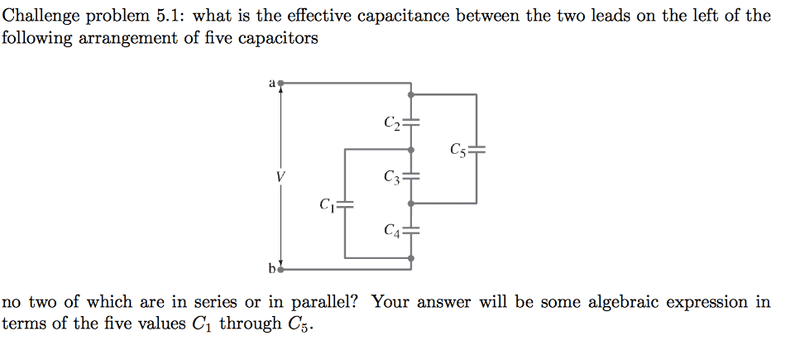
The discussion centers on solving a complex introductory electricity circuit problem involving capacitors. Participants suggest using the equation Q = C V to calculate charge across multiple capacitors arranged in a non-standard configuration. The challenge arises from the lack of series or parallel arrangements among the capacitors, complicating the application of standard methods. Participants recommend using Kirchhoff's Current Law (KCL) to derive equations for the circuit, emphasizing the importance of understanding the unique arrangement of different capacitances.

PREREQUISITES
  • Understanding of capacitor behavior and the equation Q = C V
  • Familiarity with circuit analysis techniques, including Kirchhoff's Current Law (KCL)
  • Knowledge of Wheatstone bridge configurations
  • Basic principles of series and parallel capacitor combinations
NEXT STEPS
  • Research advanced capacitor circuit analysis techniques
  • Study the application of Kirchhoff's Current Law in complex circuits
  • Learn about Wheatstone bridge principles and their applications in capacitor circuits
  • Explore methods for calculating equivalent capacitance in non-standard configurations
USEFUL FOR

Students studying electrical engineering, educators teaching circuit analysis, and anyone seeking to deepen their understanding of capacitor behavior in complex circuits.
Emc2fma
Messages
9
Reaction score
0
Difficult Introductory Electricity Circuit Problem -- Capacitors

Homework Statement


MAvH81u.png


The Attempt at a Solution


This problem was very difficult, and the most I could do was re-arrange the circuit into a make-shift Wheatstone bridge with all capacitors instead of resistors/voltmeter.

Any ideas?
 
Last edited:
Physics news on Phys.org
What you need is a relevant equation ! Hence the template...

I propose Q = C V There are five of them, plus one for the equivalent over-all C, so you should get enough material to solve for the latter.

That's how we do parallel, series, etc. of two capacitors. This one is a little more involved.
 
I've already attempted doing that - I think the big problem is that since no two of them are in series/parallel with each other, it's very difficult to use the standard method.
 
Show what you did, it might be just right, only a bit confusing
 
I scrapped my approach because it wasn't working.

Do you mean I should calculate the charge on the capacitors using Q = VC?
 
Emc2fma said:

Homework Statement


[ IMG]http://i.imgur.com/MAvH81u.png[/PLAIN]

The Attempt at a Solution


This problem was very difficult, and the most I could do was re-arrange the circuit into a make-shift Wheatstone bridge with all capacitors instead of resistors/voltmeter.

Any ideas?
Are the capacitances all different, or do all capacitors have the same capacitance?
 

Attachments

  • MAvH81u.png
    MAvH81u.png
    16.5 KB · Views: 735
They're all different...does that make a difference? I figure the calculation would be the same.
 
Emc2fma said:
They're all different...does that make a difference? I figure the calculation would be the same.
The special case of all being equal allows you to make a drastic simplification right from the start, basing this on symmetry of the circuit. For this reason, the special case cannot qualify as a "challenge problem". :smile:
 
  • Like
Likes   Reactions: 1 person
Emc2fma said:

Homework Statement


MAvH81u.png


The Attempt at a Solution


This problem was very difficult, and the most I could do was re-arrange the circuit into a make-shift Wheatstone bridge with all capacitors instead of resistors/voltmeter.

Any ideas?

I just write the KCL equations for complicated questions like this.
 

Similar threads

  • · Replies 3 ·
Replies
3
Views
1K
  • · Replies 62 ·
3
Replies
62
Views
6K
Replies
2
Views
2K
  • · Replies 1 ·
Replies
1
Views
2K
  • · Replies 15 ·
Replies
15
Views
3K
  • · Replies 11 ·
Replies
11
Views
2K
Replies
11
Views
3K
  • · Replies 1 ·
Replies
1
Views
3K
  • · Replies 4 ·
Replies
4
Views
3K
  • · Replies 14 ·
Replies
14
Views
2K