Digital signal exercise (Manolakis)

Click For Summary
The discussion revolves around a digital signal processing exercise from "Applied Digital Signal Processing: Theory and Practice" by Manolakis and Ingle, where the user seeks help with understanding the problem and using MATLAB. Participants emphasize the importance of making an effort to understand the concepts before asking for assistance, suggesting that the user try basic MATLAB commands to gain insights. The core of the exercise involves finding the one-step equivalent of a series of steps related to convolution and impulse responses in linear systems. While MATLAB skills are beneficial, the primary focus is on grasping the theoretical aspects of the problem. Engaging with the problem statement and attempting initial calculations are encouraged for better understanding.
MaxR2018
Messages
5
Reaction score
0
OP has been reminded to always show their work when posting homework questions at the PF.
Homework Statement
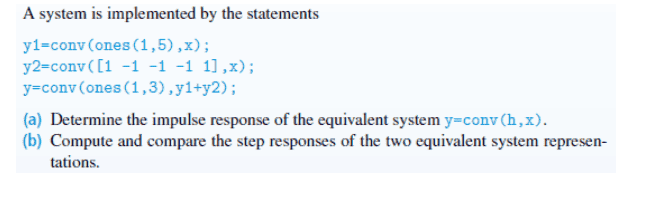
Determine the impulse response of the equivalent system.
Relevant Equations
How to start this exercise?
Hello people, I hope someone can help me with this exercise. This exercise is taken from the book "Applied Digital Signal Processing: Theory and Practice" by manolakis and Ingle. I don't understand what is being asked. The only thing I understand is that I have to use MATLAB necessarily. Someone has the solution of the book or knows how to do it? or at least a clue or suggestion.

Thank you for your time people.
244803
 
Last edited:
Physics news on Phys.org
Hello Max,
You've been around for a year but never been :welcome: 'd ?

Nevertheless, you should know by now that the PF guidelines require some effort on your part before we are allowed to assist... (previously called the 'attempt at solution')

And that 'dunno' ('How to start this exercise? ' is NOT a relevant equation!) isn't good enough !

You could start with a few explanations: what does MATLAB return from e.g.
Matlab:
ones(1,5)
?
And what does it return from
Matlab:
conv([1,-1, -1, -1, 1], x)
when x is e.g. [1,2,2,1] ?
These things you can try out yourself.
You could also type out the problem statement, so helpers can comment without having to retype :wink: ...

I grant you the word 'response' occurs awfully often in the book, but you should still be able to pick an appropriate example and use that by way of 'relevant equation'(By the way, I'm not a Matlab expert, nor a DSP expert and until ten minutes ago I'd never seen the book -- so I'm at the same point as you are with this exercise)

Now it's your turn...
##\ ##
 
  • Like
Likes berkeman
MaxR2018 said:
I don't understand what is being asked.

What is being asked is what is the one-step equivalent of those three steps. What is the ##h## that would be equivalent to those three.

This is not a Matlab question, it's a question about convolution and impulse responses and linear systems, although Matlab knowledge would be helpful in relating those calls to convolutions in your textbook.
 
Last edited:
  • Like
Likes BvU and berkeman
Question: A clock's minute hand has length 4 and its hour hand has length 3. What is the distance between the tips at the moment when it is increasing most rapidly?(Putnam Exam Question) Answer: Making assumption that both the hands moves at constant angular velocities, the answer is ## \sqrt{7} .## But don't you think this assumption is somewhat doubtful and wrong?

Similar threads

  • · Replies 2 ·
Replies
2
Views
2K
  • · Replies 6 ·
Replies
6
Views
2K
  • · Replies 11 ·
Replies
11
Views
4K
  • · Replies 6 ·
Replies
6
Views
2K
  • · Replies 2 ·
Replies
2
Views
2K
  • · Replies 2 ·
Replies
2
Views
1K
  • · Replies 8 ·
Replies
8
Views
3K
  • · Replies 4 ·
Replies
4
Views
2K
Replies
2
Views
1K
Replies
4
Views
2K
