Dimensional Analysis Buckingham Pi Theorem

Click For Summary

Discussion Overview

The discussion revolves around the application of the Buckingham Pi Theorem in dimensional analysis, specifically regarding the selection of variables for forming pi groups in a fluid dynamics context. Participants are examining the relevance of certain variables in relation to a problem involving liquid head pressure at a nozzle.

Discussion Character

  • Technical explanation
  • Debate/contested
  • Homework-related

Main Points Raised

  • One participant identifies a set of pi groups (h1, h2, d, D, g, t, and velocity) but questions the inclusion of Δh, D, t, ρ, d, ϒ, and h1 in the solution without clear justification.
  • Another participant seeks clarification on the meaning of ϒ, suggesting that a combination of h1 and h2 could yield similar results to h1 and Δh.
  • A participant explains that ϒ represents specific weight, defined as density times gravity, and notes that Δh must be included in the pi groups due to its required form in the analysis.
  • It is mentioned that the liquid head pressure at the nozzle is dependent on the fluid's density.
  • One participant reiterates the definition of ϒ and emphasizes that Δh must be part of the terms due to the structure of the pi groups, while also correcting a terminology issue regarding the distinction between dimensionless groups and dimensional parameters.

Areas of Agreement / Disagreement

Participants express differing views on the selection of variables for the pi groups, with some agreeing on the necessity of certain parameters while others question their relevance. The discussion remains unresolved regarding the optimal selection of variables.

Contextual Notes

There is uncertainty regarding the relevance of specific variables in the context of the problem, particularly concerning the inclusion of density and pressure. The discussion also highlights a potential misunderstanding of terminology related to dimensional analysis.

Raddy13
Messages
30
Reaction score
0
This is the problem I'm currently working on:
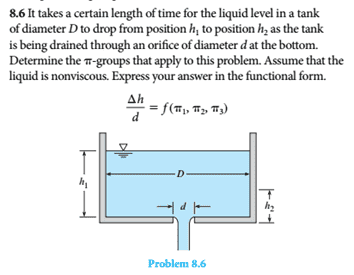
upload_2017-7-19_20-48-23.png


The pi groups I identified were h1, h2, d, D, g, t, and velocity, but when I looked at the solution, it selected Δh, D, t, ρ, d, ϒ, h1, with no explanation why those variables are needed. If I was solving with the Bernoulli equation, I wouldn't need density or specific weight, so why do those come up in this case? And if we're using all variables from the equation even if they're not relevant, then why doesn't pressure appear? The only explanation that the book gives is that "knowing what variables to choose requires experience" and then lists some common ones, but no explanation as to when they would be needed and when they wouldn't.

EDIT: Sorry, I meant to post this in the homework question forum.
<Moderator's note: Moved from a technical forum and thus no template.>
 
Last edited by a moderator:
Physics news on Phys.org
What does ϒ represent? I would think that using combination of h1 and h2 could get the same result as h1 and Δh.
 
ϒ is specific weight (density times gravity).

It would end up with the same result, but since the one of the pi groups has to take the form of Δh/d, so Δh has to be one of the terms.
 
The liquid head pressure a the nozzle is a function of the density of the fluid.
 
Raddy13 said:
ϒ is specific weight (density times gravity).

It would end up with the same result, but since the one of the pi groups has to take the form of Δh/d, so Δh has to be one of the terms.
So the only parameter that they selected that you didn't select was ##\rho##, right?

Incidentally, a terminology issue: The pi groups are the dimensionless groups, not the dimensional parameters.
 

Similar threads

Replies
5
Views
11K
Replies
7
Views
2K
  • · Replies 1 ·
Replies
1
Views
1K
  • · Replies 4 ·
Replies
4
Views
2K
  • · Replies 7 ·
Replies
7
Views
3K
  • · Replies 1 ·
Replies
1
Views
1K
  • · Replies 1 ·
Replies
1
Views
2K
Replies
6
Views
2K
  • · Replies 1 ·
Replies
1
Views
2K
  • · Replies 4 ·
Replies
4
Views
3K