StkMtd
- 7
- 0
First post, after tinkering with electronics so long I just had to join a physics oriented forum.
I'm trying to work out how I can get an input voltage to "clip" at a certain level. I start by imagining an ideal diode (no current on reverse bias, infinite current on forward bias).
My setup is below:
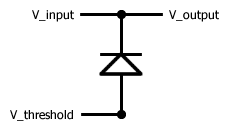
If I had a sine wave from V_sinMin to V_sinMax, I would expect the following behaviour:
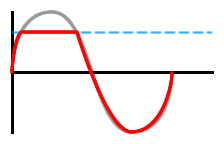
The grey line represents the input sine @ V_input, the red line represents my expected output @ V_output, and the dotted blue line represents V_threshold.
From my interpretation of an ideal diode, my diode will conduct when V_input < V_threshold
Now I know something is missing, because in this current circuit, V_output will simply pass the sine wave I put in.
What I need is for the signal to pass when it's less than V_threshold, but for V_threshold to be passed out when V_input > V_threshold.
One idea that comes to mind is to have a parallel branch come off the cathode of the diode controlling the base of a PNP transistor on the input. In this way, when the diode passes current, V_input will be blocked, and V_output will equal V_threshold. The only problem with this is when V_input comes back down, the diode will have no way to see this and won't stop conducting.
I've been tearing my hair out all day trying to understand clipping diodes (my notebook is about 20 pages shorter now :P), and after searching the internet for guides that don't explain things in a non-ambiguous way, I'm wondering if anyone can explain to me how I can create a clipping circuit with a variable threshold using only diodes (and simple passive components if need be).
My end goal is to create a distortion pedal, and I've looked at guides written by a bunch of "dudes" who think they can explain electronics, but they always seem to leave some critical bits out. I'm not looking to build a distortion pedal for the sheer aesthetic joy of it, I want to further my understanding of how the circuit works.
My roadmap for learning is as follows:
1. Amplify the input signal (covered)
2. Pass the amplified signal into diodes that are set up to clip at a threshold given as an input voltage
If I can understand how to make diodes clip at a given threshold, I can start by using a static voltage for a static clipping level. If I really understand how things work, I should be able to pass any voltage into the threshold input and invent whatever effect I can come up with.
I should note that I'm a hobbyist at this point. I've done a lot of work with digital logic, but I'm looking to branch out into the analog domain. I'll be going to college for electrical engineering in september, but I have a lot of time to kill before then. If I could get this figured out now, I would have something to amuse myself with.
Thanks to anyone who can give me a hand with this.
I'm trying to work out how I can get an input voltage to "clip" at a certain level. I start by imagining an ideal diode (no current on reverse bias, infinite current on forward bias).
My setup is below:
If I had a sine wave from V_sinMin to V_sinMax, I would expect the following behaviour:
The grey line represents the input sine @ V_input, the red line represents my expected output @ V_output, and the dotted blue line represents V_threshold.
From my interpretation of an ideal diode, my diode will conduct when V_input < V_threshold
Now I know something is missing, because in this current circuit, V_output will simply pass the sine wave I put in.
What I need is for the signal to pass when it's less than V_threshold, but for V_threshold to be passed out when V_input > V_threshold.
One idea that comes to mind is to have a parallel branch come off the cathode of the diode controlling the base of a PNP transistor on the input. In this way, when the diode passes current, V_input will be blocked, and V_output will equal V_threshold. The only problem with this is when V_input comes back down, the diode will have no way to see this and won't stop conducting.
I've been tearing my hair out all day trying to understand clipping diodes (my notebook is about 20 pages shorter now :P), and after searching the internet for guides that don't explain things in a non-ambiguous way, I'm wondering if anyone can explain to me how I can create a clipping circuit with a variable threshold using only diodes (and simple passive components if need be).
My end goal is to create a distortion pedal, and I've looked at guides written by a bunch of "dudes" who think they can explain electronics, but they always seem to leave some critical bits out. I'm not looking to build a distortion pedal for the sheer aesthetic joy of it, I want to further my understanding of how the circuit works.
My roadmap for learning is as follows:
1. Amplify the input signal (covered)
2. Pass the amplified signal into diodes that are set up to clip at a threshold given as an input voltage
If I can understand how to make diodes clip at a given threshold, I can start by using a static voltage for a static clipping level. If I really understand how things work, I should be able to pass any voltage into the threshold input and invent whatever effect I can come up with.
I should note that I'm a hobbyist at this point. I've done a lot of work with digital logic, but I'm looking to branch out into the analog domain. I'll be going to college for electrical engineering in september, but I have a lot of time to kill before then. If I could get this figured out now, I would have something to amuse myself with.
Thanks to anyone who can give me a hand with this.