Discharging this capacitor in an RC bridge circuit

Click For Summary

Homework Help Overview

The discussion revolves around the discharging of a capacitor in an RC bridge circuit after a switch has been turned off. Participants are exploring how to determine the time it takes for the current from the capacitor to drop below 1 mA, considering the initial conditions and the circuit configuration.

Discussion Character

  • Exploratory, Conceptual clarification, Assumption checking

Approaches and Questions Raised

  • Participants discuss the need for quantitative information to solve the problem, questioning whether the problem requires a complex formula. There are mentions of voltage dividers and the behavior of the circuit in steady state. Some participants suggest looking at the steady state to determine the voltage across the capacitor and the equivalent resistance during discharge.

Discussion Status

The discussion is active, with participants providing insights into the circuit's behavior and raising questions about the assumptions made in the problem. Some guidance has been offered regarding the use of Thevenin equivalents and the analysis of parallel and series connections, but no consensus has been reached on a specific method or solution.

Contextual Notes

There is a noted absence of quantitative data in the problem, which is affecting the ability to derive a complete solution. Participants are also considering the implications of the initial current assumption of at least 1 mA from the capacitor.

Karl Karlsson
Messages
104
Reaction score
12
Homework Statement
See below
Relevant Equations
Kirchoffs 2 laws
The voltage source in the circuit below has been switched on for a long time when the switch S switches off. How long will it take before the current coming out of the capacitor has become less than 1 mA?

Skärmavbild 2020-02-05 kl. 15.32.24.png


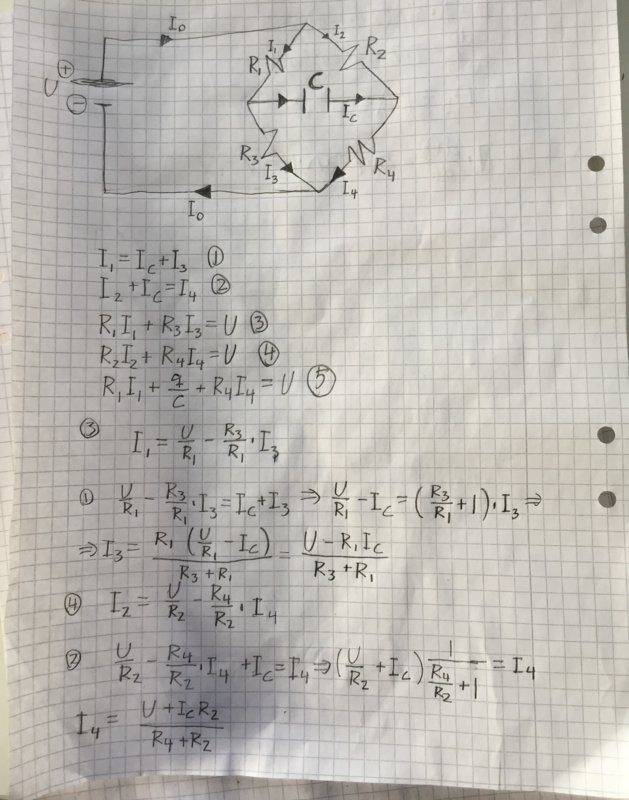
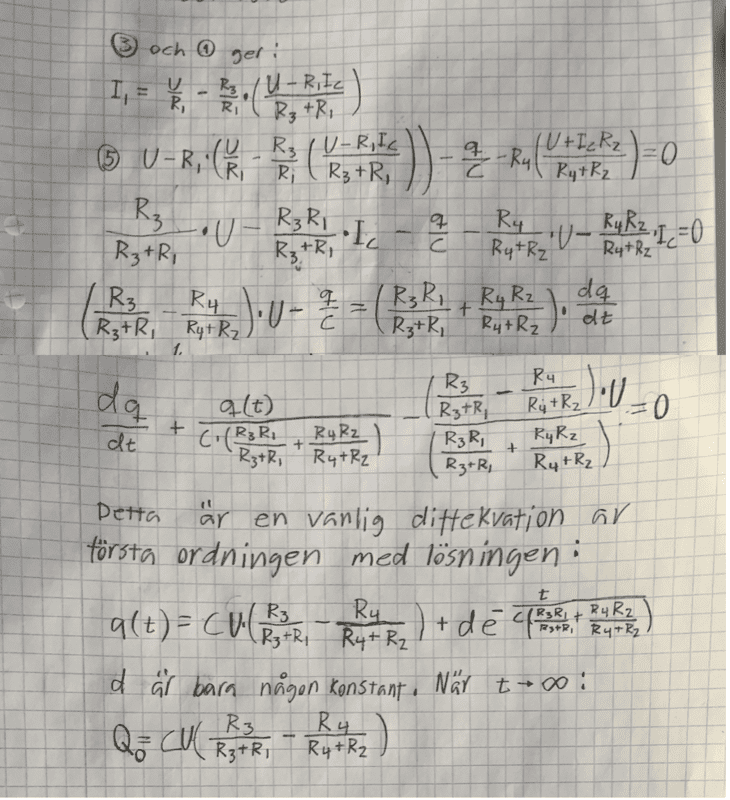
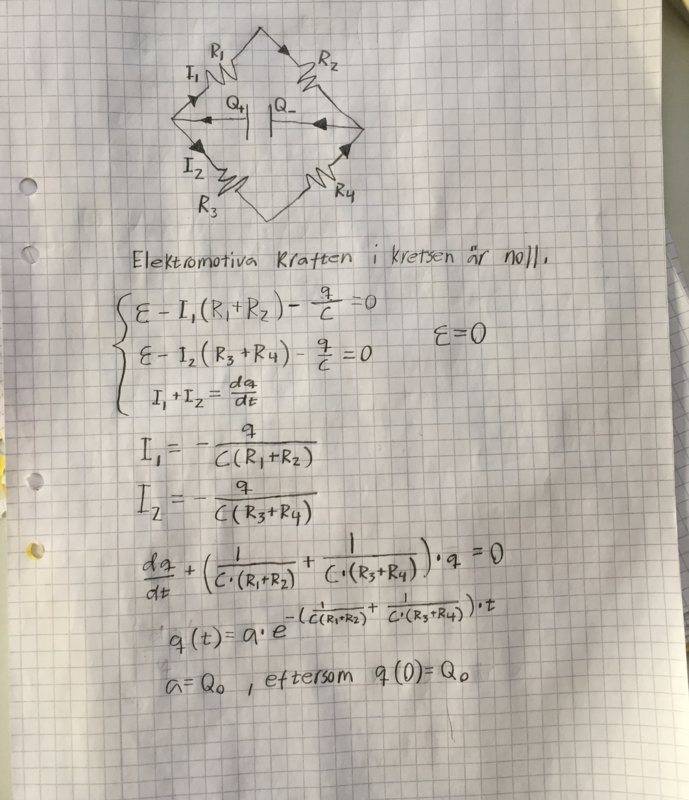
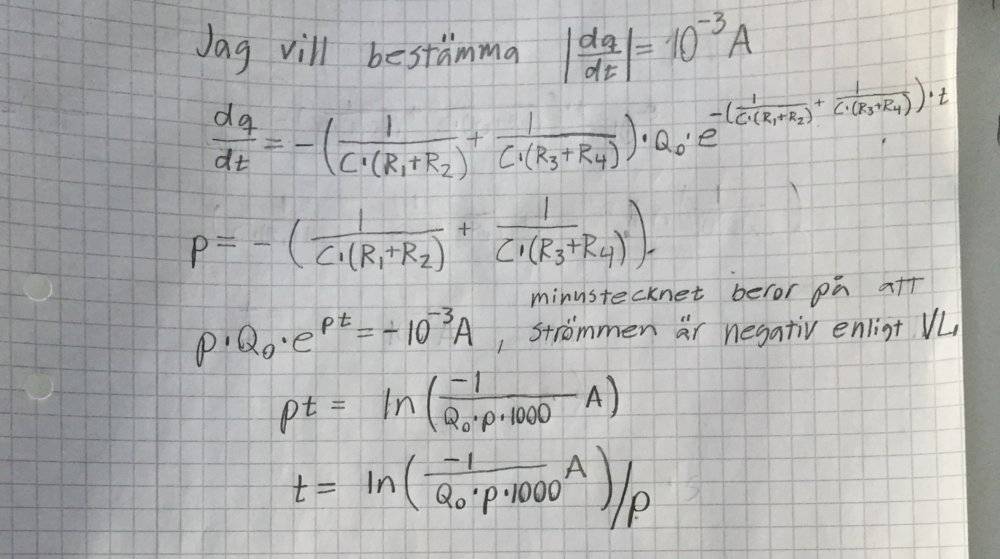
My attempt:
Bild1 (kopia).jpeg


bild2 (kopia).png


bild3 (kopia).jpeg


bild4 (kopia).jpeg


I am far from sure that my solution is correct. This is because i have never done any problem like this one before. I would be really happy if some smart person could review my solution.

Thanks in beforehand!
 
Physics news on Phys.org
Hi, There are two parts in your exercise:
one is to determine the voltage over the capacitor at the start of unloading
two is to determine how the discharge goes in time

For both you need quantitative information, which appears to be absent. Or does the composer of the exercise want you to provide a huge formula ? If the resistors are big enough, the current never exceeds 1 mA !

relevant equations: see below is meaningless: almost everything is 'below'.

Do you know about voltage dividers and parallel circuits of resistors ?
 
BvU said:
Hi, There are two parts in your exercise:
one is to determine the voltage over the capacitor at the start of unloading
two is to determine how the discharge goes in time

For both you need quantitative information, which appears to be absent. Or does the composer of the exercise want you to provide a huge formula ? If the resistors are big enough, the current never exceeds 1 mA !

relevant equations: see below is meaningless: almost everything is 'below'.

Do you know about voltage dividers and parallel circuits of resistors ?
Hi, I edited the thread. We are assuming that current from the capacitor at the start of discharge is at least 1mA
 
You could have solved it more quickly by looking at the steady state after the switch is closed. The currents through R1 , R3 and R2 , R4 become constant defining the voltage difference across the capacitor.

On the discharge The capacitor is shunted by R1+R3 in parallel with R2 + R4 .
 
  • Like
Likes   Reactions: Merlin3189
You could have solved it more quickly by looking at the steady state after the switch is closed. The currents through R1 , R3 and R2 , R4 become constant defining the voltage difference across the capacitor.

Interesting, how would you do that? But is my solution correct?
 
Karl Karlsson said:
how would you do that?
In steady state the capacitor charge is constant, so no current in the wires connecting it. Easy to calculate the currents through the rest of the circuit and deduce the capacitor voltage.
 
After the switch has been closed for some time the capacitor is fully charged and the currents only pass through the resistors. Since R1,R3 and R2,R4 are connected in parallel you can easily determine the voltages at the positions where the capacitor is connected and determine the potential difference across the capacitor which is U(R3/(R1+R3) - R4/(R2+R4)) which you determined.

After the switch is opened the capacitor will discharge through the equivalent resistance of R1 +R3 in parallel with R2+R4, call it Req Using the discharge equation for a capacitor I =V/Reqe-t/ReqC with V = U(R3/(R1+R3) - R4/(R2+R4)) and Req =(R1+R3)(R2+R4)/(R1+R2+R3+R4).

Your express looks correct.
 
In steady state the capacitor charge is constant, so no current in the wires connecting it. Easy to calculate the currents through the rest of the circuit and deduce the capacitor voltage.
Did not think about that, thanks!
gleem said:
After the switch is opened the capacitor will discharge through the equivalent resistance of R1 +R3 in parallel with R2+R4, call it Req Using the discharge equation for a capacitor I =V/Reqe-t/ReqC with V = U(R3/(R1+R3) - R4/(R2+R4)) and Req =(R1+R3)(R2+R4)/(R1+R2+R3+R4).

Your express looks correct.

Hi gleem. I have only dealt with the discharge equation for series circuits. Is there any faster way to come up with the expression for that compared to what i did, some general formula for parallell circuits?
 
You have two things connected. They appears to be in parallel but they are also in series too. The current runs through the resistors to discharge the capacitor. The resistors are in fact in series with the capacitor.
 
  • #10
I am surprised that no one has said the magic phrase "Thevenin Equivalent Circuit" here. The "ports" of the circuit are taken at the connection to the capacitor and then the circuit replaced by a RThevenin and VThevenin in series for final analysis.
I believe this provides a more general and direct method of attack, although the algebra will of course end up looking similar.
 
  • #11
Karl Karlsson said:
Hi, I edited the thread. We are assuming that current from the capacitor at the start of discharge is at least 1mA
That adresses one question. Did you ignore the others on purpose ?

Do you see the two voltage dividers sitting there when C is fully loaded ?
Do you see the two parallel paths when C unloads ?
 

Similar threads

Replies
20
Views
2K
  • · Replies 13 ·
Replies
13
Views
3K
  • · Replies 3 ·
Replies
3
Views
2K
  • · Replies 4 ·
Replies
4
Views
3K
  • · Replies 4 ·
Replies
4
Views
4K
  • · Replies 4 ·
Replies
4
Views
2K
  • · Replies 9 ·
Replies
9
Views
7K
Replies
20
Views
4K
  • · Replies 2 ·
Replies
2
Views
2K
  • · Replies 1 ·
Replies
1
Views
3K