Discovering Lift Force in Case 2

  • Context: Undergrad 
  • Thread starter Thread starter yilbaris
  • Start date Start date
  • Tags Tags
    Force Lift Lift force
Click For Summary

Discussion Overview

The discussion revolves around understanding the lift force in a specific scenario referred to as "case 2," contrasting it with a previously established "case 1." Participants explore the nature of forces acting on submerged objects, particularly focusing on buoyancy and lift, and the complexities involved in calculating these forces.

Discussion Character

  • Exploratory
  • Technical explanation
  • Conceptual clarification
  • Debate/contested

Main Points Raised

  • Some participants note that in case 2, there is an additional force from the liquid acting on the wings added to the object.
  • One participant states that buoyant force is dependent solely on the volume of water displaced, regardless of the object's shape.
  • There is a distinction made between "lift force," which is associated with dynamic situations, and "buoyancy," which pertains to static conditions, referencing Archimedes' Principle.
  • A participant expresses interest in the distribution of forces acting on the submerged object, questioning how these forces can be calculated.
  • Another participant explains that every point on the submerged surface experiences a normal force related to the pressure at that depth, described by the equation ## \rho g h ##.
  • A clarification is made that a force cannot equal pressure due to differing dimensions, emphasizing that the normal force on an area element is the pressure multiplied by the area.

Areas of Agreement / Disagreement

Participants express differing views on the definitions and implications of lift force versus buoyancy. There is no consensus on the complexities of calculating resultant forces or the distribution of forces acting on submerged surfaces.

Contextual Notes

Limitations in the discussion include assumptions about the conditions under which forces are calculated and the potential confusion between static and dynamic forces. Some mathematical steps regarding force distribution remain unresolved.

yilbaris
Messages
6
Reaction score
0
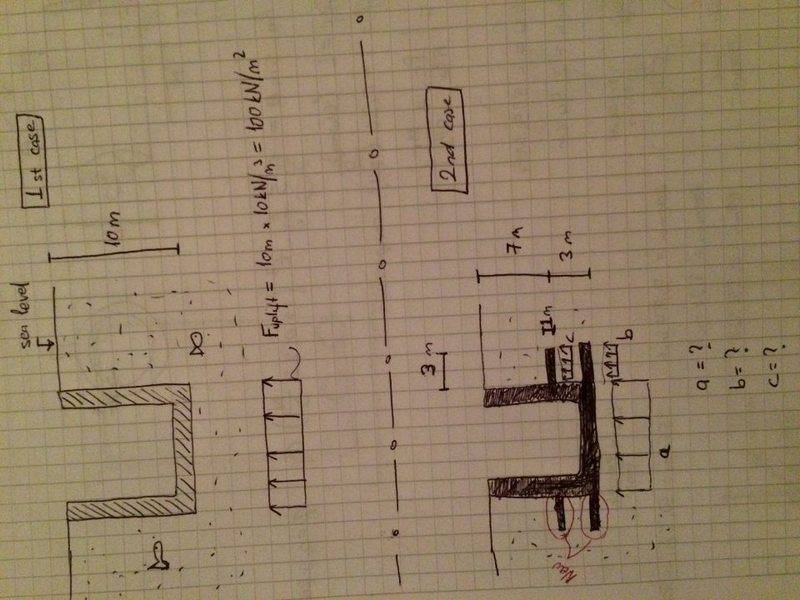
We all know the lift force in case 1, what about case 2 ?
IMG_4271.JPG
 
Physics news on Phys.org
Note that there is also a force from the liquid pushing down on the additional wings you put in ...
 
Buoyant force depends only on the amount of water displaced, not the shape of the object displacing it.
 
yilbaris said:
We all know the lift force in case 1, what about case 2 ?View attachment 89160
If by "lift force", you actually mean "buoyancy", this can be calculated for case 2, although it is slightly more complicated than case 1.

Remember Archimedes' Principle:

https://en.wikipedia.org/wiki/Archimedes'_principle

Note: in technical use, "lift force" is usually reserved for a force which is created by a dynamic situation, like the lift generated by an airplane's wings when flying.
OTOH, "buoyancy" usually refers to a force created by a static situation, like the displacement of fluid by a floating object.
 
Thank you for answers,

? To calculate the resultant force is possible, but i wonder distribution of force. ?
 
Every point on the submerged surface of the object feels a normal force proportional to the pressure at that depth ## \rho g h ##
 
Last edited:
MrAnchovy said:
Every point on the submerged surface of the object feels a normal force equal to the pressure at that depth ## \rho g h ##
A force can never equal a pressure, the dimensions are different. An area element is subjected to a normal force equal to the pressure multiplied by the area
 
Thank you all.

------------------SOLVED------------
 
Orodruin said:
A force can never equal a pressure, the dimensions are different. An area element is subjected to a normal force equal to the pressure multiplied by the area
I wanted to steer clear of elemental areas for the sake of clarity but I take your point; I have amended 'equal' to 'proportional'.
 

Similar threads

  • · Replies 128 ·
5
Replies
128
Views
12K
  • · Replies 30 ·
2
Replies
30
Views
5K
  • · Replies 17 ·
Replies
17
Views
3K
  • · Replies 11 ·
Replies
11
Views
2K
  • · Replies 9 ·
Replies
9
Views
3K
  • · Replies 34 ·
2
Replies
34
Views
5K
  • · Replies 12 ·
Replies
12
Views
3K
  • · Replies 17 ·
Replies
17
Views
2K
  • · Replies 12 ·
Replies
12
Views
2K
  • · Replies 7 ·
Replies
7
Views
3K