Discrete Fourier transform question

Click For Summary

Homework Help Overview

The discussion revolves around a Discrete Fourier Transform (DFT) exam question, with participants exploring the complexities of the topic and the original poster's understanding of it.

Discussion Character

  • Exploratory, Conceptual clarification, Assumption checking

Approaches and Questions Raised

  • Participants suggest starting from known concepts related to sampling and DFT, questioning how to approach the problem without a complete solution. There is discussion about the possibility of inferring frequency components from the function and sampling rate without performing the DFT.

Discussion Status

The discussion is ongoing, with participants providing guidance on how to approach the problem and emphasizing the importance of the original poster making an attempt before receiving further assistance. There is a recognition of the challenge posed by the question.

Contextual Notes

Participants note that the level of difficulty may depend on the course content covered, and there is an emphasis on the need for the original poster to engage with the problem before receiving detailed help.

thereddy
Messages
1
Reaction score
0
Thread moved from the technical forums, so no Homework Template is shown.
Summary:: Discrete Fourier transform exam question

Hi there, I'm not really sure how to do this question at all. Any help would be appreciated.
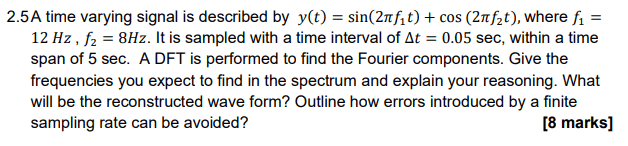
Annotation 2020-05-18 213422.png
 
Physics news on Phys.org
Last edited:
  • Like
Likes   Reactions: Delta2 and berkeman
Looked at your exercise. Not for the faint-hearted.

My advice: if you don't know where to start, start where your knowing is. What do you know about sampling, DFT, etc. ? Can we make it easier with just ##f(t) = \sin(2\pi f_1 t)\ ## ?
 
Are you still here ?
 
BvU said:
Looked at your exercise. Not for the faint-hearted.
Depends on what is covered in the course. I would expect my students to be able to answer this question without too much thought, including even the complex phase of the frequency components.
 
DrClaude said:
Depends on what is covered in the course. I would expect my students to be able to answer this question without too much thought, including even the complex phase of the frequency components.
By looking at the function and the sampling rate i suppose we can conclude which going to be the main frequencies present in the DFT, but is it really possible to know the exact magnitude and phase of the DFT without actually doing the DFT ?
 
Delta2 said:
By looking at the function and the sampling rate i suppose we can conclude which going to be the main frequencies present in the DFT, but is it really possible to know the exact magnitude and phase of the DFT without actually doing the DFT ?
With a ##y(t)## such as that given in the OP, yes. However, I cannot say more for now as it would help the OP too much.
 
  • Like
Likes   Reactions: Delta2

Similar threads

  • · Replies 5 ·
Replies
5
Views
2K
  • · Replies 23 ·
Replies
23
Views
3K
Replies
1
Views
2K
  • · Replies 6 ·
Replies
6
Views
3K
  • · Replies 6 ·
Replies
6
Views
2K
  • · Replies 6 ·
Replies
6
Views
2K
Replies
9
Views
2K
  • · Replies 1 ·
Replies
1
Views
2K
  • · Replies 2 ·
Replies
2
Views
3K
  • · Replies 9 ·
Replies
9
Views
3K
