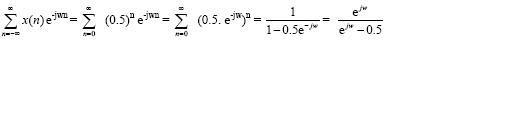
The discussion focuses on computing the Discrete-Time Fourier Transform (DTFT) of the signal x[n] = n(0.5)^n u[n]. The contributor shares their solution, which is 0.5 e^(-jw)/((1-0.5e^(-jw))^2). They express frustration that this topic seems to confuse many people. The solution appears to be correct based on the context provided. The thread highlights the challenges of understanding DTFT calculations in discrete-time signals.
#1
Eng67
21
0
I am trying to compute the DTFT of x[n]=n(.5)^n u[n].
Question: A clock's minute hand has length 4 and its hour hand has length 3. What is the distance between the tips at the moment when it is increasing most rapidly?(Putnam Exam Question)
Answer: Making assumption that both the hands moves at constant angular velocities, the answer is ## \sqrt{7} .## But don't you think this assumption is somewhat doubtful and wrong?