Divergence/Convergence for Telescoping series

Join the discussion
Ask a follow-up here, or get your own question answered by working scientists, mathematicians and engineers — people, not an autocomplete.
Real named experts · corrections over time · the nuance an AI answer skips
10 replies · 4K views
Neon32
Messages
68
Reaction score
1
Can I use the divergence test on the partial sum of the telescoping series?
Lim n>infinity an if not equal zero then it diverges

The example below shows a telescoping series then I found the partial sum and took the limit of it. My question is shouldn't the solution be divergent? Since the result -1+cos 1 is not equal to 0? I'm confused.
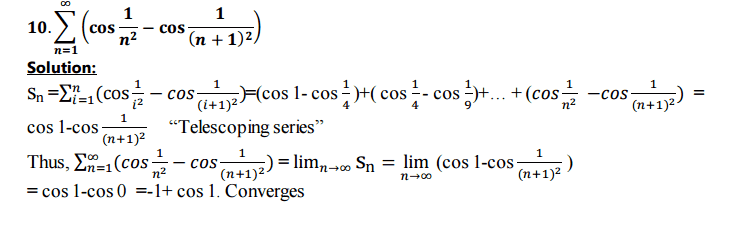
upload_2017-3-25_11-45-47.png
 
Physics news on Phys.org
that is right i guess
 
Neon32 said:
Lim n>infinity an if not equal zero then it diverges
it is ##a_n## must tend to zero, not the sum :)
 
zwierz said:
it is ##a_n## must tend to zero, not the sum :)

what's ##a_n##?
 
a term of the series
 
zwierz said:
a term of the series

How can I determine convergence/divergence for telescopinc series then?
 
you have already done this
 
zwierz said:
you have already done this
I haven't? the solution is above, however I don't quite understand. I want a general rule to detect convergence/divergence fore telescoping series.
 
The series ##\sum (b_{n+1}-b_n)## is convergent iff the sequence ##b_n## is convergent
 
zwierz said:
The series ##\sum (b_{n+1}-b_n)## is convergent iff the sequence ##b_n## is convergent
but he didn't find the convergence of bn sepeartly in the solution above?
 
He restored the proof of my proposition for this concrete example