DIY Vibration Measurement Device for Engineers using Flex Sensors

  • Context: Undergrad 
  • Thread starter Thread starter Smooth
  • Start date Start date
  • Tags Tags
    Damping
Click For Summary

Discussion Overview

The discussion revolves around the design and theoretical considerations of a DIY vibration measurement device using flex sensors. Participants explore the physics of measuring vibrations, particularly focusing on the effects of air resistance and damping in a half-pendulum setup.

Discussion Character

  • Exploratory
  • Technical explanation
  • Conceptual clarification
  • Debate/contested
  • Experimental/applied

Main Points Raised

  • One participant describes a device that uses flex sensors to measure vibrations along an axis and seeks to understand the physics behind damping effects.
  • Another participant suggests writing down the damping forces and mentions the need for experimentally determining constants like the drag coefficient.
  • A different participant proposes using the standard drag equation to calculate aerodynamic drag but notes its limitations due to assumptions of fully developed flow.
  • Concerns are raised about the complexity of calculating drag due to shape and Reynolds numbers, with one participant considering using a vacuum chamber to eliminate air resistance.
  • Several participants agree that measuring damping directly may be more practical than theoretical calculations.

Areas of Agreement / Disagreement

Participants generally agree that measuring damping directly is preferable to theoretical calculations, but there is no consensus on the best approach to account for air resistance and damping effects in the device design.

Contextual Notes

Participants express uncertainty regarding the applicability of the drag equation and the influence of factors like shape and flow conditions on damping calculations. There are also mentions of potential nonlinear behaviors in the materials used.

Who May Find This Useful

Engineers and hobbyists interested in DIY measurement devices, particularly those exploring vibration analysis and damping effects in mechanical systems.

Smooth
Messages
6
Reaction score
3
Hi,

I need something that would measure vibrations along an axis, so instead of buying a bunch of accelerometers I thought I’d quickly make smth myself. I’m majoring in engineering and not physics, so while I have no problems with the construction, I’m kind of stuck with the physics aspect.

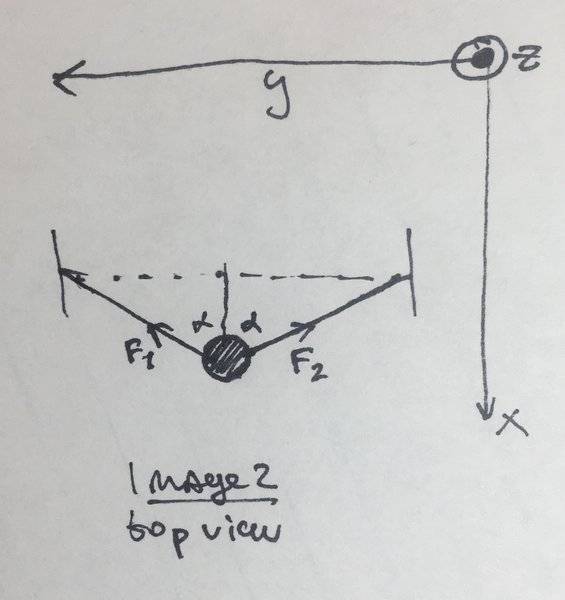
I explained my device on image 1. I have a weight that is suspended by two films (flex sensors - Piezo vibration). When a vibration along the x-axis is introduced, the weight will deviate and oscillate a little until coming back to initial position.
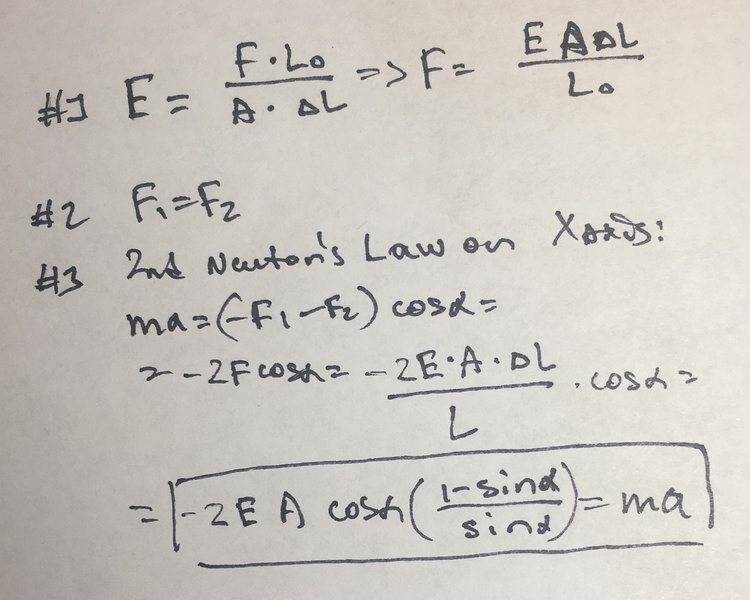
The graphic is on image 2. Suppose the weight deviates from original position. I will have the returning forces of tension from the films, and since I know the Young’s modulus of the films I can calculate the tension force due to the films. I wrote the 2nd Newton’s law on image 3.

Now, here’s my question; how do I factor in air resistance/damping of this half-pendulum? Yeah, I can easily get it experimentally by graphing the waveform. But can I write equations though?

I’ll probably increase the surface area of the weight to increase air resistance and play around with its mass to increase the damping, but question remains - how do theoretically predict that damping effect?

Many thanks for any suggestions.
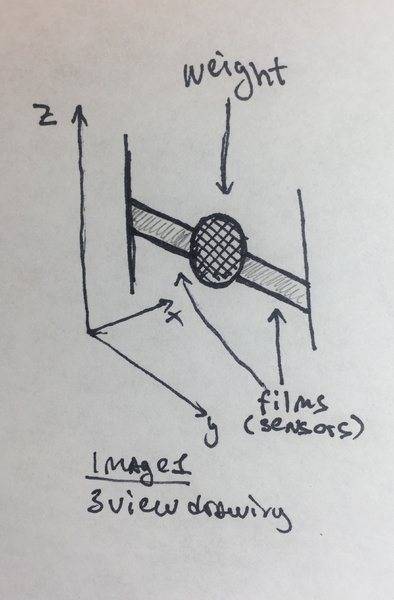
image 1.jpg
image 2.jpg
image 3.jpg
 

Attachments

  • image 3.jpg
    image 3.jpg
    45.8 KB · Views: 683
  • image 2.jpg
    image 2.jpg
    24.1 KB · Views: 732
  • image 1.jpg
    image 1.jpg
    23.6 KB · Views: 797
Physics news on Phys.org
Smooth said:
Now, here’s my question; how do I factor in air resistance/damping of this half-pendulum? Yeah, I can easily get it experimentally by graphing the waveform. But can I write equations though?
You could write down the damping forces. There is air resistance and probably some other things too. Those will typically involve constants, like the drag coefficient, that you have to measure experimentally. So you are probably better off to just measure the damping directly.
 
In theory, you could calculate the aerodynamic drag on the mass using the standard drag equation - Force = 0.5 X rho X V^2. In practice, that does not work because the equation assumes fully developed flow.

I learned this the hard way when I built a tuned mass damper using oil to damp the tuned mass. The damping oil changed the tuned mass frequency by a lot, my recollection is the change was about 40%. This was a puzzler until I calculated that the kinetic energy of the oil flowing past the tuned mass was about equal to the kinetic energy in the tuned mass. The diagram below shows the setup.

upload_2018-2-22_8-55-48.png

Also, there is likely some hysteresis, and possibly nonlinear stress/strain relationship, in the support film. I agree with @Dale, but amend his last sentence slightly: ..you are definitely better off to just measure the damping directly.
 

Attachments

  • upload_2018-2-22_8-55-48.png
    upload_2018-2-22_8-55-48.png
    18.9 KB · Views: 724
  • Like
Likes   Reactions: Smooth and Dale
Yep, I didn't want to mess with drag as the shape of the object isn't obvious, approximating Reynolds numbers, factoring the speed - pain in the neck.
I might eventually put it into a vacuum chamber just to approximate damping without air resistance.

Thank you @Dale and @jrmichler! Will be getting it experimentally then.
 
  • Like
Likes   Reactions: jrmichler and Dale

Similar threads

  • · Replies 1 ·
Replies
1
Views
2K
  • · Replies 131 ·
5
Replies
131
Views
8K
  • · Replies 5 ·
Replies
5
Views
2K
  • · Replies 10 ·
Replies
10
Views
7K
Replies
2
Views
1K
Replies
7
Views
2K
  • · Replies 52 ·
2
Replies
52
Views
6K
Replies
10
Views
4K
  • · Replies 1 ·
Replies
1
Views
3K
Replies
15
Views
12K