Discussion Overview
The discussion revolves around whether objects in circular motion must also undergo rotation. Participants explore the relationship between linear motion, circular motion, and rotational motion, considering various scenarios and visual representations.
Discussion Character
- Exploratory
- Debate/contested
- Conceptual clarification
Main Points Raised
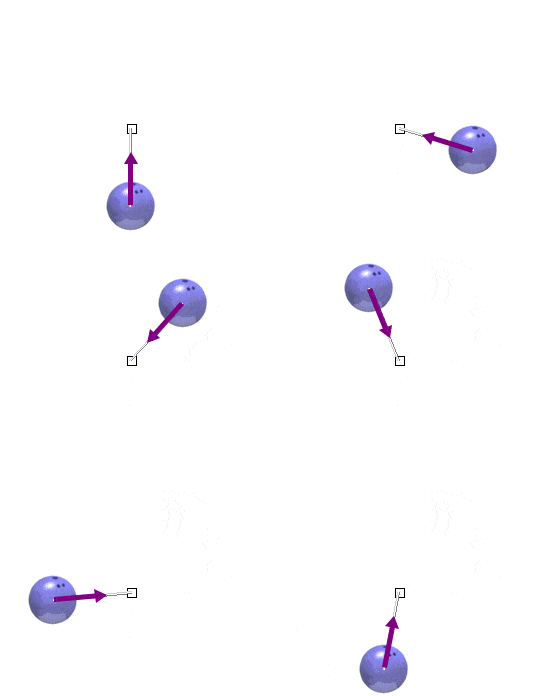
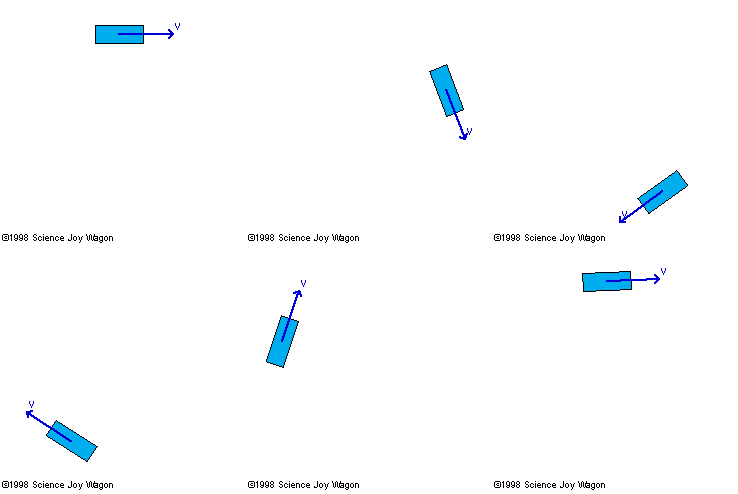
- Some participants suggest that if an object has zero rotational motion before a force acts on it, the resulting motion could resemble either of two pictures, depending on how the force is applied.
- There is a claim that circular motion requires constant acceleration, prompting questions about the forces responsible for that acceleration.
- Some argue that the difference between two pictures lies in whether the object is rotating about its axis or not, with one picture depicting no rotation and the other depicting rotation.
- One participant states that the squared object undergoes one rotation for every complete orbit, while the round object does not rotate about its axis, indicating a difference in behavior.
- A later reply mentions that if the force applied does not create torque, the object will remain in a non-rotating state, suggesting that rotation is not necessary for circular motion.
- Another participant introduces the concept of reference frames, noting that an object can appear to rotate in one frame while not rotating in another.
- One participant outlines conditions for an object to undergo rotation, stating that the arrangement of particles and their motion must satisfy specific geometric criteria.
- There is a discussion about the implications of applying force at different points on an object, which can lead to rotation or not, depending on the location of the force application.
Areas of Agreement / Disagreement
Participants express differing views on whether circular motion necessitates rotation, with some asserting that it does not, while others suggest that it often does. The discussion remains unresolved, with multiple competing perspectives presented.
Contextual Notes
Participants reference various scenarios and visual representations, but the discussion does not reach a consensus on the necessity of rotation in circular motion. The conditions for rotation mentioned by one participant introduce additional complexity without resolving the debate.