Does every control system contain an integrator?

Click For Summary
SUMMARY

Not every control system contains an integrator, although many do for achieving zero DC error. Control systems without integrators operate as negative feedback systems and exhibit different properties. The integrator is typically part of the control system rather than the plant itself, which can often be proportional. Understanding the distinction between the plant and the control system is essential for accurate analysis and design.

PREREQUISITES
  • Control system fundamentals
  • State-space representation in control theory
  • Negative feedback mechanisms
  • Understanding of integrators and their role in control systems
NEXT STEPS
  • Study the principles of state-space representation in control systems
  • Learn about negative feedback systems and their properties
  • Explore the role of integrators in achieving zero DC error
  • Investigate the differences between plants and control systems in various applications
USEFUL FOR

Control engineers, systems designers, and students of control theory seeking to deepen their understanding of integrators and feedback mechanisms in control systems.

PainterGuy
Messages
938
Reaction score
73
Hi,

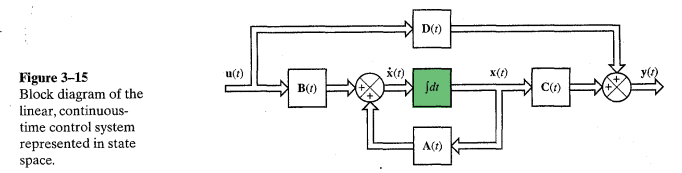
Let's call the box in green a plant. Does every plant consist of an integrator? It has to because when \overset{\cdot }{x}(t) passes through the green box, it becomes x(t). It's an operation of integrator; integrator converts the derivative back to the variable. Could you please guide me?

1620010372182.png
 
Engineering news on Phys.org
You designate an integrator 'the plant' and then you are surprised that a 'plant' integrates?

##\ ##
 
  • Like
Likes   Reactions: PainterGuy
No, not every control system has an integrator. But yours does.

However, most control systems contain an integrator. That's how you make it achieve zero DC error.
 
  • Like
Likes   Reactions: PainterGuy and AlexCaledin
It seems to me that a control system without an integrator will feed back the actual signal, so becomes a negative feedback system, which has different properties.
 
  • Skeptical
Likes   Reactions: DaveE
tech99 said:
It seems to me that a control system without an integrator will feed back the actual signal, so becomes a negative feedback system, which has different properties.
If you want something nearly universal about all control systems, negative feedback is the closest you will get. Seldom zero feedback and never net positive feedback.

But many control systems have negative feedback and proportional output. No integrator. For example, James Watts' flyball governor.

1620071812072.png
 
  • Like
Likes   Reactions: PainterGuy
PainterGuy said:
Hi,

Let's call the box in green a plant. Does every plant consist of an integrator? It has to because when \overset{\cdot }{x}(t) passes through the green box, it becomes x(t). It's an operation of integrator; integrator converts the derivative back to the variable. Could you please guide me?

View attachment 282402
Sorry, I miss read your question. No, not every plant acts as an integrator, in fact that's common in my experience. Most plants are proportional. The integrator is normally applied as part of the control system.

However, this partly depends on how you define the inputs and outputs. So, for example, a motor may have speed proportional to applied voltage, but position is the integral of applied voltage. So, same motor, but different behavior depending on what you want to control.
 
  • Like
Likes   Reactions: PainterGuy, eq1 and Merlin3189
Thank you, everyone!

I don't think my question was phrased properly. Let me try again.

BvU said:
You designate an integrator 'the plant' and then you are surprised that a 'plant' integrates?

##\ ##
It's not me who designated an integrator as the plant rather this is how the state representation is shown. Please see the figure below. The representation suggests that an integrator is always there present and when \overset{\cdot }{x}(t) passes through it, it becomes x. In other words, an integrator is a natural part of state space representation. Where am I going wrong?

1620097769592.png

https://en.wikipedia.org/wiki/State-space_representation#Linear_systems
 
PainterGuy said:
Thank you, everyone!

I don't think my question was phrased properly. Let me try again.It's not me who designated an integrator as the plant rather this is how the state representation is shown. Please see the figure below. The representation suggests that an integrator is always there present and when \overset{\cdot }{x}(t) passes through it, it becomes x. In other words, an integrator is a natural part of state space representation. Where am I going wrong?

View attachment 282469
https://en.wikipedia.org/wiki/State-space_representation#Linear_systems
I suspect your question is bordering on semantics. A system with no integrators (or derivatives) can be described in the state space format, such as:

$$ \begin{align}
&\dot x = Ax + bu \
&y = Cx + du
\end{align} $$

But without integrators (or derivatives), there is no state of the system. It's not dynamical and has no memory. So, A=0, b=0, C=0. It is the zero order trivial case that reduces to a set of linear equations. So in practice, no one talks about state space unless there is a state, i.e. unless there is at least one derivative.

Also, of course, the canonical form shown differentiates the equations to eliminate integrals in favor of derivatives.

I think there may be some confusion in the responses between what is the plant, what is the compensation, and what is the system. My take on your block diagram is that it is the canonical form of a generic linear dynamic system in state space form. It really doesn't matter at the system level which is the plant and which is the compensation when you are solving a previously designed system. Of course it makes a tremendous difference when you are designing that system.
 
  • Like
Likes   Reactions: PainterGuy, eq1 and BvU
  • #10
Also that Wiki page talks about the representation of a linear system. Not all systems are control systems.
 
  • Like
Likes   Reactions: tech99 and PainterGuy
  • #11
anorlunda said:
Also that Wiki page talks about the representation of a linear system. Not all systems are control systems.
They're not even all continuous,
https://en.wikipedia.org/wiki/Bang–bang_control
Some don't even sense the output,
https://en.wikipedia.org/wiki/Feed_forward_(control)

But I totally agree with DaveE, the question is basically a semantics one. Once the definitions are agreed upon it will be pretty easy to check the question against the definition. The trick is agreeing on a definition. :)
 
  • Like
Likes   Reactions: DaveE and PainterGuy

Similar threads

  • · Replies 12 ·
Replies
12
Views
4K
  • · Replies 4 ·
Replies
4
Views
5K
  • · Replies 31 ·
2
Replies
31
Views
5K
  • · Replies 12 ·
Replies
12
Views
3K
Replies
9
Views
7K
  • · Replies 5 ·
Replies
5
Views
3K
  • · Replies 11 ·
Replies
11
Views
2K
  • · Replies 0 ·
Replies
0
Views
3K
  • · Replies 6 ·
Replies
6
Views
2K
  • · Replies 12 ·
Replies
12
Views
2K