Double Helix and Euler's Formula

  • Thread starter Thread starter Jimster41
  • Start date Start date
  • Tags Tags
    Formula Helix
Click For Summary
SUMMARY

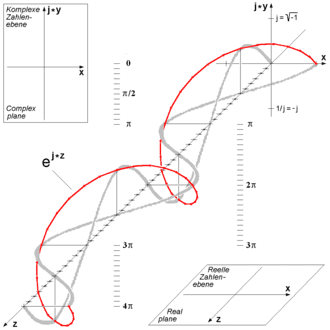
The discussion centers on the visual representation of Euler's formula, specifically the relationship between the formula \( e^{ix} \) and the appearance of a helix. Participants clarify that the plotted representation is a single helix, not a double helix, and that the lighter gray trends are sinusoidal waves, not indicative of a double helix structure. The conversation highlights the confusion surrounding the visualization of mathematical concepts and their physical representations, emphasizing the need for a deeper intuitive understanding of Euler's formula and its implications in various fields.

PREREQUISITES
  • Understanding of Euler's formula \( e^{ix} \)
  • Basic knowledge of sinusoidal functions and their properties
  • Familiarity with three-dimensional graphing concepts
  • Concept of chirality in molecular structures
NEXT STEPS
  • Explore the geometric interpretation of Euler's formula in three dimensions
  • Study the properties of sinusoidal functions and their applications in physics
  • Investigate the concept of chirality in DNA and its mathematical representations
  • Learn about the Fourier transform and its relationship to Euler's formula
USEFUL FOR

Mathematicians, physicists, and students seeking to deepen their understanding of Euler's formula and its visual representations, as well as those interested in the intersection of mathematics and molecular biology.

Jimster41
Gold Member
Messages
782
Reaction score
83
I was just trying for the ninetieth time to try and understand the sort of physicality Euler's formula and the role i plays in the way so many equations work - it's always been such an obstacle to reading so many of them. I mean what the heck is that i doing there. Progress, maybe, but... no luck

so it's a totally well-known thing, or a completely coincidental irrelevance that the double helix looks like the plot of euler's formula I'd never seen Euler plotted this way, and it did sort give me a visual of the way { e }^{ ix } works I had not had before.
330px-Euler's_Formula_c.png

http://en.wikipedia.org/wiki/Euler's_formula

And I got to ask this question before I'm going to be able to keep studying.
 
Biology news on Phys.org
Jimster41 said:
so it's a totally well-known thing, or a completely coincidental irrelevance that the double helix looks like the plot of euler's formula

The plot of Euler's formula that you refer to is really a single helix, not a double helix.

Jimster41 said:
I got to ask this question

What question are you asking?
 
I was looking at the two orthogonal axes, the lighter gray trends of the Re and Imaginary projections? That's a double helix isn't it?

I guess I was just looking for an answer as to why it looks like that those, if there was any connection, therefore to Euler's formula. Like, I was expecting someone to chime in with something over my head but confirming, "yes yes, the mathematical behavior described by { e }^{ ix } describes accurately the the something something process of base pair chirality something something of the tertiary structure, due to optimization of the Gibbs free energy of the PI bonds something something." Or for someone to say... "what are you talking about?"

So now I have one data point. :sorry:

The overall quest I'm currently on is to get a feel for what { e }^{ ix } means as mechanism, which is just so ubiquitous. I can feel what an integral means, what a derivative, a square root, etc, I am even starting to get a feel for what the { U }^{ a }{ \nabla }_{ a }{ U }^{ b } means. But the darn { e }^{ ix } is just so perplexing. I mean I know euler's equation. I took signals and systems and did the Fourier transform using it, but I was just following orders. I want to understand more intuitively what it's operational function is. My only cartoon at present is that it "induces periodic aspect".

I thought maybe this was an opportunity to nail that down in a way that I could keep as a picture in my head.
 
Last edited:
Jimster41 said:
I was looking at the two orthogonal axes, the lighter gray trends of the Re and Imaginary projections? That's a double helix isn't it?

No, those are two sinusoidal waves that are perpendicular to each other. The helix is the red curve. As ##x## increases, ##e^{ix}## goes around in a circle, forming a helix. And it's just one helix, not two.

Jimster41 said:
the mathematical behavior described by ##{ e }^{ ix }## describes accurately the the something something process of base pair chirality something something of the tertiary structure, due to optimization of the Gibbs free energy of the PI bonds something something.

Not really, no.

Jimster41 said:
wtf are you talking about?

This would be my response. :wink:
 
I was imagining that the Helix might represent the minimum of some energy minimization function circling, or centered inside of those other two.

Anyway, now I know.

Carry on sir.
 
EDIT: Too late. I received no "Other have posted in this thread, would you like to review them before posting?" type message, does PF not have this feature?

Jimster41 said:
I was looking at the two orthogonal axes, the lighter grey trends of the Re and Imaginary projections? That's a double helix isn't it?
The gray trends are 2d projections of the helix. They are just sin waves (out of phase by pi/2). A helix is three dimensional, DNA is the classic example of a double helix, this is another striking example:

http://www.worldfortravel.com/wp-content/uploads/2013/01/Stunning-Helix-Bridge.jpg
 
Yeah, that's beautiful. Singapore. Gotta show that to the wife. She's got an Asia uber-vacation plan going. I know Singapore is on the short list.
 
billy_joule said:
The gray trends are 2d projections of the helix. They are just sin waves (out of phase by pi/2). A helix is three dimensional, DNA is the classic example

I did know that part, it's the "just" in the sentence that that gives me trouble.o_O
 
If you follow the helix, and let it rotate the axes, then aren't they a double helix. I guess that's what my eye was doing, filling in those little bars going around in a chase after the red trend. Seemed to make a DNA thing.
 
  • #10
A double helix would have two red lines. This is a single helix.
And see post 4 please.
 
  • #11
Starting at bottom left and going up to top right. I think if you allow the red single helix to rotate the orthogonal coordinates you, you get a double helix from the grey lines. But maybe I'm imagining it. :confused:
 
  • #12
Jimster41 said:
I think if you allow the red single helix to rotate
Then you don't have the plot of ##e^{i \phi}## any more. I don't get the point.
 
  • #13
Dude I just thought that that graph was pretty clever, the way it overlaid a track (the red helix). I started with the first crossbar and started filling them in following it with my eye. At the end It sure seemed like double helix. I wasn't thinking very carefully about the steps, or if was defeating the purpose. I thought that what the little rungs were for.
 
Last edited:
  • #14
If you start with bottom left-most line connecting the two light grey sine waves. Go to the middle of it then go to the middle of the next one, down the middle of n imagined identical connectors, then do the same to the middle of the next one, all the way through to the last one, it traces out a helix with a radius of 1/2 the red helix, running through a double helix. No?​
 
  • #15
No, this thread has been answered and is closed.
 
Last edited:

Similar threads

Replies
1
Views
1K
  • · Replies 9 ·
Replies
9
Views
2K
  • · Replies 14 ·
Replies
14
Views
3K
  • · Replies 14 ·
Replies
14
Views
4K
  • · Replies 2 ·
Replies
2
Views
3K
Replies
15
Views
6K
  • · Replies 6 ·
Replies
6
Views
914
  • · Replies 5 ·
Replies
5
Views
2K
  • · Replies 4 ·
Replies
4
Views
3K
  • · Replies 1 ·
Replies
1
Views
2K