Double integral domain with absolute value

Click For Summary
The discussion focuses on finding the domain of the function defined by the inequalities D={(x,y)∈ℝ2: 2|y|-2≤|x|≤½|y|+1}. Participants analyze the correct approach to graphing the inequalities and determining the intersection of the resulting regions. It is noted that the first system of inequalities is graphed correctly, while the second system requires adjustments. The bounded region is described as an "arrowhead" shape, with suggestions to divide the integration process based on the sign of y. The initial step of establishing the bounds for |y| is emphasized as crucial for solving the problem effectively.
DottZakapa
Messages
239
Reaction score
17
Homework Statement
compute the double integral
Relevant Equations
double integral
D={(x,y)∈ℝ2: 2|y|-2≤|x|≤½|y|+1}

I am struggling on finding the domain of such function
my attempt :

first system
\begin{cases}
x≥2y-2\\
-x≥2y-2\\
x≥-2y-2\\
-x≥-2y-2
\end{cases}

second system
\begin{cases}
x≤y/2+1\\
x≤-y/2+1\\
-x≤y/2+1\\
-x≤-y/2+1\\
\end{cases}

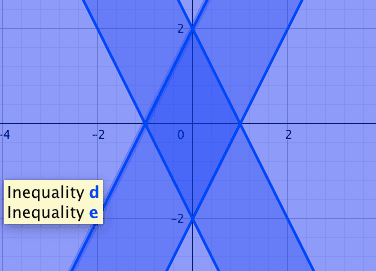
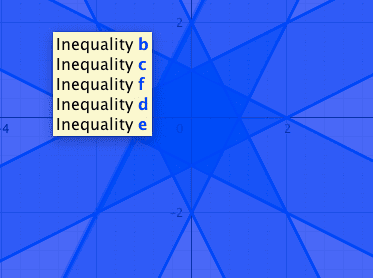
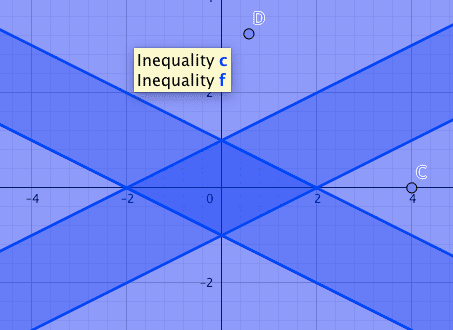
i draw the graph and get the intersection for each system, then intersect the two graphs?
first system
Screen Shot 2020-01-17 at 13.56.26.png

Second
Screen Shot 2020-01-17 at 13.58.22.png

intersection between the two
Screen Shot 2020-01-17 at 13.58.36.png


is the procedure correct or in what am i doing wrong?
 
Physics news on Phys.org
Perhaps focus on getting the domain for ##y## first?
 
It looks to me like you have the second constraint graphed wrong. x= 2|y|- 2 consists of two straight lines, the first, for y\ge 0, x= 2y- 2, is the line through (-2, 0) and (0, 1), the second, for y\le 0, x= -2y- 2, is the line through (-2, 0) and (0, -1). That you appear to have graphed correctly.

But x= (1/2)|y|+ 1 seems to be graphed incorrectly. For y\ge 0 that is x= y/2+ 1 which is a straight line through (2, 2) and (1, 0). For y\le 0 it is x= -y/2+ 1 which is a straight line through (2, -2) and (1, 0).

The region bounded by those is an "arrow head" shaped region pointing to the left. The best way to integrate over that region is probably to divide it into y\ge 0 and y\le 0. For y\ge 0, take y going from 0 to 2 and, for each y, x going from 2y- 2 to y/2+ 1. For y \le 0, take y going from -2 to 0 and, for each y, x going from -2y- 2 to -y/2+ 1.
 
PeroK said:
Perhaps focus on getting the domain for ##y## first?
the graph's that you see are depicting each inequality
HallsofIvy said:
It looks to me like you have the second constraint graphed wrong. x= 2|y|- 2 consists of two straight lines, the first, for y\ge 0, x= 2y- 2, is the line through (-2, 0) and (0, 1), the second, for y\le 0, x= -2y- 2, is the line through (-2, 0) and (0, -1). That you appear to have graphed correctly.

But x= (1/2)|y|+ 1 seems to be graphed incorrectly. For y\ge 0 that is x= y/2+ 1 which is a straight line through (2, 2) and (1, 0). For y\le 0 it is x= -y/2+ 1 which is a straight line through (2, -2) and (1, 0).

The region bounded by those is an "arrow head" shaped region pointing to the left. The best way to integrate over that region is probably to divide it into y\ge 0 and y\le 0. For y\ge 0, take y going from 0 to 2 and, for each y, x going from 2y- 2 to y/2+ 1. For y \le 0, take y going from -2 to 0 and, for each y, x going from -2y- 2 to -y/2+ 1.
i've just copied and pasted the inequalities of the systems that you see in geogebra, the first mage is of the first system, the second image is related to the second system, the third is merging the two.

Are the two systems correct? in terms of inequalities combinations
the first one is studying the left side of the inequality , the second the right side. Is this the right way to study that domain?
 
Okay, but you should be able to get ##|y| \le 2## to start things off.
 
Question: A clock's minute hand has length 4 and its hour hand has length 3. What is the distance between the tips at the moment when it is increasing most rapidly?(Putnam Exam Question) Answer: Making assumption that both the hands moves at constant angular velocities, the answer is ## \sqrt{7} .## But don't you think this assumption is somewhat doubtful and wrong?

Similar threads

  • · Replies 2 ·
Replies
2
Views
2K
  • · Replies 1 ·
Replies
1
Views
2K
  • · Replies 8 ·
Replies
8
Views
1K
  • · Replies 14 ·
Replies
14
Views
2K
Replies
3
Views
2K
Replies
2
Views
1K
  • · Replies 8 ·
Replies
8
Views
2K
  • · Replies 11 ·
Replies
11
Views
3K
  • · Replies 8 ·
Replies
8
Views
2K
  • · Replies 9 ·
Replies
9
Views
2K