Dynamic physical model - automobile wheel suspension confusion

Click For Summary
SUMMARY

The discussion focuses on the application of Newton's laws of motion and Kirchhoff's Voltage Law (KVL) in dynamic physical modeling, specifically in the context of automobile wheel suspension systems and electric circuits. Participants clarify the equations governing these systems, including the spring force equation \( F_s = -kx \) and the dashpot force \( F_d = -D\frac{dx}{dt} \). Errors in the representation of constants in equations are also highlighted, emphasizing the importance of dimensional analysis. The conversation concludes with a clear understanding of how to derive equations of motion using the sum of forces and the application of KVL in circuit analysis.

PREREQUISITES
  • Understanding of Newton's laws of motion
  • Familiarity with Kirchhoff's Voltage Law (KVL)
  • Knowledge of mechanical systems, including springs and dampers
  • Basic principles of electric circuits, including charge and current relationships
NEXT STEPS
  • Study the derivation of equations of motion for mechanical systems
  • Learn about the dynamics of dampers and their role in mechanical systems
  • Explore Kirchhoff's laws in greater detail, focusing on circuit analysis
  • Investigate the relationship between charge, current, and voltage in electric circuits
USEFUL FOR

Students and professionals in mechanical engineering, electrical engineering, and physics who are involved in system simulation and modeling, particularly those focusing on dynamic physical models and circuit analysis.

shivajikobardan
Messages
637
Reaction score
54
Homework Statement
dynamic physical model
Relevant Equations
spring mass system equation, electric circuit equation
Been a long time I studied physics that had anything to do with mechanics, so I'm now in need of memorizing almost everything. So I am seeking for some guidance here. This is "system simulation/modeling/discrete event system simulation/etc" type of subject.
1657552151433.png

1657552164872.png

1657552183049.png


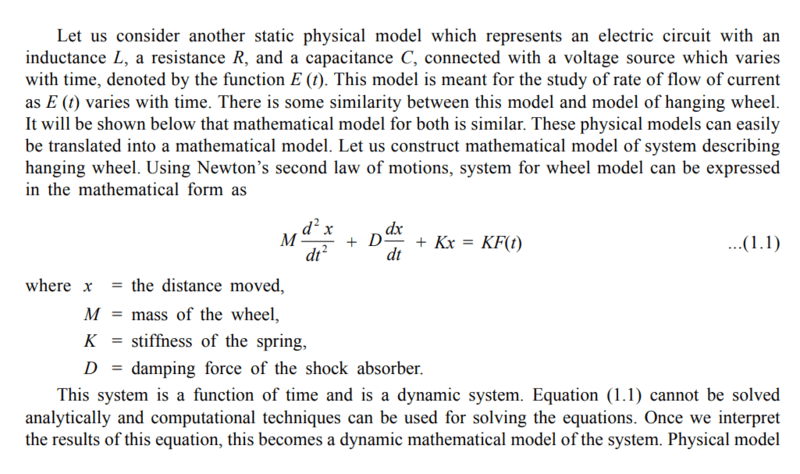
The first thing that I didn't understand is "what point are we trying to make by equating 2 equations" in relation with dynamic physical model?
While i get it that we have analogous equations in real world though.
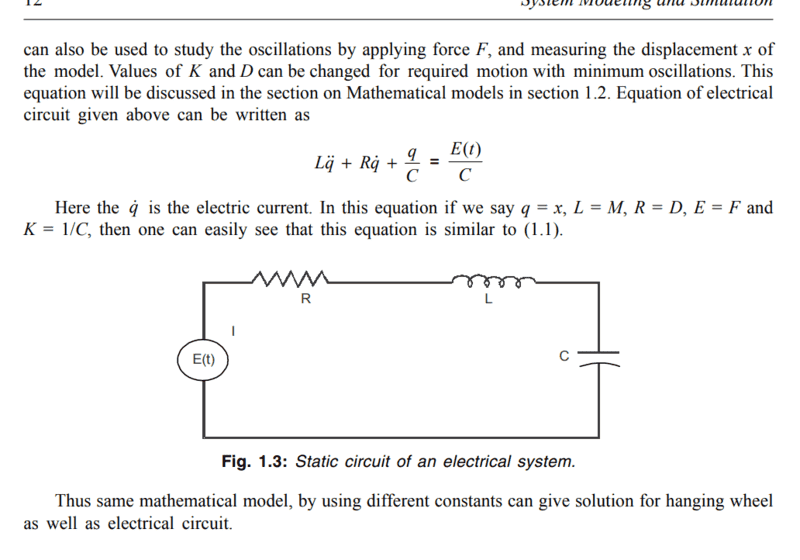
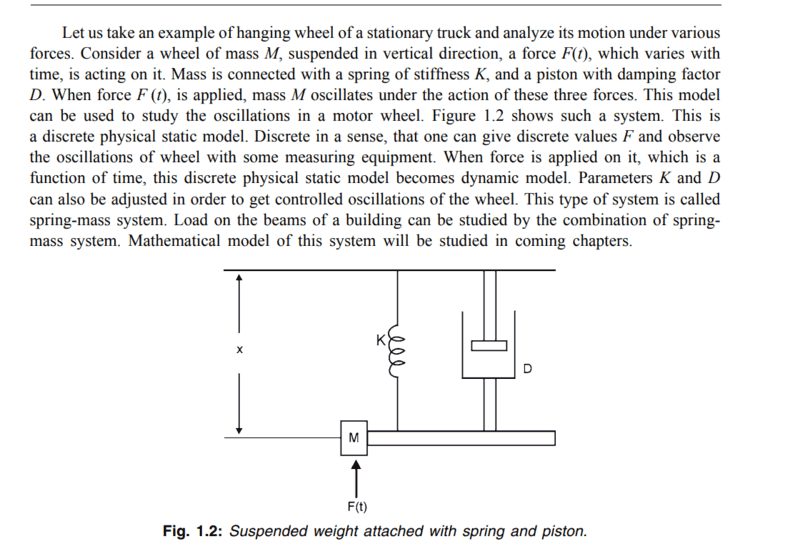
And I didn't understand how Newton's law of motion was applied to the first figure? And what law is applied in electric circuit in second figure? Coloumb's law? I forgot why are we using derivatives of current L and R but charge q for C?

I know these equations-:

q/C=V

=>V~q

LdI/dt=V
=> V~q**

V=IR
=>V~q*

I guess it is sth like this. But not sure how exactly it was translated (but I think this much information would be enough for this exam for electric circuit part so just help me with physics mechanics part).

 
Physics news on Phys.org
shivajikobardan said:
And I didn't understand how Newton's law of motion was applied to the first figure
Hi,

##F = ma## is the law applied here. ##ma## appears as ##m{d^2x\over dt^2}## and there are three forces that add up to the ##F##. Maybe the fact that they moved over two of them to the other side of the ##=## sign is what confuses you a bit ?

The spring exerts ##F_s = -kx##
The dashpot exerts ##F_d = - D\dot x = -D {dx\over dt}##
And the exernal force is ##F_t##.

The ##K## in front of that in ##(1.1)## is in error. Likewise the ##{1\over C}## in the electric analogon.
(Check the dimensions).

##\ ##
 
  • Like
Likes   Reactions: shivajikobardan and jack action
BvU said:
The ##K## in front of that in ##(1.1)## is in error. Likewise the ##{1\over C}## in the electric analogon.
(Check the dimensions).

##\ ##
Every other book about this is saying the same thing(written in that book) though.
 
BvU said:
The dashpot exerts ##F_d = - D\dot x = -D {dx\over dt}
How do you find dashpot force? I didn't get this.
 
shivajikobardan said:
Every other book about this is saying the same thing(written in that book) though.
Never seen the spring stiffness associated with the external force before and it doesn't make sense anyway. From Wikipedia:
Deriving the equations of motion for this model is usually done by examining the sum of forces on the mass:

a7595e04d4f8cb59560a2be5f12170a42afb66a4

shivajikobardan said:
How do you find dashpot force? I didn't get this.

https://en.wikipedia.org/wiki/Dashpot said:
A dashpot, also known as a damper, is a mechanical device that resists motion via viscous friction. The resulting force is proportional to the velocity, but acts in the opposite direction, slowing the motion and absorbing energy.
 
  • Like
Likes   Reactions: shivajikobardan
jack action said:
Never seen the spring stiffness associated with the external force before and it doesn't make sense anyway. From Wikipedia:
yeah not adding it doesn't make any difference.
 
shivajikobardan said:
Homework Statement:: dynamic physical model
Relevant Equations:: spring mass system equation, electric circuit equation

And what law is applied in electric circuit in second figure? Coloumb's law? I forgot why are we using derivatives of current L and R but charge q for C?
That's Kirchoff's Voltage Law which tells us the sum of potential differences around any closed loop is zero. Applying the law we get
$$E(t) - IR - L\frac{dI}{dt} - \frac{q}{C} = 0$$

You can then rephrase ##\frac{dI}{dt}## and ##I## in terms of the derivatives of charge ##q## . Does that clear your doubt?

Although like BvU said, the ##\frac{1}{C}## on the right has to be an error because the units don't add up. Hope this helped.
 
  • Like
Likes   Reactions: Delta2
haider said:
That's Kirchoff's Voltage Law which tells us the sum of potential differences around any closed loop is zero. Applying the law we get
$$E(t) - IR - L\frac{dI}{dt} - \frac{q}{C} = 0$$

You can then rephrase ##\frac{dI}{dt}## and ##I## in terms of the derivatives of charge ##q## . Does that clear your doubt?

Although like BvU said, the ##\frac{1}{C}## on the right has to be an error because the units don't add up. Hope this helped.
oh yeah KVL, thanks for the info. this helps for electric circuit doubt.
 
  • Like
Likes   Reactions: Delta2 and haider

Similar threads

  • · Replies 102 ·
4
Replies
102
Views
7K
  • · Replies 3 ·
Replies
3
Views
1K
  • · Replies 45 ·
2
Replies
45
Views
6K
  • · Replies 4 ·
Replies
4
Views
2K
Replies
9
Views
3K
  • · Replies 7 ·
Replies
7
Views
2K
  • · Replies 26 ·
Replies
26
Views
3K
  • · Replies 3 ·
Replies
3
Views
2K
  • · Replies 8 ·
Replies
8
Views
2K
  • · Replies 3 ·
Replies
3
Views
2K