Dynamics exam prep -- forces explanation in FBD please

Click For Summary
SUMMARY

The discussion focuses on calculating tension in a free body diagram (FBD) for a Dynamics exam question involving a rider on a swing. The user calculated tension as T = mg cos(30) = 680N, but noted that the tangential acceleration is zero, leading to confusion regarding the forces involved. A key insight provided is that as rotational speed increases, the angle (theta) also increases, affecting the tension in the cable. The user is advised to consider additional forces acting on the rider that contribute to the overall tension beyond just the weight component.

PREREQUISITES
  • Understanding of free body diagrams (FBD)
  • Basic principles of dynamics and forces
  • Knowledge of tension in cables and its relation to weight
  • Familiarity with angular motion and rotational dynamics
NEXT STEPS
  • Study the relationship between tension and angular velocity in rotational systems
  • Learn about the forces acting on objects in circular motion
  • Review the concept of centripetal acceleration and its impact on tension
  • Practice solving problems involving free body diagrams in dynamics
USEFUL FOR

Students preparing for Dynamics exams, particularly those struggling with free body diagrams and the relationship between tension and forces in rotational motion.

Gunter_ZA
Messages
2
Reaction score
0
Thread moved from the technical forums, so no Homework Help Template is shown
I am doing a review for a Dynamics exam, but I am having trouble with this one question (below).

Please note the top of the picture contains the answers.

What I have done is make a free body diagram that includes the tension of the cable and the weight of the rider/swing. So according to my calculations for part i:

T= mg cos (30) = 680N

The tangential acceleration is 0

Which according to the provided solutions is incorrect. Am I missing a force?

I figured the tension is integral to finding the velocity of the rider. So I want to get my tension right before I proceed with finding the velocity, though I am also having trouble figuring out how to relate tension and velocity of the acceleration of the rider is 0

I would appreciate an explanation so I can understand.
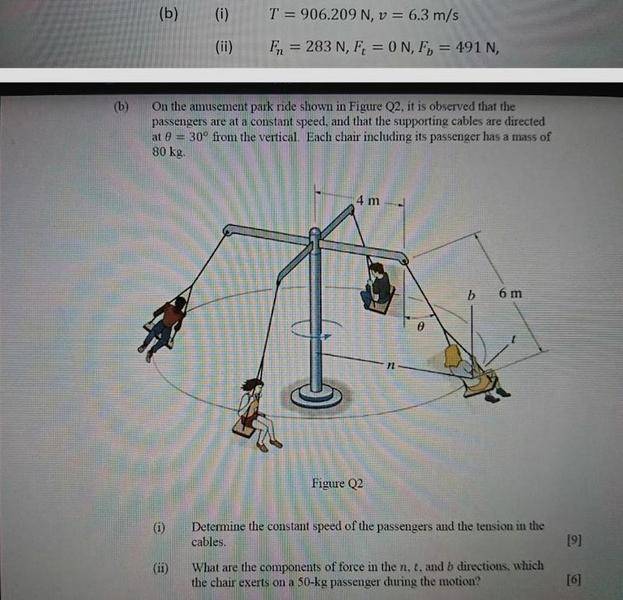
nSd3YBe.jpg
 
Physics news on Phys.org
Gunter_ZA said:
I am doing a review for a Dynamics exam, but I am having trouble with this one question (below).

Please note the top of the picture contains the answers.

What I have done is make a free body diagram that includes the tension of the cable and the weight of the rider/swing. So according to my calculations for part i:

T= mg cos (30) = 680N

The tangential acceleration is 0

Which according to the provided solutions is incorrect. Am I missing a force?

I figured the tension is integral to finding the velocity of the rider. So I want to get my tension right before I proceed with finding the velocity, though I am also having trouble figuring out how to relate tension and velocity of the acceleration of the rider is 0

I would appreciate an explanation so I can understand.

View attachment 197584
Welcome to the PF. :smile:

if the rotational speed is zero, then theta is zero, and T=mg.

As the rotational speed increases, theta increases. So if T=mg cos(theta), the tension would be decreasing with increasing theta, which clearly is not the case. What other force acts on the rider that pulls them out? How does that force add to the tension over and above mg?
 
Gunter_ZA said:
T= mg cos (30)
With that equation you are saying forces balance along the line of the cable, so there is no acceleration component in that direction.
What acceleration is occurring? In what direction does that have no component?
 

Similar threads

  • · Replies 47 ·
2
Replies
47
Views
3K
  • · Replies 20 ·
Replies
20
Views
2K
Replies
13
Views
2K
Replies
2
Views
1K
Replies
27
Views
1K
Replies
44
Views
3K
  • · Replies 19 ·
Replies
19
Views
2K
  • · Replies 17 ·
Replies
17
Views
3K
Replies
10
Views
1K
  • · Replies 3 ·
Replies
3
Views
2K