udtdewclaw
- 3
- 0
Some background: I am self studying dynamics and I have encountered a fundamental problem with either my understanding of linear algebra, or I am just plain dumb. So, I print screened the page of the book we're on. Now let me try to reduce some ambiguity in my question, I have a general understanding of the cross product and unit vectors. With this question it's stating the G is the momentum of the particle is G = mvn, where n is the unit vector in the direction of velocity. When we try to take the moment of the position vector from O to P with the momentum we get, M(G/O)[G with respect to O] =p(P/O) ×G=p(Q/O) ×G
=y_0*n*y ×m*v*(cosθn_x +sinθn_z)
=m*v*y0(sinθn_x −cosθn_z). * indicated multiplication, obviously.
My question is, how does G = mvn, => G = mv(cosθn_x +sinθn_z) or more specifically, how does n = (cosθn_x +sinθn_z) and further deductions until the end result. And can someone explain intuitively what a 'moment' is? I would like a full explanation of these mathematical deductions if possible.
Here is a link to the book: Fundamentals of Applied Dynamics - Tenenbaum
http://f3.tiera.ru/2/P_Physics/PC_Classical%20physics/PCtm_Theoretical%20mechanics/Tenenbaum%20R.A.%20Fundamentals%20of%20applied%20dynamics%20%28Springer,%202004%29%28ISBN%20038700887X%29%28O%29%28730s%29_PCtm_.pdfHere is a screenshot of the page of the book also, Fundamentals of Applied dynamics - Tenenbaum - Page 33.
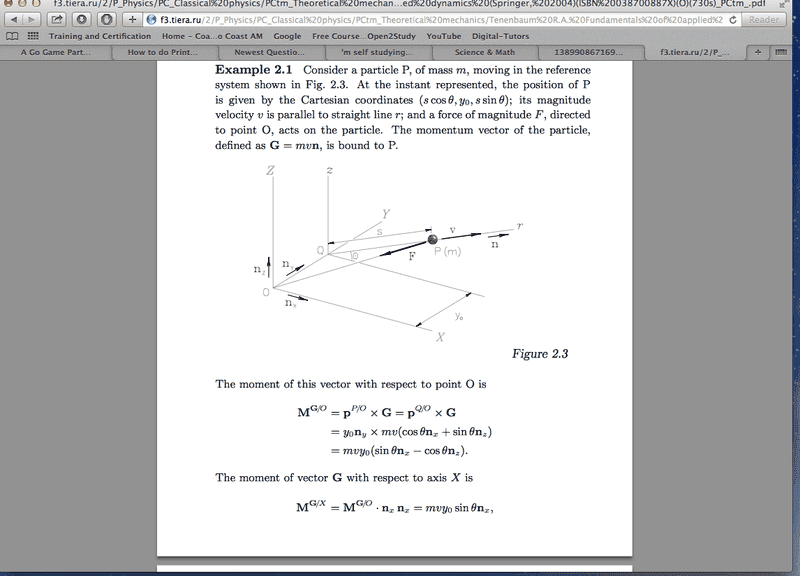 I also have a post on math.stackexchange asking the same question however, stack exchange has a latex version of the equations for easier reading, here is a link
http://math.stackexchange.com/questions/641029/cross-product-moments-dynamics
=y_0*n*y ×m*v*(cosθn_x +sinθn_z)
=m*v*y0(sinθn_x −cosθn_z). * indicated multiplication, obviously.
My question is, how does G = mvn, => G = mv(cosθn_x +sinθn_z) or more specifically, how does n = (cosθn_x +sinθn_z) and further deductions until the end result. And can someone explain intuitively what a 'moment' is? I would like a full explanation of these mathematical deductions if possible.
Here is a link to the book: Fundamentals of Applied Dynamics - Tenenbaum
http://f3.tiera.ru/2/P_Physics/PC_Classical%20physics/PCtm_Theoretical%20mechanics/Tenenbaum%20R.A.%20Fundamentals%20of%20applied%20dynamics%20%28Springer,%202004%29%28ISBN%20038700887X%29%28O%29%28730s%29_PCtm_.pdfHere is a screenshot of the page of the book also, Fundamentals of Applied dynamics - Tenenbaum - Page 33.
http://math.stackexchange.com/questions/641029/cross-product-moments-dynamics