Einstein solid partition function in canonical ensemble

1 reply · 2K views · last reply
besebenomo
Messages
11
Reaction score
1
Homework Statement
The system is composed of a set of N non-interacting harmonic oscillators which can be described as a two-dimensional Einstein solid model in the x, y plane. Suppose that each oscillator has mass m and charge q and that there is a magnetic field HH directed along the z direction.
Relevant Equations
Compute (when the system at thermal equilibrium at temperature T):
Internal Energy
Magnetization
Specific heat capacity\bigm
Typed problem statement on a two-dimensional Einstein solid of N non-interacting harmonic oscillators in a magnetic field, giving the Hamiltonian, energy spectrum E(n_r, n_l), Lz eigenvalues, and the quantities to compute.


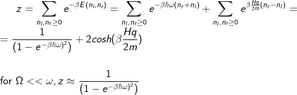
I tried to solve it considering the canonical ensemble (since the system is at the equilibrium with temperature T) and started finding the partition function:
Handwritten-style LaTeX derivation of a canonical partition function z = sum of exp(-beta E) over n_l and n_r, expanded with terms exp(-beta hbar omega) and exp(beta Hq/2m), ending with 1/(1 - exp(-beta hbar omega)^2) plus 2cosh(beta Hq/2m), and a limit for Omega much less than omega giving 1/(1 - exp(-beta hbar omega)^2).
The problem is I am not sure if I have done it correctly and need help because I don't really know where to check.
 
Attachments
  • Handwritten-style LaTeX derivation of a partition function z as a double sum over n_l and n_r, with exponential factors involving beta, hbar, omega, Hq/2m, leading to a result with cosh and a simplified form 1/(1 - e^(-beta hbar omega)^2) for small Omega.
    CodeCogsEqn(2).png
    3.1 KB · Views: 195
Last edited:
Why are you adding the two terms in your expression for the partition sum? You just have to use the expression and do the two sums over ##n_r## and ##n_l##. Obviously these two sums factorize!