Electric Field as potential gradient

Click For Summary
SUMMARY

The discussion focuses on the relationship between electric fields and potential gradients, specifically addressing the direction and magnitude of the electric field generated by point charges Q and P. Participants clarify that the electric field is directed from the positive charge towards the negative charge, and they emphasize the importance of defining the distances rP and rQ accurately to determine the electric field's magnitude. The conversation highlights the necessity of understanding vector directionality in electric fields.

PREREQUISITES
  • Understanding of electric fields and potential gradients
  • Familiarity with Coulomb's Law
  • Knowledge of vector mathematics
  • Basic concepts of point charges in electrostatics
NEXT STEPS
  • Study the principles of Coulomb's Law in detail
  • Learn about vector addition and subtraction in physics
  • Explore the concept of electric potential and its relation to electric fields
  • Investigate the effects of multiple point charges on electric fields
USEFUL FOR

Students of physics, educators teaching electrostatics, and anyone interested in understanding the fundamentals of electric fields and potential gradients.

sep1231
Messages
1
Reaction score
0
Homework Statement
In the figure (attached), the lines represent equipotential lines. A positive point charge is placed at point P, and another positive point charge is placed at Q. Which set of vectors represent the relative magnitudes and directions of the electric field exerted on the positive charges at P and Q?
a) Equal fields directed from P to Q
b) Field in P greater than in Q, directed from Q to P
c) Field in P smaller than in Q, directed from Q to P
d) Field in P greater than in Q, directed from P to Q
e) Field in P smaller than in Q, directed from P to Q
Relevant Equations
E = -V/d
I know that the electric field is directed from Q to P, but I'm not sure which magnitud is greater, I tried this
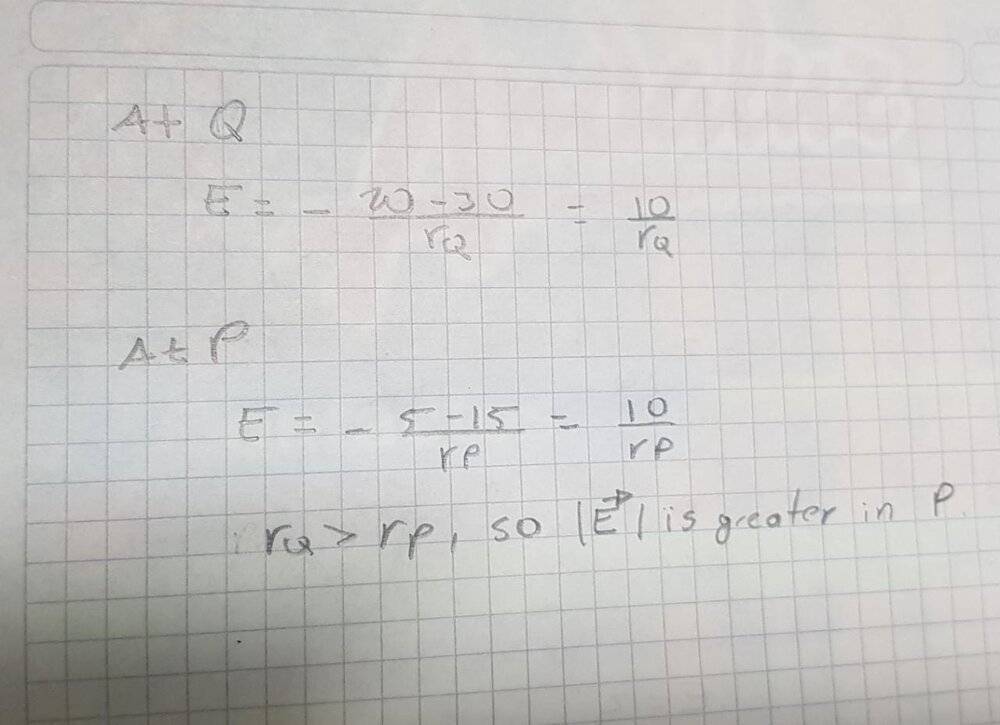
image.jpeg
 

Attachments

  • dfdf.png
    dfdf.png
    4.5 KB · Views: 170
Physics news on Phys.org
And the electric field at P and Q points toward...?
 
How are you defining rP and rQ?
 

Similar threads

Replies
6
Views
2K
Replies
10
Views
2K
  • · Replies 7 ·
Replies
7
Views
899
  • · Replies 1 ·
Replies
1
Views
969
  • · Replies 5 ·
Replies
5
Views
1K
Replies
1
Views
2K
Replies
11
Views
2K
  • · Replies 11 ·
Replies
11
Views
1K
  • · Replies 22 ·
Replies
22
Views
4K
  • · Replies 16 ·
Replies
16
Views
1K