Electric field at the center of a sphere

Click For Summary

Homework Help Overview

The discussion revolves around the electric field at the center of a sphere, specifically addressing the implications of surface charge density and the geometry involved in calculating the electric field. Participants explore the assumptions regarding the sphere's structure and the application of relevant equations.

Discussion Character

  • Exploratory, Conceptual clarification, Mathematical reasoning, Assumption checking

Approaches and Questions Raised

  • Participants discuss the assumption that the electric field is zero at the center of the sphere and question the validity of the integral approach used to calculate the electric field. There are inquiries about the coordinate system being utilized and the implications of surface charge density on the sphere's structure.

Discussion Status

Some participants express uncertainty about the methods being employed and seek clarification on the integral's representation. There is a mix of suggestions for clearer notation and the importance of visual aids in understanding the problem setup. The discussion reflects an ongoing exploration of the topic without a clear consensus on the approach.

Contextual Notes

There is mention of potential confusion arising from the use of the variable 'r' in different contexts, as well as the lack of explicit information regarding whether the sphere is conducting or non-conducting. Participants are encouraged to consider these factors in their reasoning.

Physicslearner500039
Messages
124
Reaction score
6
Homework Statement
A sphere of radius r carries a surface charge of density σ = ar, where a is a constant vector, and r is the radius vector of a point of the sphere relative to its center. Find the electric field strength vector at the center of the sphere.
Relevant Equations
E = q/(4πεr^2)
My first impression was the electric field is 0 at the center of the sphere, but it turned out not the case.
My understanding when problems refer surface charge density, is that the charge exists only on the surface and it is hollow inside the sphere. Am i correct?
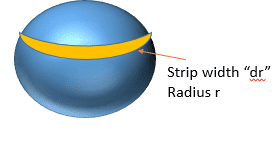
Using the electric field equation assuming width dr. The area of the strip is ##4\pi r.dr## is this correct?
1588940865464.png

## E = \int_0^r \sigma . 4\pi r dr/(4\pi \epsilon r^2) ##
replacing ##\sigma ##
##
E = \int_0^r a dr/\epsilon \\
E = ar/\epsilon
##
I am not very confident of the method. Please advise.
 
Physics news on Phys.org
Physicslearner500039 said:
Relevant Equations: NA
This can't be true

Physicslearner500039 said:
I am not very confident of the method.
Neither am I. In fact , I don't even see a method in your approach. Can you explain what you think your integral represents ?
 
Physicslearner500039 said:
Using the electric field equation assuming width dr. The area of the strip is ##4\pi r\; dr## is this correct?
Whwat coordinate system are you using ?
Re area: Compare a strip of your description at the equator with one at a pole !
 
Almost forgot: free advice, golden tip: make a clear sketch of your own !
 
Physicslearner500039 said:
Relevant Equations:: E = q/(4πεr^2)
Good to see you added one relevant equation. Note that ##\vec E## is a vector, though !
and is this r the same r as the radius of the sphere ?
My understanding when problems refer surface charge density, is that the charge exists only on the surface and it is hollow inside the sphere. Am i correct?
Doesn't say the sphere is hollow, but you may assume ##\varepsilon=\varepsilon_0##, so it doesn't matter.

Also doesn't say the sphere is non-conducting, which I think is a painful omission.
 
Thank you for the reply.
BvU said:
Note that ##\vec E## is a vector, though !
Yes my mistake
BvU said:
and is this r the same r as the radius of the sphere ?
Yes
BvU said:
Whwat coordinate system are you using ?
Not sure about the question. It is the normal x,y coordinates.
I read the following from the text
1588950580842.png

The sphere in question almost matches with above conditions. I am not sure what i am missing.
 
That's for a conducting sphere or shell: the charge distributes evenly over the surface.

Physicslearner500039 said:
It is the normal x,y coordinates
no it is not: if you write $$E = \int_0^r \sigma . 4\pi r dr/(4\pi \epsilon r^2) $$ you integrate over r from 0 to r. That is not in Cartesian coordinates. (*)

Now you see what confusion you can create by using the symbol ##r## for a whole bunch of completely different beasts.​
Note that sigma is only nonzero at ##r##, not at ##r<r##.

Now you see (again :smile: ) what confusion you can create by using the symbol ##r## for a whole bunch of completely different beasts.​

Proposal:
Since you master a bit of ##\TeX##, use ##R## as the radius of the sphere, so that one irritant source of misunderstanding/error is eliminated !

And write ##\sigma = \vec a \cdot\vec r##.

Where did you position your vector ##\vec a## ?

#4 post advice is relevant and indispensable for setting up a decent integral. I don't want to do the work for you, but for my own purposes I draw a sphere with radius R in a spherical (physics) coordinate system and align the z-axis (ok, ##\theta = 0## :smile: ) with the vector ##\vec A##. (upper case reminds me it's like R, a constant).

Next: I know that an area ##dS## of the shell has charge ##\sigma\, dS = \vec A \cdot \vec r \,dS## and subsequently I work out those factors in terms of ##|\vec A|, r\ (=R), \theta, \phi\ d\theta, d\phi##.

It also gives me an idea of the charge distribution over the sphere and its symmetry.

Which way is ##\vec E## at the origin pointing ? So for which component of ##\vec E## do I need an expression for ##dE## as a function of the above ?(*) Generally speaking a problem with a shell or a sphere benefits from working in spherical coordinates. The word says it already. In this exercise: definitely !
 
Last edited:
  • Like
Likes   Reactions: Physicslearner500039

Similar threads

Replies
6
Views
2K
Replies
12
Views
2K
Replies
11
Views
2K
  • · Replies 11 ·
Replies
11
Views
2K
Replies
23
Views
5K
Replies
17
Views
2K
  • · Replies 4 ·
Replies
4
Views
2K
  • · Replies 43 ·
2
Replies
43
Views
4K
Replies
4
Views
4K
  • · Replies 35 ·
2
Replies
35
Views
4K