zenterix
- 774
- 84
- Homework Statement
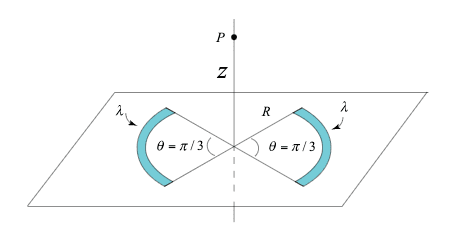
- Two circular arcs of radius ##R## are uniformly charged with a positive charge per unit length ##\lambda##. The arcs lie on a plane as shown in the figure below. Each arc subtends an angle ##\theta=\frac{\pi}{3}##.
What is the direction and magnitude of the electric field anywhere along the ##z## axis that passes through the center of the circular arcs, perpendicular to the plane of the figure?
- Relevant Equations
- Infinitesimal electric field created by an infinitesimal charge ##dq## on the right-side arc
$$d\vec{E}_{p_r}=\frac{k_e dq}{r_{dq,p}^2}\hat{r}_{dq,p}$$
The strategy will be to figure out what ##dq##, ##\hat{r}_{dq,p}##, and ##r_{dq,p}## are, plug them into the expression for ##d\vec{E}_{p_r}##, then integrate over ##d\vec{E}_{p_r}## to obtain ##\vec{E}_{p_r}##, the electric field at ##P## due to the arc on the right.
Then I will repeat the process to calculate ##d\vec{E}_{p_l}## and ##\vec{E}_{p_l}##, for the arc on the left. The latter will be basically the same result as for ##d\vec{E}_{p_r}## but with one sign changed.
$$dq=\lambda ds = \lambda R d\theta$$
Here are the original sketch of the problem and my own sketch
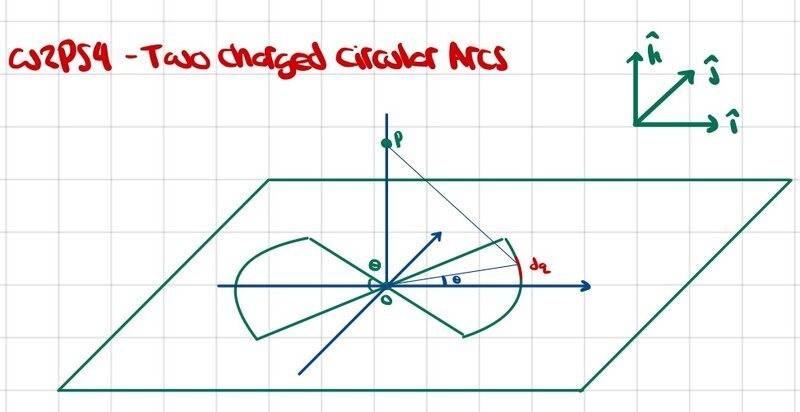
$$\vec{r}_{dq,p}=\vec{r}_{0,p}-\vec{r}_{0,dq}$$
$$\vec{r}_{0,p}=z\hat{k}$$
$$\hat{r}_{0,dq}=\cos{\theta}\hat{i} +\sin{\theta}\hat{j}$$
$$\vec{r}_{0,dq}=R\hat{r}_{0,dq}=R(\cos{\theta}\hat{i} +\sin{\theta}\hat{j})$$
$$\implies \vec{r}_{dq,p}=z\hat{k}-R\cos{\theta}\hat{i} -R\sin{\theta}\hat{j}$$
$$d\vec{E}_{p_r}=\frac{k_e \lambda R d\theta}{(z^2+R^2)^{3/2}}(z\hat{k}-R\cos{\theta}\hat{i} -R\sin{\theta}\hat{j})$$
The expression for ##d\vec{E}_{p_l}## is derived analogously, and the only thing that changes is s sign on ##\hat{r}_{0,dq}##
$$\hat{r}_{0,dq}=-\cos{\theta}\hat{i} +\sin{\theta}\hat{j}$$
$$d\vec{E}_{p_l}=\frac{k_e \lambda R d\theta}{(z^2+R^2)^{3/2}}(z\hat{k}+R\cos{\theta}\hat{i} -R\sin{\theta}\hat{j})$$
Now we integrate over ##\theta##
$$\vec{E}_{p_r}=\int_{-\frac{\pi}{3}}^{\frac{\pi}{3}} \frac{k_e \lambda R d\theta}{(z^2+R^2)^{3/2}}(z\hat{k}-R\cos{\theta}\hat{i} -R\sin{\theta}\hat{j})$$
$$\vec{E}_{p_l}=\int_{-\frac{\pi}{3}}^{\frac{\pi}{3}} \frac{k_e \lambda R d\theta}{(z^2+R^2)^{3/2}}(z\hat{k}+R\cos{\theta}\hat{i} -R\sin{\theta}\hat{j})$$
We end up with
$$\vec{E}_{p_r}=\frac{k_e \lambda R d\theta}{(z^2+R^2)^{3/2}}(\frac{2\pi z}{3}\hat{z} -R\sqrt{3}\hat{i})$$$$\vec{E}_{p_l}=\frac{k_e \lambda R d\theta}{(z^2+R^2)^{3/2}}(\frac{2\pi z}{3}\hat{z} +R\sqrt{3}\hat{i})$$
Therefore
$$\vec{E}_p=\vec{E}_{p_r}+\vec{E}_{p_l}=\frac{k_e \lambda R d\theta}{(z^2+R^2)^{3/2}}\frac{4\pi z}{3}\hat{k}$$
$$=\frac{\lambda R z}{3\epsilon_0 (z^2+R^2)^{3/2}}\hat{k}$$
I'd like to know if this solution is correct because I am following along on MIT Open Learning Library and this is a practice problem. I am allowed to submit answers, and am given a correct/incorrect feedback. For the expression above, I am getting incorrect, though I can't figure out why.
Then I will repeat the process to calculate ##d\vec{E}_{p_l}## and ##\vec{E}_{p_l}##, for the arc on the left. The latter will be basically the same result as for ##d\vec{E}_{p_r}## but with one sign changed.
$$dq=\lambda ds = \lambda R d\theta$$
Here are the original sketch of the problem and my own sketch
$$\vec{r}_{dq,p}=\vec{r}_{0,p}-\vec{r}_{0,dq}$$
$$\vec{r}_{0,p}=z\hat{k}$$
$$\hat{r}_{0,dq}=\cos{\theta}\hat{i} +\sin{\theta}\hat{j}$$
$$\vec{r}_{0,dq}=R\hat{r}_{0,dq}=R(\cos{\theta}\hat{i} +\sin{\theta}\hat{j})$$
$$\implies \vec{r}_{dq,p}=z\hat{k}-R\cos{\theta}\hat{i} -R\sin{\theta}\hat{j}$$
$$d\vec{E}_{p_r}=\frac{k_e \lambda R d\theta}{(z^2+R^2)^{3/2}}(z\hat{k}-R\cos{\theta}\hat{i} -R\sin{\theta}\hat{j})$$
The expression for ##d\vec{E}_{p_l}## is derived analogously, and the only thing that changes is s sign on ##\hat{r}_{0,dq}##
$$\hat{r}_{0,dq}=-\cos{\theta}\hat{i} +\sin{\theta}\hat{j}$$
$$d\vec{E}_{p_l}=\frac{k_e \lambda R d\theta}{(z^2+R^2)^{3/2}}(z\hat{k}+R\cos{\theta}\hat{i} -R\sin{\theta}\hat{j})$$
Now we integrate over ##\theta##
$$\vec{E}_{p_r}=\int_{-\frac{\pi}{3}}^{\frac{\pi}{3}} \frac{k_e \lambda R d\theta}{(z^2+R^2)^{3/2}}(z\hat{k}-R\cos{\theta}\hat{i} -R\sin{\theta}\hat{j})$$
$$\vec{E}_{p_l}=\int_{-\frac{\pi}{3}}^{\frac{\pi}{3}} \frac{k_e \lambda R d\theta}{(z^2+R^2)^{3/2}}(z\hat{k}+R\cos{\theta}\hat{i} -R\sin{\theta}\hat{j})$$
We end up with
$$\vec{E}_{p_r}=\frac{k_e \lambda R d\theta}{(z^2+R^2)^{3/2}}(\frac{2\pi z}{3}\hat{z} -R\sqrt{3}\hat{i})$$$$\vec{E}_{p_l}=\frac{k_e \lambda R d\theta}{(z^2+R^2)^{3/2}}(\frac{2\pi z}{3}\hat{z} +R\sqrt{3}\hat{i})$$
Therefore
$$\vec{E}_p=\vec{E}_{p_r}+\vec{E}_{p_l}=\frac{k_e \lambda R d\theta}{(z^2+R^2)^{3/2}}\frac{4\pi z}{3}\hat{k}$$
$$=\frac{\lambda R z}{3\epsilon_0 (z^2+R^2)^{3/2}}\hat{k}$$
I'd like to know if this solution is correct because I am following along on MIT Open Learning Library and this is a practice problem. I am allowed to submit answers, and am given a correct/incorrect feedback. For the expression above, I am getting incorrect, though I can't figure out why.