Electric field in a solid cylinder with an offset hole
Click For Summary
SUMMARY

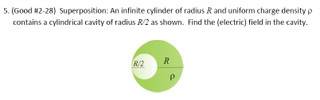
The discussion focuses on calculating the electric field within a cylindrical cavity of radius R/2 located in a solid cylinder of radius R with a uniform charge density (ρ). The solution utilizes Gauss's Law to derive the electric fields produced by both the solid cylinder and the cavity. The key conclusion is that the electric field within the cavity is not zero, as initially assumed, but rather determined by the superposition of the electric fields from the two cylinders. The resulting electric field direction points from the center of the solid cylinder to the center of the cavity.

PREREQUISITES
  • Understanding of Gauss's Law
  • Familiarity with electric fields and superposition principle
  • Knowledge of cylindrical coordinate systems
  • Basic vector calculus for field calculations
NEXT STEPS
  • Study the application of Gauss's Law in cylindrical geometries
  • Learn about electric field superposition in electrostatics
  • Explore vector calculus techniques for field analysis
  • Investigate the effects of charge density variations on electric fields
USEFUL FOR

Students in physics courses, particularly those studying electromagnetism, as well as educators and anyone interested in understanding electric fields in complex geometries.

calandra
Messages
3
Reaction score
0
[SOLVED] Electric field in a solid cylinder with an offset hole

Homework Statement


question5.jpg

its teenie, but it says: Superposition: an infinite cylinder of radius R and uniform charge density (row) contains a cylindrical cavity of radius R/2 as shown. Find the electric field in the cavity.


Homework Equations


Gauss's Law I guess.


The Attempt at a Solution


My first thought was 'zero. duh'...but that's not exactly superposition. I know there has to be something about the whole cylinder minus the hole...but I'm not sure how to go about integrating with a common origin or...I've just gotten myself very confused. HELP!
 
Physics news on Phys.org
Here's a hint: A negative charge can cancel a positive charge. :wink:
 
Let E_1 the wanted electric field, E_2 the electric field produced by the cylinder R/2 alone and E_3 the electric field produced by the cylinder R. Then

E_1+E_2=E_3\Rightarrow E_1=E_3-E_2


The electric fields E_2, E_3 are easily obtained by Gauss law.
 
thank you thank you
however...easily obtained by gauss's law...easily...I'm having a very blonde afternoon...I can't seem to pick a reference frame that works for both E1 and E2. And do I treat E2 as a cylindrical shell with uniform charge distribution? Or as nothing...not that it really matters...its still zero right?
 
Come up with two solid uniform cylinders of charge which add up to give you the needed charge configuration.
 
Hey there, I take it you're in Phys 231/239 as well?
 
wow...lol.
Yup 239.
Have you finished it?
 
I'm done the assignment except for this question. I too was having some trouble combining the two fields (awkward using two separate cylindrical coordinate systems). I think I've figured it out now though.

I'm technically in 231, but it's just 239 renamed for us purple folk.


Doc Al said:
Come up with two solid uniform cylinders of charge which add up to give you the needed charge configuration.
Hi, I'm having trouble with the same problem. The center of the cavity is at a distance A from the center of the big cylinder. My calculations of superpositioning the two fields yields an electric field within the cavity equal to zero. Is this correct?
 
  • #10


irish_coffee said:
My calculations of superpositioning the two fields yields an electric field within the cavity equal to zero. Is this correct?
No, that's not correct. Show how you came to that conclusion.
 
  • #11


I know, I discovered it was nonsense. I now have calculated the vector product of the vector field produced by the big solid cylinder with charge density rho and the vector field produced by the small cylinder with charge density minus rho. Because this adds up to the situation we have here (a big cylinder with a cavity with density of zero). The direction of the resulting vector field in an arbitrary point P within the cavity is in the direction of the vector connecting the center of the big cylinder and the center of the cavity.
 

Similar threads

  • · Replies 2 ·
Replies
2
Views
3K
  • · Replies 36 ·
2
Replies
36
Views
2K
  • · Replies 6 ·
Replies
6
Views
13K
  • · Replies 1 ·
Replies
1
Views
3K
  • · Replies 2 ·
Replies
2
Views
2K
Replies
2
Views
2K
  • · Replies 1 ·
Replies
1
Views
6K
  • · Replies 1 ·
Replies
1
Views
3K
  • · Replies 2 ·
Replies
2
Views
3K
  • · Replies 2 ·
Replies
2
Views
1K