Electric field inside and outside a sphere (Not Gauss)

Click For Summary

Homework Help Overview

The discussion revolves around calculating the electric field inside and outside a uniformly charged spherical volume by superposing the electric fields from uniformly charged disks. Participants are exploring the mathematical setup and the implications of charge density in this context.

Discussion Character

  • Exploratory, Conceptual clarification, Mathematical reasoning, Assumption checking

Approaches and Questions Raised

  • Participants discuss the transformation of variables in the equations for a disk, particularly how the distance from the evaluation point to the center of the disk changes with the angle theta. There is also a focus on how to express surface charge density in terms of volume charge density.

Discussion Status

Some participants express uncertainty about the correctness of the provided solutions and seek clarification on specific steps. There is an ongoing examination of the relationships between surface and volume charge densities, with multiple interpretations of the equations being explored.

Contextual Notes

Participants are questioning the accuracy of a solutions manual and discussing potential errors in the equations provided. There is a focus on understanding the geometric relationships involved in the problem, particularly regarding the thickness of the disks used in the superposition method.

Waxterzz
Messages
82
Reaction score
0
Find E(r) inside and outside a uniformly charged spherical volume by superposing the electric fields
produced by a collection of uniformly charged disks.

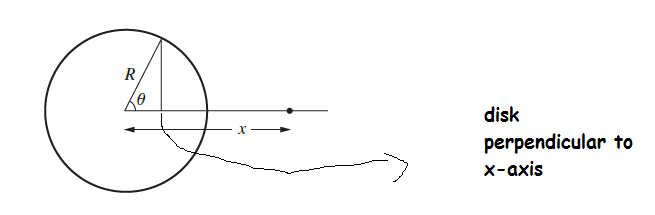
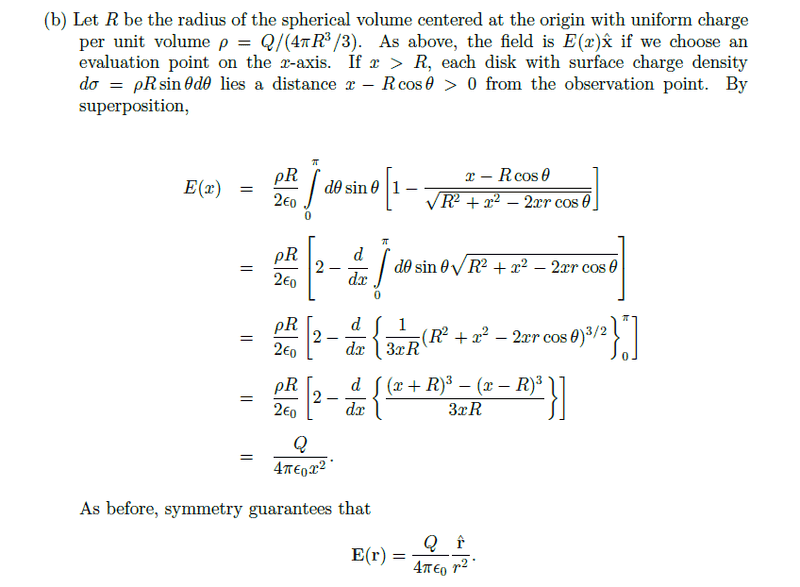
a+b) Given equations, sketch of problem
This is the equation in the handbook for a disk (but in the exercises the z becomes x, without loss of generality)

q8YVppO.png


Vh305nX.png


So by varying theta, he wants you to superpose the disks, to form a solid sphere. The disks are x- R* cos(theta) removed.

The Attempt at a Solution


[/B]
1yGPb1u.png


So he changes in the equation for the disk,the nominator z was the distance from the evaluation point to the center of the disk, this was z. This now becomes x-R*cos(theta). The denominator was the distance from the rim of the disk to the evaluation point, this was in the equation just the pythagoras rule, now it varies with theta because you have a superposition of different disks, so the pythagoras rule becomes the cosine rule. I kinda get these alterations.

What I don't get:

But I don't really get how he substitutes the surface charge density with this term with rho in? The term d(surface charge charge) = rho * R * sin (theta) * d(theta)

If anyone wants to clarify this to me, thanks in advance.
 
Last edited:
Physics news on Phys.org
I think the solution is just wrong because the last step isn't correct?

Edit:

Looks like the solutions manual from Zangwhil contains errors.

This is from a site I found on the internet (check problem 4d)

https://pa.as.uky.edu/sites/default/files/Phy416G-HWSol4.pdfbut now
dσ = 2πρR sin θdθ

and I still don't know how to do that.
 
Last edited:
Waxterzz said:
I think the solution is just wrong because the last step isn't correct?
Hello. I don't see a mistake in the solution given in your first post. Can you state more explicitly where you feel a mistake has been made?

This is from a site I found on the internet (check problem 4d)

https://pa.as.uky.edu/sites/default/files/Phy416G-HWSol4.pdf

but now
dσ = 2πρR sin θdθ
I think this is incorrect. The factor of 2π should not be there.

and I still don't know how to do that.
In general, consider a thin slab of material of thickness d that has a uniform volume charge density ρ. If you approximated this by a surface with an "equivalent" uniform surface charge density σ, how would you write σ in terms of ρ and d?
upload_2016-9-24_18-24-49.png


-------------------------------------------------------------------------------------------------------------------------------------------------
For one of the thin disks of the sphere, how would you write the thickness |dx| of the disk in terms of R, θ, and dθ?
 
TSny said:
Hello. I don't see a mistake in the solution given in your first post. Can you state more explicitly where you feel a mistake has been made?I think this is incorrect. The factor of 2π should not be there.In general, consider a thin slab of material of thickness d that has a uniform volume charge density ρ. If you approximated this by a surface with an "equivalent" uniform surface charge density σ, how would you write σ in terms of ρ and d?
View attachment 106445

-------------------------------------------------------------------------------------------------------------------------------------------------
For one of the thin disks of the sphere, how would you write the thickness |dx| of the disk in terms of R, θ, and dθ?

Excuse me sir, for the late reply. I think I didn't understood it first, then forgot about it, now I stumbled across it and still haven't figured it out

ρ . A . d = σ . A
ρ . dx = σ

Is this what you were implying?I don't see how R sin θ dθ equals the thickness of my disk, since R sin θ points in the direction perpendicular to the x-axis.
http://blob:https://imgur.com/7c67520c-b11f-4fb3-9218-afcca75d1bf7
VHdPuUC.png
 
Last edited by a moderator:
Waxterzz said:
ρ . A . d = σ . A
ρ . dx = σ

Is this what you were implying?
Yes.
I don't see how R sin θ dθ equals the thickness of my disk, since R sin θ points in the direction perpendicular to the x-axis.
http://blob:https://imgur.com/7c67520c-b11f-4fb3-9218-afcca75d1bf7
VHdPuUC.png

See if the following diagram helps. The red line in the right figure indicates the thickness of the disk. Note that the red line is also the base of a small right triangle at the top of the disk where R dθ is the hypotenuse. See if you can find the length of the red line by using trig on the right triangle.
upload_2016-11-23_11-49-17.png
 
Last edited by a moderator:

Similar threads

Replies
4
Views
4K
Replies
6
Views
2K
Replies
23
Views
5K
  • · Replies 2 ·
Replies
2
Views
2K
  • · Replies 1 ·
Replies
1
Views
1K
Replies
17
Views
1K
  • · Replies 17 ·
Replies
17
Views
2K
  • · Replies 5 ·
Replies
5
Views
6K
  • · Replies 2 ·
Replies
2
Views
2K