Blue Crayon
- 1
- 0
Hey guys I'm reviewing my notes and I noticed their was a multiple choice problem in my notes that looking back now I just don't understand.
The problem is:
The drawing shows a +ve and a -ve point charge. The -ve charge has the greater magnitude. Where on the line that passes through the charges is the one spot where the total electric field is 0.
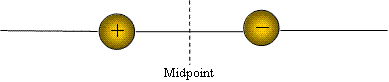
Possible Answers:
A. To the right of the negative charge
B. To the left of the positive charge
C. Between the charges, to the left of the midpoint
D. Between the charges, to the right of the midpoint
----
Looking at this I eliminate A and D right away and honestly my gut feeling then becomes to use C as the way I think of it is the mid point could have to move closer to the +ve charge to balance it out and make it 0. Maybe I am thinking of this all in the wrong sense. Anyways the answer is definitely B as that is what I have circled from my class notes. If someone could explain to me in layman's terms what I am missing I'd really appreciate it!
Thanks!
- BlueCrayon
The problem is:
The drawing shows a +ve and a -ve point charge. The -ve charge has the greater magnitude. Where on the line that passes through the charges is the one spot where the total electric field is 0.
Possible Answers:
A. To the right of the negative charge
B. To the left of the positive charge
C. Between the charges, to the left of the midpoint
D. Between the charges, to the right of the midpoint
----
Looking at this I eliminate A and D right away and honestly my gut feeling then becomes to use C as the way I think of it is the mid point could have to move closer to the +ve charge to balance it out and make it 0. Maybe I am thinking of this all in the wrong sense. Anyways the answer is definitely B as that is what I have circled from my class notes. If someone could explain to me in layman's terms what I am missing I'd really appreciate it!
Thanks!
- BlueCrayon