Electric potential and potential difference

Click For Summary
SUMMARY

The discussion centers on the concepts of electric potential and potential difference, specifically in the context of connecting capacitors and batteries. It highlights that textbooks typically connect both ends of capacitors in parallel, but poses the question of what occurs when only one end is connected. The conversation emphasizes the need to consider Maxwell's equations for accurate analysis and mentions that the potential is defined relative to an arbitrary reference point, often taken as zero at Earth's potential. Participants seek further resources and clarification on grounding and the implications of connecting capacitors and batteries in various configurations.

PREREQUISITES
  • Understanding of electric potential and potential difference
  • Familiarity with Maxwell's equations and coefficients of potential
  • Knowledge of capacitor configurations (series and parallel)
  • Basic concepts of charge distribution in electrical circuits
NEXT STEPS
  • Research "Maxwell's equations in electrostatics" for deeper insights into electric potential analysis
  • Study "Capacitor charge redistribution" to understand the dynamics when connecting capacitors
  • Explore "Grounding techniques in electrical circuits" for practical applications and complexities
  • Investigate "Floating circuits and their implications in oscilloscope measurements" for advanced circuit analysis
USEFUL FOR

Electrical engineers, physics students, and anyone interested in advanced circuit theory and the behavior of electric potential in capacitors and batteries.

yucheng
Messages
232
Reaction score
57
TL;DR
I'm hoping for resources for further reading, advanced remarks etc
Electric potential = "absolute potential"

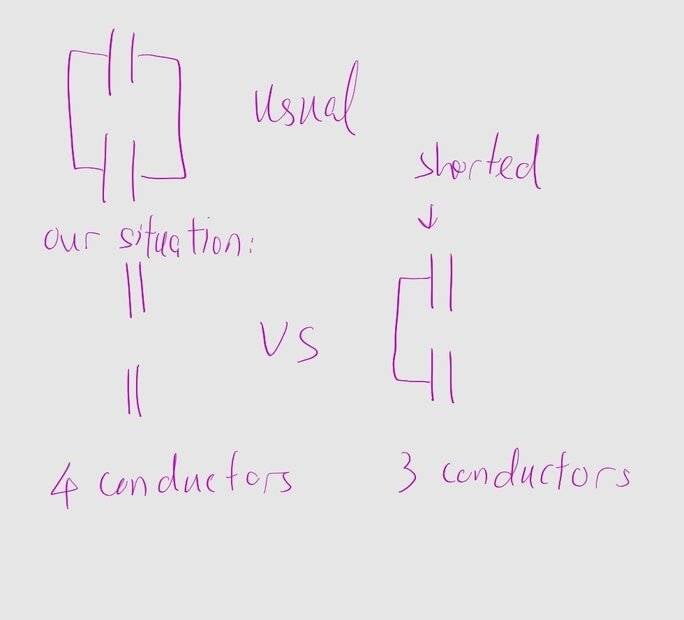
Textbooks usually connect both ends of two capacitors, of different voltages, in parallel. What would happen if we only connect one end of the capacitors? Perhaps we would have to solve for Maxwell's coefficients of potential for these two cases (to transition between both)

Right?

Here's a picture
SmartSelect_20230414_195128_Samsung Notes.jpg
My main motivation comes from:

----> https://physics.stackexchange.com/questions/421473/capacitor-connected-to-battery-at-one-end

---> https://www.physicsforums.com/threa...lues-at-battery-terminals.292702/post-2078952
Post #3 "Grounding is a potentially complex and interesting subject rarely dealt with in undergraduate studies."

Do you know of any reference for this?

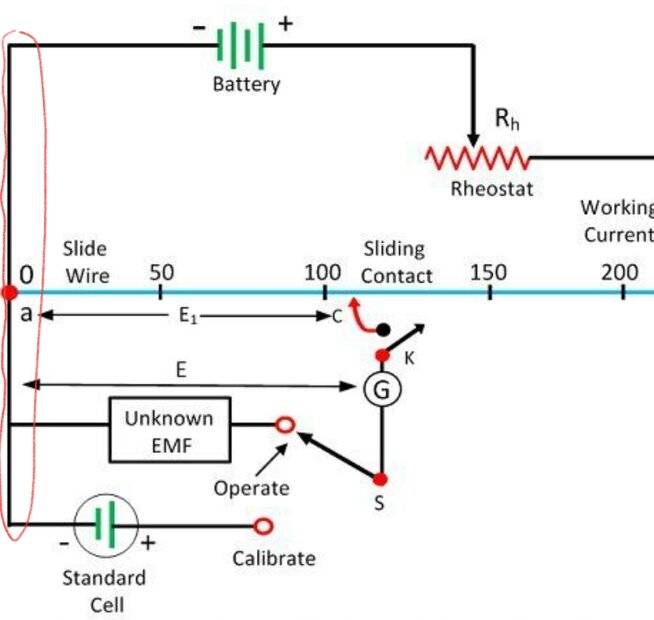
----> what would happen if we connect batteries in parallel, or that only 1 terminal is shorted. Assume that they have the same potential difference, but that they have different electric potential. Perhaps one realization (potentiometer) (circled red part):
Screenshot_20230414_201258_Samsung Internet.jpg


----> the problem of using oscilloscopes with floating circuits.

What's your comment on these?
Anywhere I can read further? Thanks!
 
Last edited:
Physics news on Phys.org
yucheng said:
TL;DR Summary: I'm hoping for resources for further reading, advanced remarks etc

Here's a picture
In order to investigate electric potential, you should let us know how much charges are on the plates.
For an example if there is no charge at all, potential is zero everywhere.
 
anuttarasammyak said:
For an example if there is no charge at all, potential is zero everywhere.
With respect, the potential is constant everywhere and we call it zero by convention
yucheng said:
TL;DR Summary: I'm hoping for resources for further reading, advanced remarks etc

Electric potential = "absolute potential"

Textbooks usually connect both ends of two capacitors, of different voltages, in parallel. What would happen if we only connect one end of the capacitors? Perhaps we would have to solve for Maxwell's coefficients of potential for these two cases (to transition between both)

Right?

Here's a picture

View attachment 324874My main motivation comes from:

----> https://physics.stackexchange.com/questions/421473/capacitor-connected-to-battery-at-one-end

---> https://www.physicsforums.com/threa...lues-at-battery-terminals.292702/post-2078952
Post #3 "Grounding is a potentially complex and interesting subject rarely dealt with in undergraduate studies."

Do you know of any reference for this?

----> what would happen if we connect batteries in parallel, or that only 1 terminal is shorted. Assume that they have the same potential difference, but that they have different electric potential. Perhaps one realization (potentiometer) (circled red part):

View attachment 324877

----> the problem of using oscilloscopes with floating circuits.

What's your comment on these?
Anywhere I can read further? Thanks!

The value of the electric potential is defined to within an arbitrary fixed constant and therefore only the differences in potential matter.
The potential of the planet Earth is often defined as zero to make the arithmetic easy.
There is no such thing as an "isolated" object or circuit. One can define the capacitance C of a isolated sphere only by assuming it is electrodynamically connected to the rest of the universe and then $$\Delta V \equiv \Delta Q /C $$ and Q is charge that has been separated from the universe to the object. Usually the rest of the universe is represented by a very large encompassing sphere. For lumped circuit theory the myth of isolation is tacitly assumed sometimes with bad result (as Prof. Walter Lewin marvelously demonstrated )
One could use Maxwell's coefficients but the rest of the universe may need to be included for any meaningful results to obtain. At some level of complexity, the lumped circuit model is probably not the place to start: better to solve Maxwell Equations directly using other approximations as needed.
 
  • Like
Likes   Reactions: yucheng and DaveE
yucheng said:
Textbooks usually connect both ends of two capacitors, of different voltages, in parallel.
They won't be different for long. Current will immediately flow to redistribute charges to equalize the two voltages. I don't think you'll see this question too often since it's sort of a trick question with a solution that requires some assumptions about the connecting inductance, oscillations, and energy radiated away as the charge is moved.

yucheng said:
What would happen if we only connect one end of the capacitors?
Since you drew this as a lumped element circuit then the answer for the usual case is that you will have the equivalent of a single capacitor with charge Q1+Q2, voltage V1=V2, and capacitance C1+C2. The charge will be redistributed to equalize the potential. For the "3-wire" case, you will have two capacitors in series which is equivalent to a single capacitor with total charge Q1+Q2, voltage V1+V2, and capacitance C1⋅C2/(C1+C2). Of course there will be no current flow, except to equalize the charge on the middle plates (which are eliminated in the single capacitor equivalent).

yucheng said:
Perhaps we would have to solve for Maxwell's coefficients of potential for these two cases
Yes, I think so. As @hutchphd said, I don't think you're really asking about a lumped element problem, which is always a huge simplification of the real world. Maxwell's equations are required when the geometric details matter.
 
  • Like
Likes   Reactions: hutchphd
I'm not familiar with the term "Maxwell's Coefficients", Can't find it on Google either could someone explain?
 
Aaah. coefficients of capacitance. Thanks.
 
  • Like
Likes   Reactions: hutchphd
Perhaps I'll just dump some other similar questions hereelectricity - Resistor circuit that isn't parallel or series - Physics Stack Exchange
https://physics.stackexchange.com/questions/22252/resistor-circuit-that-isnt-parallel-or-series

electric circuits - Capacitors in Series and Parallel/Dipole - Physics Stack Exchange
https://physics.stackexchange.com/questions/750349/capacitors-in-series-and-parallel-dipole

Connecting 2 capacitors' the leads with opposite polarity
https://images.app.goo.gl/YHWt2G2GkusnCSoX7

electricity - Charged capacitors in series -- but connected at same polarity plates? - Physics Stack Exchange
https://physics.stackexchange.com/q...-series-but-connected-at-same-polarity-plates

electric circuits - Unequal batteries in parallel (theory only & assuming ideal voltage sources) - Physics Stack Exchange
https://physics.stackexchange.com/q...el-theory-only-assuming-ideal-voltage-sources

electricity - Different batteries connected in parallel - Physics Stack Exchange
https://physics.stackexchange.com/questions/64509/different-batteries-connected-in-parallel

electricity - Is a capacitor in an open circuit charged? - Physics Stack Exchange
https://physics.stackexchange.com/questions/103099/is-a-capacitor-in-an-open-circuit-charged
 

Similar threads

  • · Replies 21 ·
Replies
21
Views
4K
  • · Replies 14 ·
Replies
14
Views
5K
  • · Replies 58 ·
2
Replies
58
Views
5K
  • · Replies 3 ·
Replies
3
Views
1K
  • · Replies 7 ·
Replies
7
Views
2K
  • · Replies 4 ·
Replies
4
Views
2K
  • · Replies 6 ·
Replies
6
Views
1K
  • · Replies 7 ·
Replies
7
Views
2K
  • · Replies 2 ·
Replies
2
Views
11K
  • · Replies 33 ·
2
Replies
33
Views
6K