Electric Potential and Potential Energy Due to Charged Particles

Click For Summary
SUMMARY

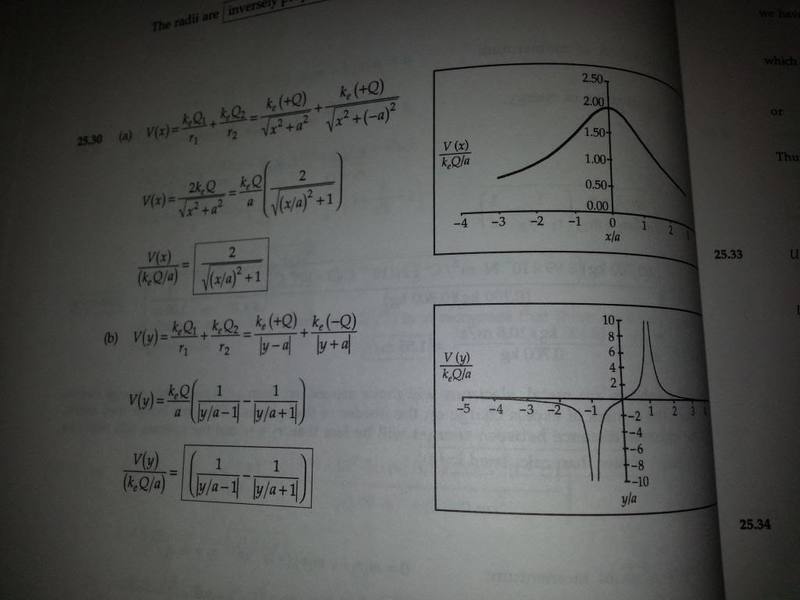
The discussion focuses on calculating the electric potential due to two charged particles positioned symmetrically along the y-axis. The potential is expressed in units of (KeQ)/a, where Ke is Coulomb's constant and Q is the charge. The participants clarify the necessity of factoring out KeQ/a to graph the potential as a function of x/a, allowing for the variable 'a' to be omitted. Additionally, the use of absolute values for the distance calculations along the y-axis is explained, emphasizing that distance cannot be negative.

PREREQUISITES
  • Understanding of electric potential and potential energy concepts
  • Familiarity with Coulomb's law and the constant Ke
  • Basic knowledge of graphing functions in physics
  • Proficiency in algebraic manipulation of equations
NEXT STEPS
  • Study the derivation of electric potential from point charges
  • Learn about the implications of symmetry in electric fields
  • Explore graphing techniques for functions involving absolute values
  • Investigate the relationship between electric potential and electric field strength
USEFUL FOR

Students and professionals in physics, electrical engineering, and anyone interested in understanding electric potential and its graphical representation in relation to charged particles.

brojas7
Messages
20
Reaction score
0
Two charged particles of equal magnitude are located along the y-axis equal distances above and below the x-axis.
Plot a graph of the electric potential at points along the x-axis over the interval -3a<x<3a. You should plot the potential in units of (KeQ)/a
Let the charge of the particle located at y=-a be negative. Plot the potential along the y-axis over the interval -4a<y<4a.

I was able to do :
(KeQ1)/r^2 + (KeQ2)/r^2 =
(KeQ)/ sqrt(x^2 + a^2) + (KeQ)/ sqrt(x^2 + -a^2) =
(2KeQ)/ sqrt(x^2 + -a^2)

Why did they factor out a KeQ/a, was it necessary? how do you plug in x to get the graph if you don't know 'a'.

and for the y axis, why did they get an absolute value for y-a and y+a.


ANSWER:

20130402_122805_zps53662169.jpg
 

Attachments

  • 20130402_122805.jpg
    20130402_122805.jpg
    28.5 KB · Views: 745
Physics news on Phys.org
brojas7 said:
Two charged particles of equal magnitude are located along the y-axis equal distances above and below the x-axis.
Plot a graph of the electric potential at points along the x-axis over the interval -3a<x<3a. You should plot the potential in units of (KeQ)/a
Let the charge of the particle located at y=-a be negative. Plot the potential along the y-axis over the interval -4a<y<4a.

I was able to do :
(KeQ1)/r^2 + (KeQ2)/r^2 =
(KeQ)/ sqrt(x^2 + a^2) + (KeQ)/ sqrt(x^2 + -a^2) =
(2KeQ)/ sqrt(x^2 + -a^2)

Why did they factor out a KeQ/a, was it necessary? how do you plug in x to get the graph if you don't know 'a'.
It made it possible to graph V as a function of x/a only. You don't need to know a if you're happy with x/a for the x-axis (really making it an "x/a" axis).
and for the y axis, why did they get an absolute value for y-a and y+a.

Because r is always positive, so the quantity y-a or y- (-a) must be positive and therefore put in absolute bars. y can be as negative as -4a, remember. (a is always positive.)

BTW your 1st eq. has a typo in it. r, not r^2, as you know.
 
Ok the first part makes sense as for the second, since r is always positive and must put in the absolute bars, why didn't we do that with the first? Is it because the square root already takes care of that?
 
Also, why must r always be positive? Or is this just a rule?
And thank you for the correction, I completely overlooked it, even on paper.
 
brojas7 said:
Ok the first part makes sense as for the second, since r is always positive and must put in the absolute bars, why didn't we do that with the first? Is it because the square root already takes care of that?

Right. You just ignore the negative root.
 
brojas7 said:
Also, why must r always be positive? Or is this just a rule?
And thank you for the correction, I completely overlooked it, even on paper.

You can't have negative distance! The sign of the potential due to a charge is determined solely by the sign of the charge.
 
Ok it all makes sense now. I didn't think of it as a distance. thank you so much
 

Similar threads

Replies
5
Views
627
  • · Replies 2 ·
Replies
2
Views
1K
Replies
64
Views
5K
Replies
1
Views
3K
Replies
11
Views
2K
Replies
2
Views
681
  • · Replies 2 ·
Replies
2
Views
2K
  • · Replies 10 ·
Replies
10
Views
2K
  • · Replies 18 ·
Replies
18
Views
1K
Replies
6
Views
2K