Electric potential - Is the teacher wrong?

Click For Summary

Homework Help Overview

The discussion revolves around the electric potential created by two point charges, specifically an 8.0 µC charge at the origin and a -7.0 µC charge at (0 m, 0.25 m). Participants are tasked with finding the points along the y-axis where the potential is zero, and there is some confusion regarding the nature of the solutions and the expected quadratic form of the equation.

Discussion Character

  • Exploratory, Assumption checking, Problem interpretation

Approaches and Questions Raised

  • Participants discuss their attempts to set up the equation for electric potential and question the teacher's assertion that the problem leads to a quadratic equation. Some express uncertainty about the number of solutions and the behavior of the equipotential lines in relation to the charges.

Discussion Status

There is an ongoing exploration of the correct form of the potential equation, with some participants suggesting that the approach should involve summing the potentials from both charges. Several participants have noted discrepancies in their calculations and are seeking clarification on the implications of their setups.

Contextual Notes

Some participants mention that the teacher indicated there should be two solutions, while others are grappling with the implications of their calculations not yielding a quadratic form. There is also mention of a potential misunderstanding regarding the positions of the charges and their influence on the potential along the y-axis.

tony873004
Science Advisor
Gold Member
Messages
1,753
Reaction score
143
electric potential -- Is the teacher wrong?

Homework Statement


This is from our practice midterm test:

A point charge of 8.0 [tex]\mu C[/tex] is placed at the origin of a coordinate system and a charge of -7.0 [tex]\mu C[/tex] is placed at (0 m, 0.25 m). Find where on the y-axis the potential is zero.


Homework Equations


V=kQ/y


The Attempt at a Solution


[tex] \begin{array}{l}<br /> d_1 = y \\ <br /> d_2 = y - 0.25 \\ <br /> \\ <br /> \frac{{Q_1 }}{y} = \frac{{Q_2 }}{{y - 0.25}}\,\,\,\, \Rightarrow \,\,\,\,\frac{{Q_1 }}{y} = \frac{{Q_2 }}{{y - 0.25}}\,\,\,\, \Rightarrow \,\,\,\, \\ <br /> \\ <br /> \,Q_1 \left( {y - 0.25} \right) = yQ_2 \,\,\,\, \Rightarrow \,\,\,\,Q_1 y - 0.25Q_1 = yQ_2 \,\,\,\,\, \Rightarrow \,\,\,\, \\ <br /> \\ <br /> - 0.25Q_1 = yQ_2 - Q_1 y\,\,\,\, \Rightarrow \,\,\,\, - 0.25Q_1 = y\left( {Q_2 - Q_1 } \right)\,\,\,\, \Rightarrow \\ <br /> \\ <br /> y = \frac{{ - 0.25Q_1 }}{{\left( {Q_2 - Q_1 } \right)}} = \frac{{ - 0.25\left( {8\mu C} \right)}}{{ - 7\mu C - 8\mu C}} = \frac{{ - 2\mu C}}{{ - 15\mu C}} = \frac{2}{{15}}{\rm{m}} \\ <br /> \end{array}[/tex]

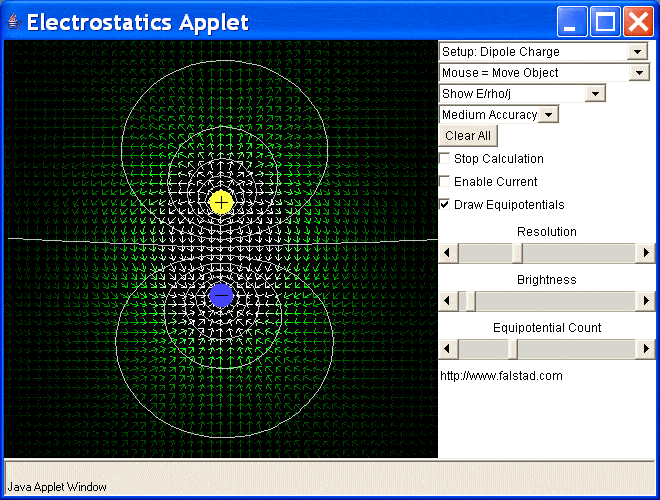
Here's the problem. In class, he said it would boil down to a quadratic, and we should get two answers. On the worksheet, he gives two answers of 2/15, like I got, and 2. But I never got a quadratic. Furthermore, I played around with the online applet for 2 opposite charges, and I don't see the equipotential line for 0 crossing the y-axis more than once. Here's a screen shot:
pm2.GIF


What am I missing here?
 
Last edited:
Physics news on Phys.org
I'm guessing the teacher is right. In the applet, my charges are equal. It doesn't let me control that. But in the example they are not quite equal, so perpahs that zero line does wrap around. Also, simply plugging (2/15) and (2) into the 8/y = -7/(y-0.25) gives me equal but opposite answers in both cases. But I still don't get a quadratic. My method implies that there are not two answers.
 
Yah I think you did something wrong, let me make sure I understand this right...

Q2 is located at the point (m, .25m)?

So you're looking for the charge's distance to the y axis, which for Q1 is simply enough y since it's on the origin, but the distance from Q2 to y is going to be sqrt[m^2+(y-.25m^2)^2] where y is whatever point on the y axis

As for why there's two answers your picture from the applet, while sweet, is implying both charges are sitting on the y axis, which barring typo or me reading it wrong is not the case. Especially if the offset charge is smaller, that "zero line" is going to curve back and touch the y-axis twice
 
sorry, its a typo.

charge 2 is at (0 meters, 0.25 meters). Both charges are on the y-axis. The point(s) of interest are also on the y-axis.

Thinking about it, I should probably be doing kq1/y + kq2/(y-0.25) = 0 rather than kq1/y = kq2/(y-0.25). At least that explains the "equal but opposite" dillemma. But I'm still not getting a quadratic.
 
Last edited:
Think about it this way: as [itex]y\to\pm\infty[/itex] it begins to look more and more like a charge of [itex]1\mu C[/itex] at the origin. Now envision a test point moving from y = plus infinity toward y = minus infinity. At some point the test point will see the closer but smaller negative charge as exactly balancing out the positive charge at the origin. There are obviously poles at 0.25 m and the origin. Somewhere between these poles the negative charge at 0.25 m and the positive charge at the origin will balance.

In general, the equipotential surfaces for this charge distribution will not be a "quadratic". However, the special case of zero potential is "quadratic" (I put "quadratic" in quotes because the correct term is quadric, not quadratic).
 
Yah, note that now with the right form of the equation (V1+V2=0) I'm going to bet 2/15*m, when plugged in doesn't work. Where as with the other way 2m didn't work. I believe that makes sense, explain!
 
The potential is zero at 2/15 meters and 2 meters. The potential along the y-axis is quadratic in y.
 
I believe you because when I plug them into verify the answers, they work. But how do you get that? I don't get a y^2, I only get a y.
 
[tex]\begin{array}{l}<br /> \frac{{kq_1 }}{y} + \frac{{kq_2 }}{{y - 0.25}} = 0 \\ <br /> \\ <br /> \frac{{kq_1 \left( {y - 0.25} \right) + kq_2 y}}{{y\left( {y - 0.25} \right)}} = 0 \\ <br /> \\ <br /> kq_1 \left( {y - 0.25} \right) + kq_2 y = 0 \\ <br /> \\ <br /> kq_1 y - 0.25kq_1 + kq_2 y = 0 \\ <br /> \\ <br /> kq_1 y + kq_2 y = - 0.25kq_1 \\ <br /> \\ <br /> y\left( {kq_1 + kq_2 } \right) = - 0.25kq_1 \\ <br /> \\ <br /> y = \frac{{ - 0.25kq_1 }}{{kq_1 + kq_2 }} \\ <br /> \\ <br /> y = \frac{{ - 0.25q_1 }}{{q_1 + q_2 }} \\ <br /> \end{array}[/tex]

There's no y2, hence only 1 value for y. What am I doing wrong?
 
  • #10
tony873004 said:
What am I doing wrong?
You are dividing by y and y-0.25. You should be dividing by the distance from the point charges. For example, what is the potential at some point away from the y-axis? With point charges [itex]q_1[/itex] and [itex]q_2[/itex] at [itex]\mathbf r_1[/itex] and [itex]\mathbf r_2[/itex], the potential is

[tex] U(\mathbf r) =<br /> \frac 1{4\pi\epsilon_0}<br /> \left(<br /> \frac {q_1}{||\mathbf r - \mathbf r_1||} +<br /> \frac {q_2}{||\mathbf r - \mathbf r_2||}<br /> \right)[/tex]

The surface on which the potential is zero is thusly

[tex] \frac {q_1}{||\mathbf r - \mathbf r_1||} +<br /> \frac {q_2}{||\mathbf r - \mathbf r_2||} = 0[/tex]

or

[tex] q_1||\mathbf r - \mathbf r_2|| = -q_2||\mathbf r - \mathbf r_1||[/tex]

Setting [itex]q_1=8\mu C[/itex], [itex]q_2=-7\mu C[/itex], [itex]\mathbf r_1 = \mathbf 0[/itex], and [itex]\mathbf r_2=0.25\,\text{m}\,\hat y[/itex],

[tex] 8||\mathbf r-0.25\,\text{m}\,\hat y|| = 7 ||\mathbf r||[/tex]

Squaring to get rid of those vector magnitudes,

[tex] 64 (r^2 - 0.5\,\text{m}\,\mathbf r\cdot\hat y + \frac 1 {16} \,\text{m}^2)<br /> = 49 r^2[/tex]

For a point on the y-axis ([itex]\mathbf r = y\hat y[/itex]) this becomes

[tex] 64 (y^2 - 0.5\,\text{m}\,y + \frac 1 {16} \,\text{m}^2) = 49 y^2[/tex]

which simplifies to

[tex] 15 y^2 - 32\,\text{m}\,y + 4 \,\text{m}^2 = 0[/tex]

This quadratic has solutions

[tex]y=\frac{32\pm28}{30} = \frac 2 {15}, 2[/tex]
 
  • #11
Thanks for that detailed answer! I follow the 1st part, up to where you said "squaring". I'll look at it tommorow. My brain is fried now. Thanks, DH
 
  • #12
The part where you squared r, did you square the vector of y-cap too?

I did it in a weird way, but I got 2/15 and 2. Although I got the answers, I'm not entirely sure it was correct.

I set the 0,0 coor as y and 0, 0.25 as y+0.25
So 8/y + -7/(y+0.25) = 0
8/y = -[-7/(y+0.25)]
8/y = 7/(y+0.25)
y = -2

I also tried 8/y - [-7/(y+0.25)]=0
8/y = [-7/(y+0.25)]
y = -2/15

Can you please explain why the way I used only works when d1=y and d2 = y - 0.25?
And is the way I did it valid?
 
  • #13
tony873004 said:
Thanks for that detailed answer! I follow the 1st part, up to where you said "squaring". I'll look at it tommorow. My brain is fried now. Thanks, DH
Innuendo said:
The part where you squared r, did you square the vector of y-cap too?
Answering both of these questions at once, the Euclidean norm of some vector [itex]\mathbf x[/itex] is, by definition, the number [itex]r[/itex] such that [itex]r*r = \mathbf x \cdot \mathbf x[/itex]. So what if [itex]\mathbf x = \mathbf r - 1/4\,\text{m}\,\hat y[/itex]?

[tex] \begin{aligned}<br /> ||\mathbf r - \frac 1 4 \,\text{m}\,\hat y||^2 &=<br /> (\mathbf r - \frac 1 4 \,\text{m}\,\hat y) \cdot<br /> (\mathbf r - \frac 1 4 \,\text{m}\,\hat y) \\[4pt]<br /> &= r^2 - \frac 1 2 \,\text{m}\,\mathbf r\cdot\hat y + \frac 1 {16} \,\text{m}^2<br /> \end{aligned}[/tex]

Innuendo said:
I did it in a weird way, but I got 2/15 and 2. Although I got the answers, I'm not entirely sure it was correct.

I set the 0,0 coor as y and 0, 0.25 as y+0.25
So 8/y + -7/(y+0.25) = 0
8/y = -[-7/(y+0.25)]
8/y = 7/(y+0.25)
y = -2

I also tried 8/y - [-7/(y+0.25)]=0
8/y = [-7/(y+0.25)]
y = -2/15

Can you please explain why the way I used only works when d1=y and d2 = y - 0.25?
And is the way I did it valid?
Look at your own post again. You did not get 2/15 and 2. You got -2/15 and -2. So what did you do wrong? The potential due to the charge at the origin is not 8/y. What is the potential at y=-1?

Ignoring off axis points, one can do something similar to what I did above but using absolute values. The potential due to the charge at the origin is 8/|y|, not 8/y. The same goes for the charge at 0.25 meters.

[tex] \begin{aligned}<br /> & \frac 8 {|y|} + \frac {-7} {|y-0.25|} = 0 \\<br /> & 8 |y-0.25| = 7 |y| \\<br /> & 64 (y-0.5y+0.0625) = 49 y^2 \\<br /> & 15 y^2 - 32y + 4 = 0<br /> \end{aligned}[/tex]

Which is of course the same quadratic as before (except here I was sloppy with the units).
 
  • #14
I understand the absolute values, but I'm confused about why the second d is y-0.25 instead of y+0.25
I would assume |y| is the first d (the lower coordinate) and |y+0.25| is the second d (the higher coor at 0,0.25) But if you use |y-0.25| wouldn't this coordinate be lower than |y|?
 
  • #15
You use y-0.25 because the second charge is 0.25 meters above the origin. Think about it. Which form describes the distance when the test point y is also located 0.25 meters above the origin: |y-0.25| or |y+0.25| ?
 
  • #16
Oh I see.. I always thought y was used to represent point 1. Didn't know it was used as the test charge.
 

Similar threads

Replies
4
Views
2K
  • · Replies 30 ·
2
Replies
30
Views
3K
  • · Replies 5 ·
Replies
5
Views
1K
Replies
6
Views
2K
  • · Replies 3 ·
Replies
3
Views
2K
  • · Replies 3 ·
Replies
3
Views
2K
  • · Replies 13 ·
Replies
13
Views
2K
  • · Replies 3 ·
Replies
3
Views
4K
Replies
64
Views
6K
  • · Replies 9 ·
Replies
9
Views
2K