Electrical hinge mechanism of some sort?

Click For Summary

Discussion Overview

The discussion revolves around creating an electrically actuated hinge mechanism for a prop project, focusing on how to design a system that can push a light tube up in a straight line. Participants explore various actuator options, including solenoids, servos, and gear motors, while considering factors like size, cost, and control over movement.

Discussion Character

  • Exploratory
  • Technical explanation
  • Debate/contested
  • Mathematical reasoning

Main Points Raised

  • One participant seeks advice on creating a hinge mechanism for a prop, indicating a lack of experience and asking for guidance.
  • Some participants suggest using rotary solenoids as a potential solution for the hinge mechanism.
  • Questions arise about the control of speed and distance for the actuators, with mixed responses regarding feasibility.
  • One participant shares their experience with quarter turn actuators, noting their all-or-nothing operation and suggesting that speed-controllable actuators exist but may be too large and expensive for hobby projects.
  • Another participant proposes using gear motors with clamps to hold the light tubes, suggesting that 3D printing could aid in creating necessary mounts.
  • There is a discussion about the physical movement of the arms, with one participant confirming that all arms will move simultaneously and considering servos for control.
  • Suggestions are made to explore model boat and car components, which may offer suitable servos and winches.
  • One participant introduces the idea of using pneumatics, highlighting their speed control capabilities but noting challenges with precise stopping.
  • A later reply recommends using a servo and microcontroller for programmable control over speed and range.
  • Another participant suggests a mechanical actuator approach, involving a spring and damping mechanism, although it would require manual resetting.

Areas of Agreement / Disagreement

Participants express various opinions on the best approach to creating the hinge mechanism, with no consensus on a single solution. Multiple competing views regarding actuator types and control methods remain unresolved.

Contextual Notes

Participants mention limitations related to size, cost, and the need for precise control, indicating that the discussion is influenced by the constraints of a hobby project.

Who May Find This Useful

Individuals interested in prop design, hobby electronics, or actuator mechanisms may find the discussion relevant.

Artonn
Messages
5
Reaction score
0
I'm not sure if this is the right thread to post this, but here it is!

I'm currently trying to create a prop for one of my friends, since I found it an interesting challenge.
This is a simple drawing of what I'm trying to do:
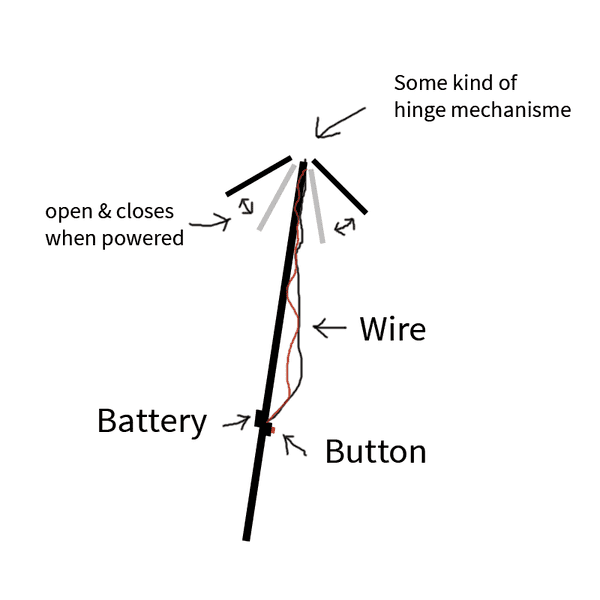
oI5xjxk.png

The button, battery and so on it not my problem, it's that I've no idea how to create this hinge mechanisme I want. As demonstrated I basically want to make something that can push a light tube up in a straight line when powered, there's going to be three of them where each one of them should have one of these hinge mechanisme. Feel freely to ask me more questions about my project, since I'm beginner and not sure where to start with anything regarding the hinge mechanisme. Thanks. :)
 
Engineering news on Phys.org
Artonn said:
Is it possible to control how slow and far they push out ?
I don't know, but probably not. My only experience with them was as a quarter turn actuator used to open and close a radioactive source shutter mechanism, and was an all-or-nothing affair.

Speed controllable linear and rotary actuators exist, in fact, rotary actuators are often used as valve positioners, but they are rather large, and on the expensive side for a hobby project. http://exlar.com/product/tritex-ii-rotary-actuator/ is one of the many manufacturers that make them.
 
Asymptotic said:
I don't know, but probably not. My only experience with them was as a quarter turn actuator used to open and close a radioactive source shutter mechanism, and was an all-or-nothing affair.

Speed controllable linear and rotary actuators exist, in fact, rotary actuators are often used as valve positioners, but they are rather large, and on the expensive side for a hobby project. http://exlar.com/product/tritex-ii-rotary-actuator/ is one of the many manufacturers that make them.

Ah damn, need something really small, compatc and cheap..
 
Depending upon the size and weight of the tube lights a gear motor for each light with a 90° clamp on the shaft end to hold the light might work. I don't know what level of cheap you need but a gear motor like the one on the below site might fall in your price range. You would still have to make the mounting for the motors to the shaft and the tube light mounts; but, if you know someone with a 3D printer then those items could be easily made at a low price. A push button switch would allow the user to control the angle of the lights.

https://www.sparkfun.com/products/12367
 
Not sure what the physical limits are - but in this 2D view it looks a little like a cross seciton of an umbrella. Are both of the moving arems to move at the same time? Both iup or both down?
 
Windadct said:
Not sure what the physical limits are - but in this 2D view it looks a little like a cross seciton of an umbrella. Are both of the moving arems to move at the same time? Both iup or both down?

Yes there's going to be three feathers, they are all going to expand or contract at the same time. I think i found something that can serve that purposes a servo. Since so far I know u can actually control how many degree it turns and can lock at the deciderede degree, the material it's going to lift will mostly be foam and worbla.
 
Perhaps look at what's available for model boats and cars. There are a wide range of servos and sail winches all of which have a standard electrical interface.
 
  • #10
I don't know if it's feasible for you, but pneumatics could do it, you can put flow controls on them and control the speed very nicely.. however stopping them at a precise location other than full travel is hard.. If it only has to do it a couple times, you could use a CO2 canister as an air source, small electric solenoid valves are available
 
  • #11
Artonn said:
Is it possible to control how slow and far they push out ?
Just use a Servo and a Microcontroller! You may want a larger servo based on the size of the piece you are moving, but these are fully programmable for speed and range:
https://www.sparkfun.com/products/11965
 
  • #12
Have you thought of just using a mechanical actuator? You could just have a spring with a trigger latch, damping could be done with a little oil filled cylinder.. would require a manual reset though
 

Similar threads

  • · Replies 36 ·
2
Replies
36
Views
4K
Replies
5
Views
1K
  • · Replies 4 ·
Replies
4
Views
2K
Replies
3
Views
2K
  • · Replies 5 ·
Replies
5
Views
3K
  • · Replies 14 ·
Replies
14
Views
5K
  • · Replies 3 ·
Replies
3
Views
2K
  • · Replies 11 ·
Replies
11
Views
437
Replies
7
Views
4K
  • · Replies 6 ·
Replies
6
Views
2K