lcr_melo
- 2
- 0
- TL;DR
- What is the impact of increasing power system loading on generator reactance? Should we consider synchronous generator reactance constant for each loading solved by power flow?
I have been studying the representation of generators in power flow studies and I would appreciate your comments in this thread.
From the book Fitzgerald & Kingsley's Electric Machinery, I understand that there are unsaturated and saturated reactances.
In section 5.3.2 of the book it is said: "For operation at or near rated terminal voltage, it is common to assume that the machine is equivalent to an unsaturated one with a linear magnetizing characteristic which starts at the origin and which passes through the rated-voltage point on the open-circuit characteristic ".
By this statement, I can assume that near the terminal voltage the reactance of the generator with the unsaturated value, which is approximately constant.
Here starts my question, as I am willing to perform power flow studies under different operating conditions.
My question is this: can I assume that under conditions other than terminal voltage, the generator has a variable reactance, such as the saturated reactance?
This will be important in the solutions of power flow study when I consider the reactive limit of the generators, as the terminal voltage will be allowed to vary. By varying the terminal voltage, I understand that the reactance will no longer be constant.
Is this reasoning correct?
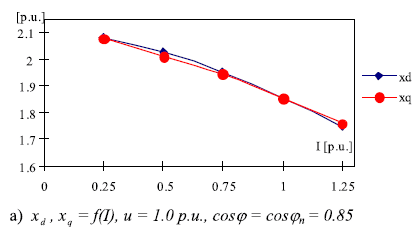
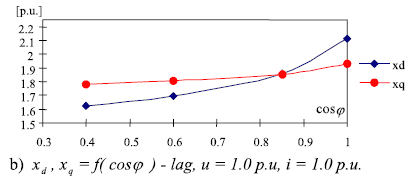
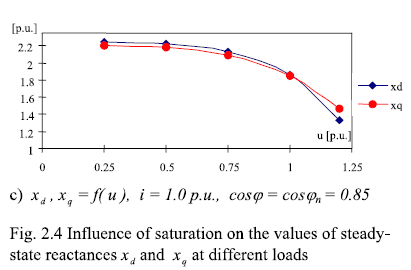
Also, I would like to add information obtained from the article "BAN, D .; ŽARKO, D.; MALJKOVIC, Z. The analysis of saturated reactances of the 247 MVA turbogenerator by using the finite element method": The saturation of the machines is different for each operative point. The values of the synchronous reactances in steady-state are to armature current, terminal voltage and power factor. In the figures below are shown the direct and quadrature reactances in function of armature current (I), power factor (cos phi) and terminal voltage (u).
Thank you very much for you help!
From the book Fitzgerald & Kingsley's Electric Machinery, I understand that there are unsaturated and saturated reactances.
In section 5.3.2 of the book it is said: "For operation at or near rated terminal voltage, it is common to assume that the machine is equivalent to an unsaturated one with a linear magnetizing characteristic which starts at the origin and which passes through the rated-voltage point on the open-circuit characteristic ".
By this statement, I can assume that near the terminal voltage the reactance of the generator with the unsaturated value, which is approximately constant.
Here starts my question, as I am willing to perform power flow studies under different operating conditions.
My question is this: can I assume that under conditions other than terminal voltage, the generator has a variable reactance, such as the saturated reactance?
This will be important in the solutions of power flow study when I consider the reactive limit of the generators, as the terminal voltage will be allowed to vary. By varying the terminal voltage, I understand that the reactance will no longer be constant.
Is this reasoning correct?
Also, I would like to add information obtained from the article "BAN, D .; ŽARKO, D.; MALJKOVIC, Z. The analysis of saturated reactances of the 247 MVA turbogenerator by using the finite element method": The saturation of the machines is different for each operative point. The values of the synchronous reactances in steady-state are to armature current, terminal voltage and power factor. In the figures below are shown the direct and quadrature reactances in function of armature current (I), power factor (cos phi) and terminal voltage (u).
Thank you very much for you help!

